The cryptocurrency market is currently navigating a complex period of transition, characterized by a notable divergence between aggregate market sentiment and the underlying trading behavior within the altcoin sector. While the broader digital asset landscape has been marred by months of selling pressure and a general sense of investor exhaustion, recent data from the blockchain analytics platform CryptoQuant suggests that a significant shift is occurring beneath the surface. This phenomenon is defined by a growing volume of trade in smaller-cap altcoins at a time when the overall market appears stagnant, signaling that a cohort of sophisticated market participants may be positioning themselves for a future rotation out of dominant assets like Bitcoin and into the broader altcoin ecosystem.
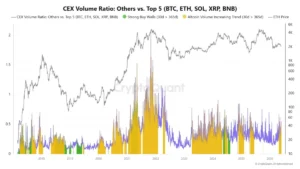
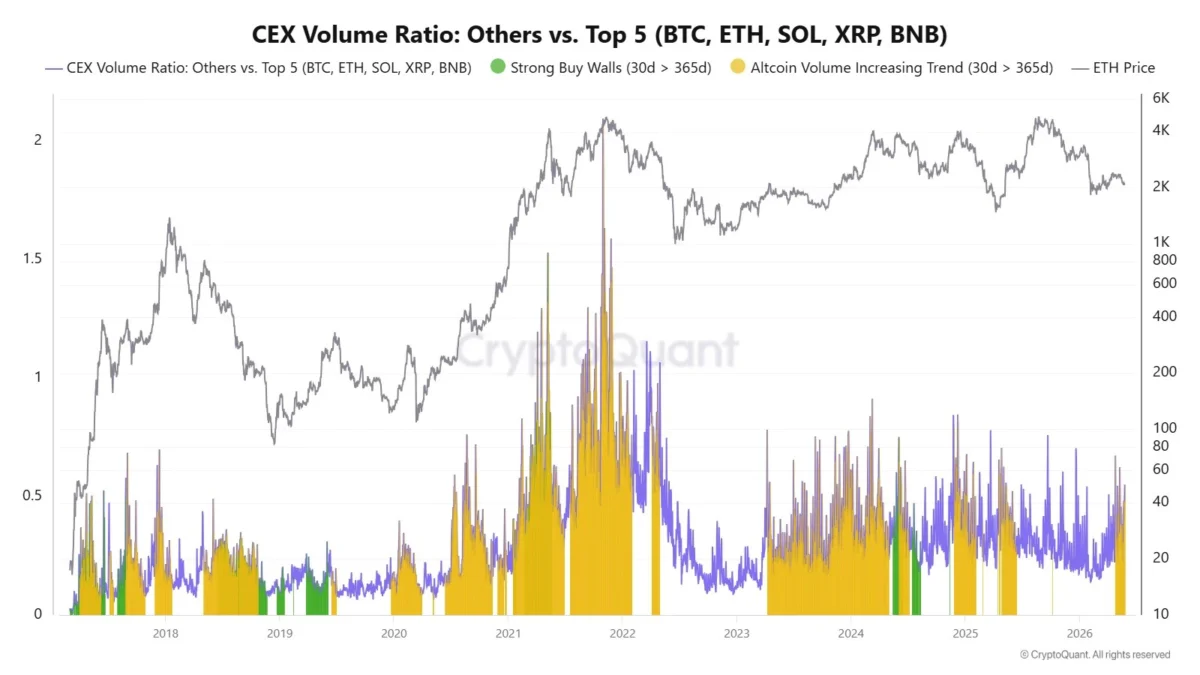
The current macro environment for digital assets remains challenging. Since the recovery attempts seen in early 2024, the market has largely entered a phase of sideways consolidation. This lack of clear directional momentum has led to a decline in overall trading volumes across major exchanges, as retail interest wanes and institutional focus remains primarily tethered to Bitcoin through the lens of Spot ETFs. However, the CryptoQuant analysis highlights a specific anomaly: exchange volume for altcoins—specifically those excluding the "Big Five" (Bitcoin, Ethereum, Solana, XRP, and BNB)—is on the rise. This segment, often referred to in market indices as "OTHERS," represents the more speculative and early-stage projects within the crypto space.
The Dynamics of Volume Divergence and Market Sentiment
In traditional and digital financial markets, a divergence between price action and volume often serves as a precursor to a trend reversal. In the current context, the "quietness" of the market is a reflection of the majority of participants being disengaged or fearful. Sentiment indices have consistently trended toward "Neutral" or "Fear" as the anticipated "Altcoin Season" of 2024 failed to materialize with the vigor of previous cycles. Despite this negativity, the fact that volume is concentrating in smaller assets suggests that the participants currently active in the market are making deliberate, conviction-based moves rather than reactive, emotion-driven trades.
This accumulation phase is occurring in a vacuum of retail enthusiasm. Historically, altcoin rallies are driven by a "wealth effect" where profits from Bitcoin flow down the risk curve into Ethereum, then large-caps, and finally into the "OTHERS" category. In the current cycle, this flow has been disrupted by the institutionalization of Bitcoin, which has kept capital locked within the BTC ecosystem. The rising volume in the OTHERS category, therefore, represents a break from the standard cycle mechanics, indicating that some investors are bypassing the traditional rotation order to find value in overlooked sectors.

Chronology of the Altcoin Downtrend and Stabilization Efforts
To understand the significance of the current volume uptick, it is necessary to examine the timeline of the altcoin market’s performance over the last 18 months. Following the collapse of several major crypto entities in 2022 and the subsequent "crypto winter," the market saw a brief resurgence in late 2023. This was largely fueled by the anticipation of the Bitcoin Halving and the approval of Spot Bitcoin ETFs in the United States.
- Q1 2024: The Bitcoin-Centric Rally: Bitcoin reached new all-time highs, but the majority of altcoins failed to reclaim their 2021 peaks. This created a massive gap in performance, leading to the "Bitcoin Dominance" (BTC.D) metric reaching multi-year highs.
- Q2 – Q3 2024: The Exhaustion Phase: As Bitcoin entered a range-bound period, altcoins suffered disproportionately. Many assets in the OTHERS category saw 50% to 70% drawdowns from their yearly highs, leading to widespread retail capitulation.
- Q4 2024 – Early 2025: The Sideways Consolidation: The market entered a period of extreme "boredom." Volatility reached historic lows for many altcoins, and trading volumes hit a trough.
- Current Period (February 2025 – Present): The Stealth Volume Divergence: While prices remain suppressed, CryptoQuant identifies the start of a consistent upward trend in OTHERS exchange volume relative to the top five assets.
This chronology illustrates a transition from aggressive selling to a "exhaustion bottom," where the sellers have been washed out, and the remaining activity is driven by accumulators.
Analyzing the OTHERS/BTC Ratio and Technical Stabilization
The OTHERS/BTC index is a critical metric for assessing the health of the broader altcoin market. It measures the total market capitalization of all cryptocurrencies excluding the top 10 assets, denominated in Bitcoin. This ratio has been in a persistent downtrend for over two years, confirming that Bitcoin has been a superior store of value and investment vehicle compared to the average altcoin.
Technical analysis of the OTHERS/BTC weekly chart reveals that the ratio is currently attempting to find a floor. After the aggressive declines of 2024, the index has transitioned into a horizontal consolidation phase near the 0.12 region. While the index remains below the 50-week, 100-week, and 200-week moving averages—indicating that the macro trend is still bearish—the "rate of change" in the decline has slowed significantly.
The defense of the 0.12 support level is particularly noteworthy. In technical terms, a prolonged sideways move following a steep decline often indicates "absorption," where large buyers are absorbing the remaining sell orders without pushing the price up significantly. The CryptoQuant data regarding rising volume supports this thesis; more shares (or tokens) are changing hands at these low levels, which is a classic sign of a bottoming process. If the OTHERS/BTC ratio can eventually reclaim the 50-week moving average, it would provide the first structural confirmation of a trend reversal in years.

The Role of Sophisticated Participants in a Quiet Market
The CryptoQuant report emphasizes that the current volume is not a "spike" but a "trend." This distinction is vital. Spikes are often the result of news-driven events or temporary hype, such as a specific memecoin trending on social media. A trend, however, suggests a systematic approach to capital deployment.
Market analysts infer that the entities behind this volume are likely "smart money" players—hedge funds, venture capital firms, and high-net-worth individuals—who operate on longer time horizons. These participants typically accumulate when sentiment is at its lowest and the "retail" crowd has checked out. By the time the general public becomes bullish on altcoins again, these early accumulators will have already established their positions at significantly lower cost bases.
Furthermore, the concentration of volume in assets outside the top five suggests a search for "alpha" or outsized returns. With Bitcoin and Ethereum becoming increasingly correlated with traditional equities and macro-economic indicators, smaller altcoins offer a different risk-reward profile that can decouple from the broader market under the right conditions.
Macroeconomic Factors and Inferred Reactions
The broader financial environment continues to play a pivotal role in crypto market dynamics. High interest rates in the United States and a strong Dollar Index (DXY) have historically been headwinds for risk-on assets like altcoins. However, as expectations for a pivot in Federal Reserve policy or a stabilization of global liquidity begin to firm up, the "risk-off" sentiment that has plagued the altcoin sector may begin to thaw.
While official statements from major financial institutions regarding smaller altcoins are rare, the actions of digital asset managers provide a proxy for institutional sentiment. We have seen a proliferation of specialized funds focusing on specific niches such as Decentralized Physical Infrastructure Networks (DePIN), Artificial Intelligence (AI) integration in blockchain, and Real-World Asset (RWA) tokenization. These sectors fall within the "OTHERS" category and are likely contributing to the volume divergence identified by CryptoQuant.

Industry experts, including analysts at CryptoQuant, suggest that the market is currently in a "wait-and-see" mode. The prevailing view is that while the technical structure for altcoins is still fragile, the behavioral data is preempting a shift. As one analyst noted, "The market is most dangerous when it is quiet, because that is when the most significant moves are being planned."
Broader Implications and Future Outlook
The implications of a potential altcoin resurgence are significant for the entire digital asset ecosystem. A healthy altcoin market encourages innovation, as it provides the liquidity and capital necessary for new projects to develop and scale. It also helps to decentralize the concentration of wealth within the crypto space, which has become increasingly centered on a few dominant assets.
However, investors must remain cautious. The "OTHERS" category is vast and includes thousands of projects, many of which lack fundamental value or long-term viability. The rising volume does not guarantee a "rising tide lifts all boats" scenario. Instead, it is more likely that we will see a "fragmented" recovery, where specific sectors with clear utility and adoption lead the way, while "ghost chains" and zombie projects continue to underperform.
The key indicators to watch in the coming months include:
- BTC Dominance (BTC.D): A sustained decline in BTC dominance would confirm that capital is indeed rotating.
- Stablecoin Inflows: An increase in the supply of stablecoins on exchanges would indicate that "dry powder" is being moved into the system to facilitate purchases.
- Moving Average Reclaims: On a technical level, the OTHERS/BTC ratio needs to break above its 50-week moving average to signal a change in macro momentum.
In conclusion, while the surface of the cryptocurrency market remains calm and characterized by a lack of enthusiasm, the data provided by CryptoQuant reveals a different story. The divergence between declining general sentiment and rising altcoin-specific volume suggests that a deliberate accumulation phase is underway. This behavior, coupled with the stabilization of the OTHERS/BTC ratio, points toward a market that is preparing for its next phase of evolution—one where the focus may finally shift from the dominance of Bitcoin to the diverse potential of the broader altcoin landscape.