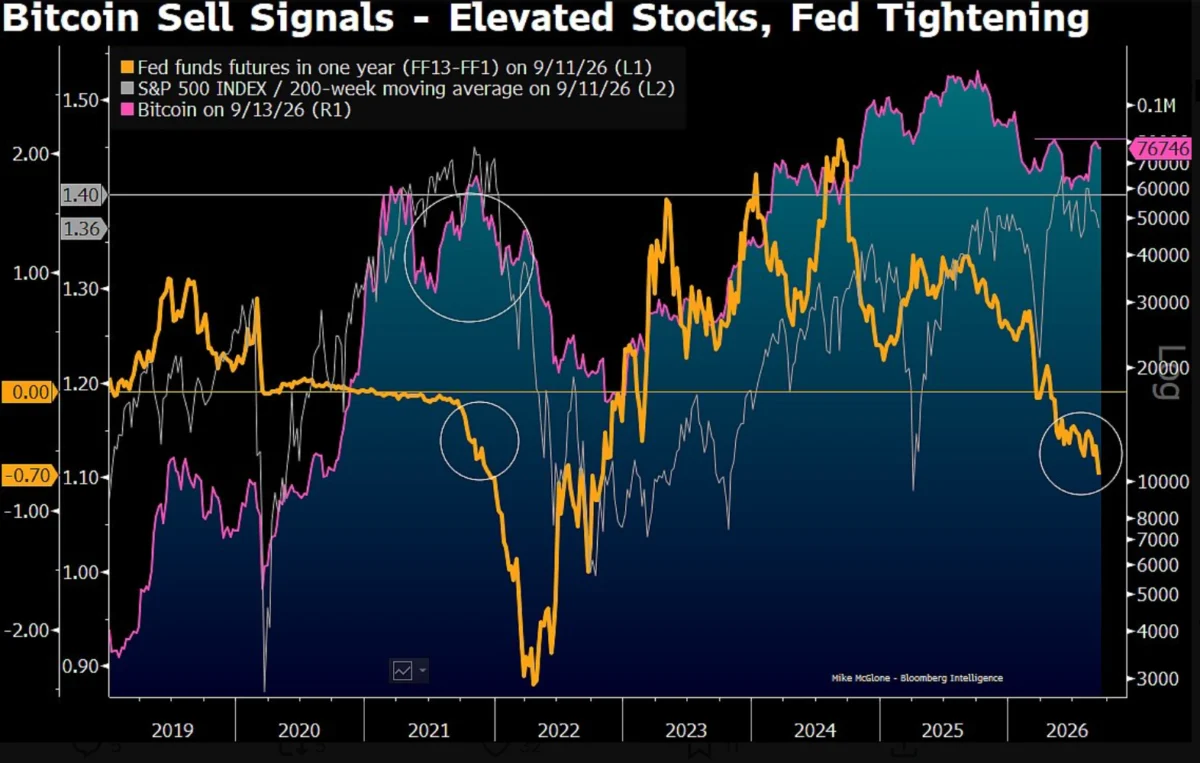
Bitcoin is increasingly shedding its identity as a safe-haven asset akin to "digital gold" and is now exhibiting behavior more characteristic of a high-risk stock market proxy, according to a recent analysis by Mike McGlone, senior macro strategist at Bloomberg Intelligence. This evolving market dynamic, McGlone suggests, could expose the cryptocurrency to significant downward pressure, particularly as monetary policy tightens and equity markets show signs of strain. The strategist posits that Bitcoin could experience a substantial decline, potentially reaching as low as $10,000, a forecast that has stirred considerable debate within the financial and cryptocurrency communities.
The assertion that Bitcoin’s correlation with traditional equities, specifically the S&P 500, has intensified is a central theme in McGlone’s assessment. Over the past five years, Bitcoin’s price movements have often mirrored those of the benchmark stock index, albeit with considerably higher volatility, nearly tripling the S&P 500’s fluctuations. From a risk management perspective, this trend presents a challenging proposition for investors. If Bitcoin continues to deliver returns akin to equities while simultaneously bearing substantially greater risk, its appeal as a diversified investment asset diminishes. McGlone argues that Bitcoin has effectively become the "beta" asset within the broader cryptocurrency market, meaning its performance is highly sensitive to the overall market sentiment. With millions of other digital assets vying for investor capital, a downturn in the wider speculative market could disproportionately impact Bitcoin, amplifying its downside potential as investors de-risk their portfolios.
Factors Signaling Potential Bitcoin Decline
McGlone identifies three primary reasons that contribute to his bearish outlook on Bitcoin’s short-to-medium term trajectory:
1. Intensifying Correlation with U.S. Equities
The strategist highlights the growing interdependence between Bitcoin and the S&P 500 as a significant concern. Historically, Bitcoin was often lauded for its potential to decouple from traditional financial markets, offering a hedge against inflation and geopolitical instability. However, recent market behavior suggests this decoupling has largely failed to materialize. The S&P 500, a broad index representing the performance of 500 of the largest publicly traded companies in the United States, has become a key indicator for Bitcoin’s price action. When the stock market experiences upward momentum, Bitcoin often follows, and conversely, a sell-off in equities tends to drag Bitcoin down with it. This correlation means that any systemic risks or negative sentiment affecting the stock market are likely to translate into increased volatility and potential price drops for Bitcoin.
Furthermore, McGlone points to the technical indicators within the S&P 500 itself as a warning sign. He notes that U.S. equities appear to be trading at valuations that are significantly extended when measured against their long-term trend. Specifically, the S&P 500’s distance from its 200-week moving average, a widely followed technical indicator, suggests that the stock market may be poised for a substantial correction. Given Bitcoin’s increased sensitivity to equity market movements, a sustained decline in stocks could exert considerable downward pressure on BTC, potentially leading to a more pronounced sell-off than typically observed in prior market cycles.

2. The Federal Reserve’s Monetary Policy Tightening
The monetary policy stance of the U.S. Federal Reserve (the Fed) represents another significant headwind for Bitcoin and other risk assets. In response to persistent inflation, the Fed has signaled its intention to raise interest rates and reduce the size of its balance sheet, a process known as quantitative tightening. Fed funds futures, which reflect market expectations for future interest rate movements, indicate a strong probability of multiple rate hikes over the coming year. Such a shift towards tighter monetary conditions typically makes borrowing more expensive and reduces the amount of liquidity in the financial system.
Historically, periods of rising interest rates have been challenging for speculative assets like cryptocurrencies. As the cost of capital increases, investors tend to move away from higher-risk, higher-return investments and toward safer, fixed-income assets that offer more predictable returns. This reallocation of capital can lead to a decrease in demand for cryptocurrencies, putting downward pressure on their prices. McGlone’s analysis suggests that if the Fed continues to pursue a hawkish monetary policy, the environment for Bitcoin and other speculative investments will become increasingly unfavorable, potentially exacerbating any existing downturns.
3. Technical Indicators and Historical Patterns
McGlone also draws attention to specific technical signals within Bitcoin’s price history. He points to the cryptocurrency’s recent rebound towards the $80,000 resistance area as a potential warning sign, rather than an indication of a renewed bull market. In his view, this upward movement might represent a temporary bounce before another significant leg lower. This perspective aligns with common market analysis that identifies brief rallies within broader downtrends as potential opportunities for sellers to exit positions or for short-sellers to re-enter the market.
The strategist’s most bearish scenario envisions Bitcoin descending towards its long-standing pivot around the $10,000 mark. He posits that a sustained decline of approximately 20% in the S&P 500 could potentially trigger a much deeper sell-off in Bitcoin. This projection is informed by historical relationships between Bitcoin and broader risk assets, where significant downturns in traditional markets have often led to amplified losses in the cryptocurrency space.
Contextualizing the $10,000 Target
To comprehend the magnitude of McGlone’s $10,000 forecast, it is essential to consider Bitcoin’s current valuation. As of Sunday, with Bitcoin trading around $77,300, a drop to $10,000 would represent a staggering decline of approximately 87%. CoinGecko data indicates that at this price level, Bitcoin’s market capitalization would shrink to roughly $200 billion, a stark contrast to its then-current valuation of approximately $1.55 trillion. This projection stands in stark contrast to Bitcoin’s all-time high of $126,080 reached in October, following which it had already experienced a significant plunge of around 38.6%. McGlone’s outlook suggests that the preceding decline may have been merely a precursor to a more profound correction.
Broader Implications and Market Sentiment

The shift in Bitcoin’s market behavior from "digital gold" to a high-beta asset has profound implications for investors. For those who have traditionally viewed Bitcoin as a hedge against inflation or a store of value independent of traditional markets, this evolving correlation presents a significant challenge. It implies that Bitcoin’s price is increasingly susceptible to the same macroeconomic forces and investor sentiment that influence equities.
The broader cryptocurrency market, which often moves in tandem with Bitcoin, would likely experience even more severe downturns if McGlone’s predictions materialize. Altcoins, which are generally more volatile and less established than Bitcoin, could see their values decimated. This could lead to a significant consolidation within the digital asset space, with only the most resilient projects surviving.
The commentary from a prominent strategist like Mike McGlone also contributes to shaping market sentiment. His bearish outlook, disseminated through various financial news channels and social media, can influence investor behavior. Fear and uncertainty can lead to a rush for the exits, further accelerating any downward price momentum. Conversely, such predictions can also serve as a catalyst for contrarian investors who may see a potential decline as an opportunity to accumulate assets at lower prices.
New York Mayor’s Bitcoin Paycheck Amidst Market Volatility
While McGlone’s analysis paints a potentially bleak picture for Bitcoin’s immediate future, it is worth noting the broader context of cryptocurrency adoption. In a separate development, New York City Mayor Eric Adams made headlines by opting to receive his first three paychecks in Bitcoin. This decision, announced in November 2021, was hailed as a significant step towards mainstream adoption of cryptocurrencies. Adams stated his intention to hold the Bitcoin, signaling confidence in its long-term value despite its inherent volatility.
The timing of his paycheck conversion, however, coincided with a period of considerable market turbulence for Bitcoin. The cryptocurrency experienced significant price swings shortly after the mayor’s announcement. Despite these immediate market fluctuations, Adams and his supporters have maintained a long-term perspective, emphasizing the potential of digital currencies and the need for cities and governments to explore and embrace technological innovation. His stance suggests a belief in the fundamental value proposition of Bitcoin, irrespective of short-term market corrections. This highlights a divergence in perspective: while analysts like McGlone focus on immediate market dynamics and potential downside risks, proponents of cryptocurrency adoption, like Mayor Adams, often emphasize the long-term potential and transformative capabilities of the technology.
The contrasting narratives – one of potential market collapse driven by macroeconomic factors and asset correlation, and another of bold adoption and long-term vision – underscore the complex and often contradictory landscape of the cryptocurrency market. As Bitcoin continues to mature and integrate further into the global financial system, its relationship with traditional markets and its role as a potential store of value will remain subjects of intense scrutiny and debate. McGlone’s analysis serves as a stark reminder of the inherent risks associated with volatile assets, particularly during periods of economic uncertainty and monetary policy shifts.