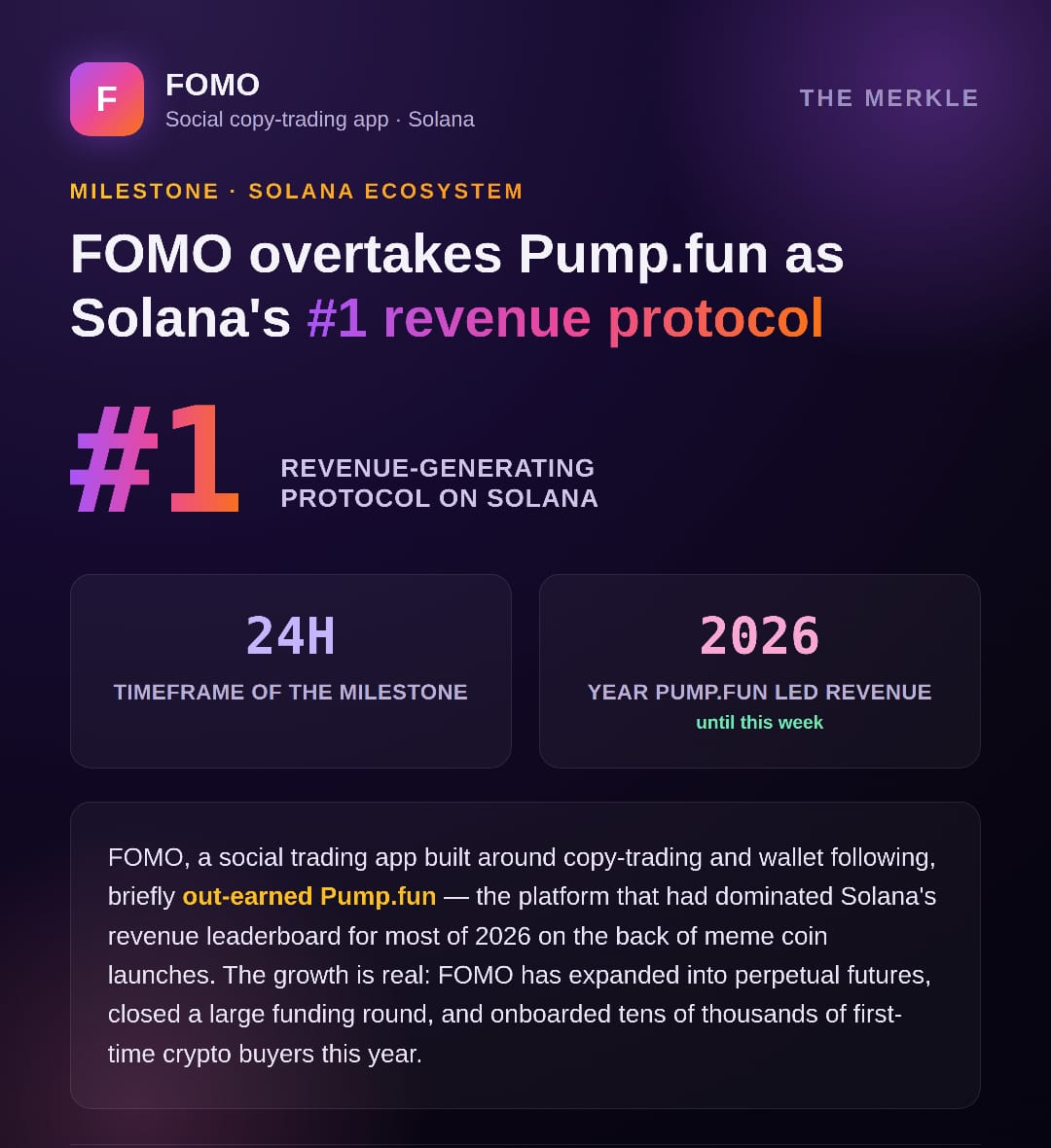
A notable dissonance has emerged in the Solana blockchain ecosystem, where the social trading application FOMO recently announced a significant milestone: becoming the top revenue-generating protocol on Solana over a 24-hour period, a position typically held by the prominent meme coin launchpad, Pump.fun. This achievement, proudly touted by FOMO’s cofounder, has been met with a stark counter-narrative from within the crypto community, alleging that a substantial majority of the platform’s users are experiencing financial losses. This juxtaposition of corporate celebration and reported widespread user deficit highlights a critical, and often uncomfortable, tension inherent in certain high-frequency trading models within the volatile cryptocurrency market. The unfolding situation has ignited discussions regarding platform transparency, the ethical implications of revenue generation, and the broader sustainability of social trading applications built on a fee-driven framework.
The immediate genesis of this narrative conflict centers on a public declaration of success from FOMO’s leadership, specifically its cofounder, following the protocol’s reported surpassing of Pump.fun in daily revenue. This particular metric, tracked diligently by entities such as Solana Floor, indicates a remarkable surge in activity and fee generation for FOMO. Pump.fun, for much of the current year, has maintained a comfortable lead on Solana’s revenue leaderboards, largely powered by its unique model facilitating the rapid creation and trading of meme coins. For FOMO, an application designed around social trading features such as copy-trading, wallet following, and real-time trade feeds, to briefly outstrip such an established leader signifies a significant, if fleeting, shift in the Solana ecosystem’s economic dynamics. The achievement itself is not contested as manufactured; FOMO has demonstrably been on a steep growth trajectory throughout the year, expanding its offerings to include perpetual futures trading, successfully closing a substantial funding round, and attracting tens of thousands of new crypto participants through streamlined onboarding processes. The revenue figures, therefore, are widely accepted as authentic. However, the celebration surrounding these figures has been profoundly complicated by a series of pointed observations from a crypto trader identified as Seyoung, who publicly questioned the nature of this revenue and its cost to the platform’s user base.
The Solana Ecosystem’s Dynamic Landscape
To fully appreciate the significance of FOMO’s reported revenue surge, it is crucial to understand the vibrant and rapidly evolving landscape of the Solana blockchain. Solana has, in recent years, emerged as a formidable competitor in the Layer-1 blockchain space, lauded for its high transaction throughput, low fees, and robust developer ecosystem. This technical prowess has fostered a fertile ground for innovation, attracting a diverse array of decentralized applications (dApps) spanning DeFi, NFTs, and, notably, meme coins. The latter, in particular, has seen explosive growth on Solana, driven by a combination of speculative fervor and the network’s efficiency in handling rapid, high-volume trading.
Pump.fun stands as a prime example of this phenomenon. As a decentralized application that enables users to launch meme coins directly onto the Solana blockchain with minimal technical expertise and upfront capital, it has become a central hub for speculative activity. Its revenue model primarily derives from a small percentage of fees on transactions and liquidity provision for these newly launched tokens. Its consistent top-tier performance on Solana’s revenue charts underscores the immense appetite for meme coin trading and the efficiency with which such platforms can capture value from this activity.
FOMO, while operating within the same Solana ecosystem, represents a different facet of crypto engagement: social trading. This model, which gained traction in traditional finance through platforms like eToro, allows users to observe, learn from, and even automatically replicate the trades of more experienced or successful investors. In the crypto sphere, where market movements can be exceptionally swift and complex, the appeal of "copying" perceived experts or following "alpha" traders is substantial. FOMO’s design, with its real-time trade feeds and simplified interface, aims to lower the barrier to entry for retail investors into sophisticated trading strategies, including perpetual futures, which are high-risk derivatives. The platform’s expansion, funding rounds, and user acquisition efforts prior to this revenue milestone illustrate its ambition to carve out a significant niche in this competitive environment, leveraging Solana’s underlying infrastructure.
The Uncomfortable Juxtaposition: Profit vs. Loss
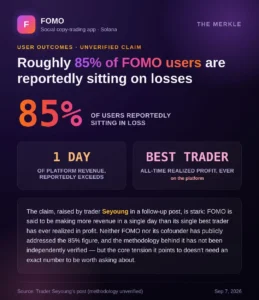
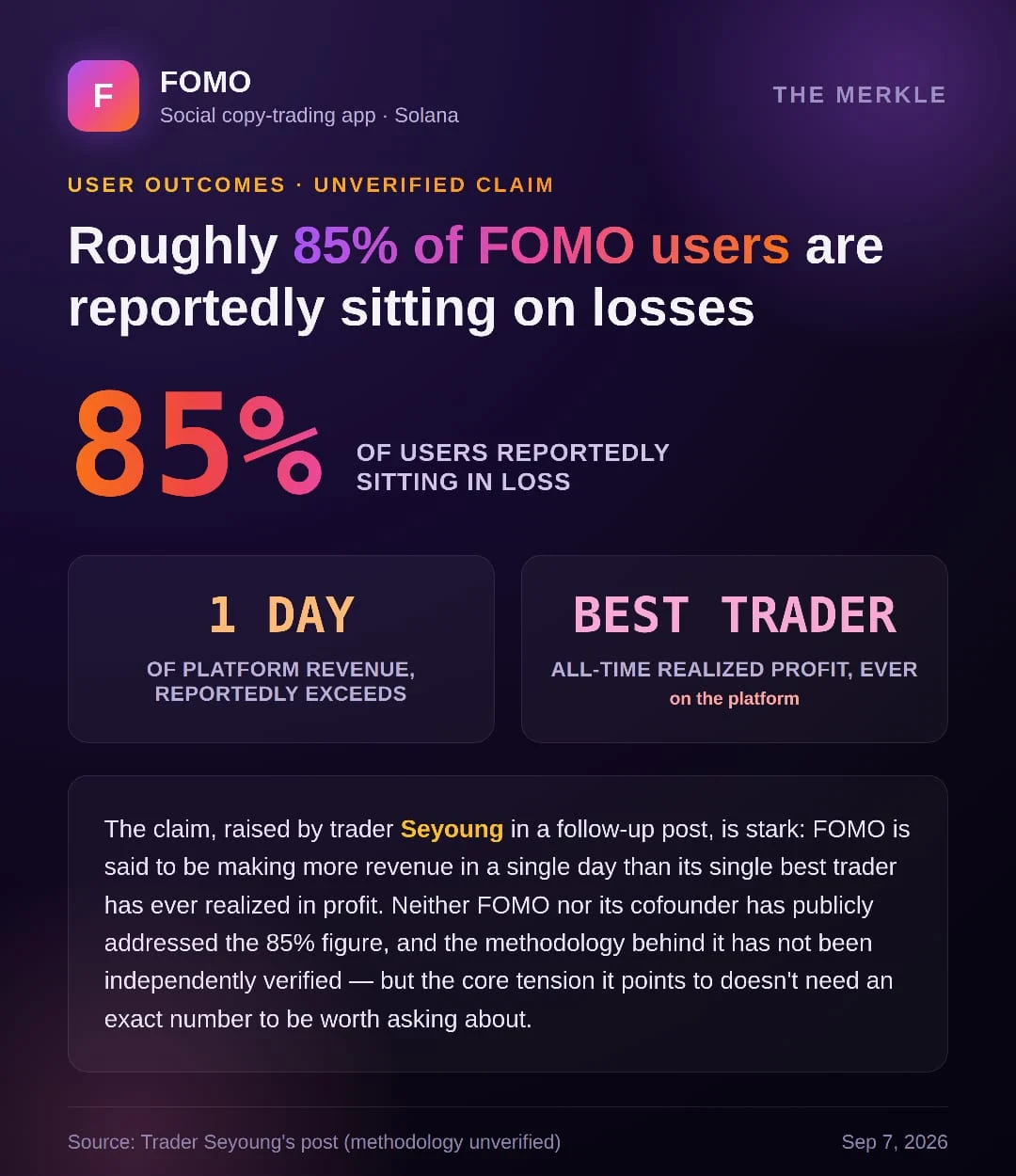
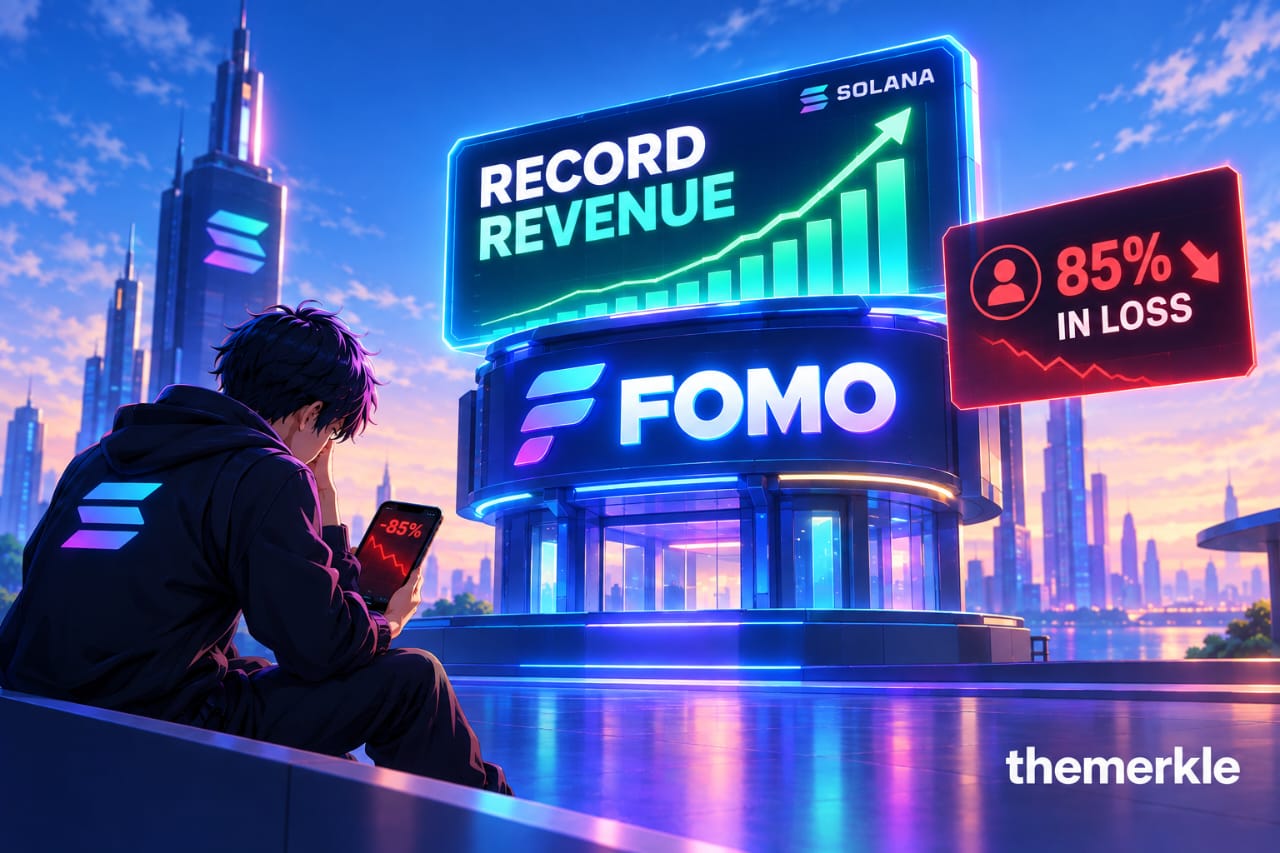
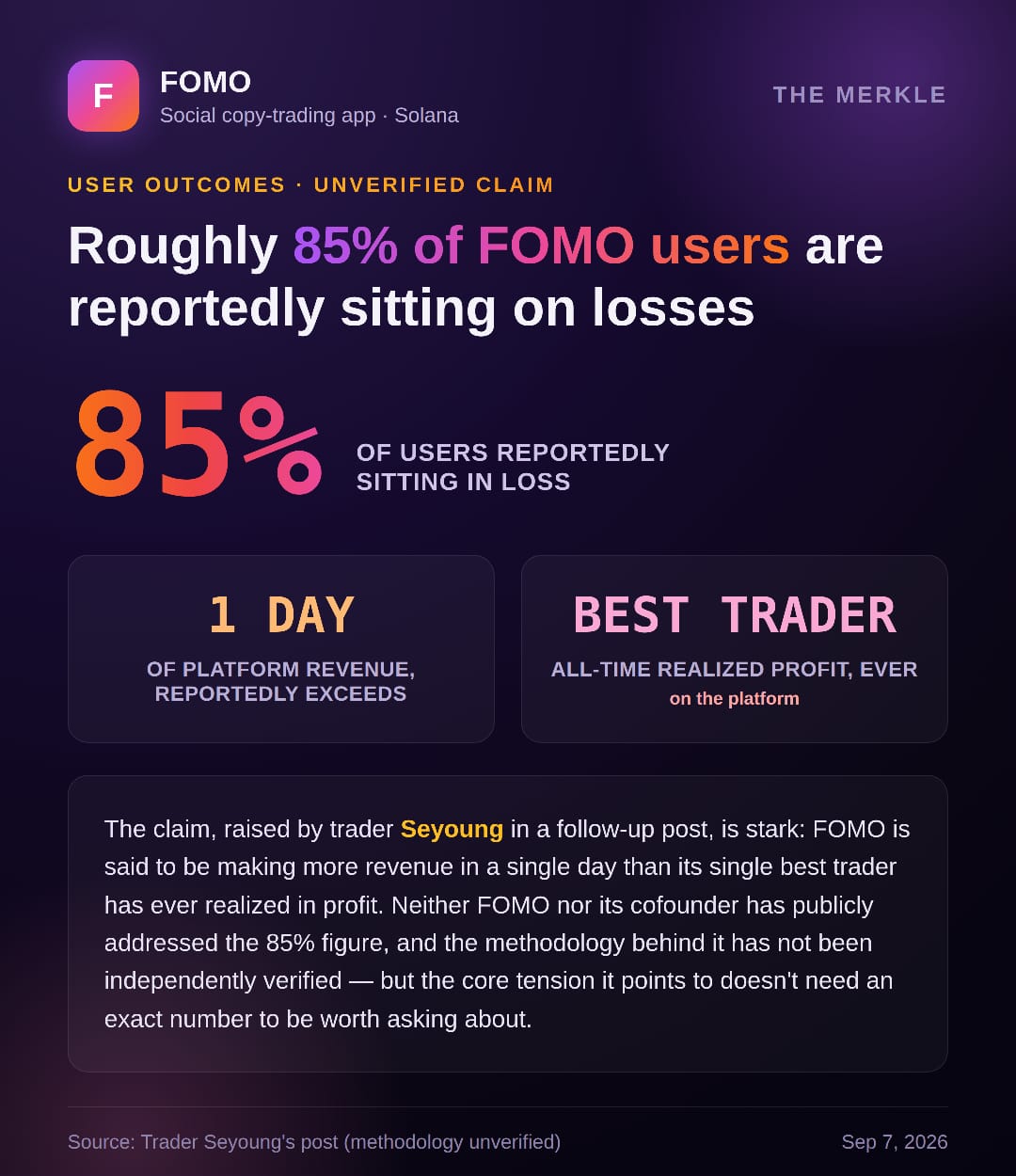
The celebratory tone from FOMO’s cofounder was quickly met with a sobering reality check by crypto trader Seyoung. In a follow-up post that gained considerable attention, Seyoung explicitly challenged the platform’s public triumph by presenting data suggesting a stark contrast between FOMO’s financial success and the financial outcomes of its users. The central claim was that approximately 85% of FOMO’s user base is reportedly experiencing losses. This figure, while currently unverified by independent third parties, casts a long shadow over the revenue milestone, forcing a reevaluation of what "success" truly means in this context.
Further compounding this discomfort was Seyoung’s additional assertion: that FOMO’s single-day revenue had surpassed the highest profit ever realized by any individual trader on its platform. If accurate, this comparison is profoundly jarring. It implies a fundamental imbalance where the collective financial contribution of the user base, leading to platform revenue, far outstrips the maximum individual gain any user has ever achieved. Such a scenario transcends mere imbalance; it verges on an indictment of the entire business model, raising questions about whether the platform’s design inadvertently prioritizes its own financial gains over the financial well-being of its participants.
The phrase "the extraction machine churns," used by Seyoung, encapsulates this critical perspective. It suggests a mechanism where value is systematically drawn from the user base, regardless of individual trading outcomes, to fuel the platform’s growth. While a trading platform earning revenue from fees is a standard operational model across all financial markets – every exchange and brokerage operates this way – the critical distinction arises when the overwhelming majority of users are reportedly losing money while the platform itself achieves record-breaking revenue. In such a scenario, the traditional perception of a "service charge" begins to morph into something more akin to the "actual product," implying that the user’s continuous trading, and thus fee generation, is the primary driver of value for the platform, rather than facilitating profitable trades for its users.
Deconstructing FOMO’s Fee Model and its Impact
Understanding the mechanics behind this alleged dynamic necessitates a closer look at FOMO’s specific fee structure. The platform operates on a flat $1 fee per trade. On the surface, this model appears straightforward and transparent, avoiding complex percentage-based calculations that can be difficult for new users to grasp. However, this simplicity carries specific and profound consequences, particularly in the context of a social trading application.
A flat per-trade fee disproportionately impacts smaller trades. For instance, a $100 trade incurs the same $1 fee as a $1,000 trade, meaning the fee represents 1% of the larger trade but a staggering 10% of the smaller one. This structure immediately disadvantages users with smaller capital, who are often precisely the target demographic for simplified onboarding and social trading platforms. More critically, the flat fee also disproportionately punishes frequent traders. Social trading apps, by their very design, actively encourage frequent trading. The real-time feed of other users’ moves, the ability to instantly mirror trades, and the inherent "fear of missing out" (FOMO, ironically) all create a constant psychological pressure to engage more often, to chase whatever asset is showing momentum. Each of these reactive trades, regardless of its size or eventual outcome, costs the user a flat dollar. This means the platform generates a steady, predictable stream of revenue, entirely independent of whether the underlying trades are profitable or result in losses for the individual user.
This mechanical explanation forms the bedrock of Seyoung’s critique. A platform meticulously engineered to foster frequent, reactive trading, combined with a flat per-trade fee that monetizes every single transaction irrespective of its success, creates a powerful engine for platform revenue. In this model, the platform’s growth and the users’ losses are not merely in tension; they can be seen as two inextricably linked facets of the same economic system. The platform profits from the activity of trading, while the users bear the full risk of the outcome of those trades, often compounded by fees that erode potential gains or accelerate losses.
Broader Context: A Recurring Pattern in Retail Trading
It is important to contextualize this specific situation within the broader landscape of retail trading. The dynamic where a trading platform generates substantial revenue while a majority of its users incur losses is not unique to FOMO, nor is it exclusive to the cryptocurrency market. This pattern is well-documented across various retail trading segments, including traditional stock brokerages, forex trading platforms, and Contracts for Difference (CFD) providers. Numerous studies and disclosures from these regulated entities consistently reveal that a significant percentage, often ranging from 70% to 90%, of retail traders lose money over time.
In traditional finance, the economic models of many brokerages are built around trading volume. Whether through spreads, commissions, or other fees, these platforms are structured to benefit from frequent transactions. High-frequency trading firms, for instance, profit from minuscule price differences on an enormous volume of trades. Similarly, market makers on exchanges profit from the bid-ask spread, effectively earning from every transaction regardless of whether the individual traders involved make a profit or loss. While these mechanisms are fundamental to market liquidity, they also illustrate how the infrastructure provider can thrive even as individual participants face an uphill battle.
In the crypto space, this dynamic is arguably amplified by increased volatility, reduced regulatory oversight in many jurisdictions, and the speculative nature of many assets. Meme coin launchpads, for example, generate revenue from the sheer volume of new token creations and subsequent trading, often in highly illiquid and manipulated markets where retail investors are particularly vulnerable. The "gamification" of trading, with social feeds, leaderboards, and simplified interfaces, can further exacerbate this by encouraging impulsive decisions and over-trading, which directly benefits platforms with volume-based fee structures. The timing of FOMO’s public celebration, juxtaposed with the damning statistic regarding user losses, created a "bad look" precisely because it shone a spotlight on this often-unspoken tension that exists throughout the retail trading industry. The fact that the underlying business model is not entirely novel does not diminish the ethical implications when such a stark disparity is brought to the fore.
Official Responses and the Quest for Verification
As of the latest reports, neither FOMO nor its cofounder has publicly addressed the specific 85% user loss claim put forth by Seyoung. This silence, while perhaps strategic from a corporate perspective, inevitably contributes to speculation and leaves the allegations largely unchallenged in the public discourse. In the absence of an official statement, the crypto community is left to weigh the reported revenue success against the unverified but impactful claims of widespread user losses.
It is crucial to approach the 85% loss figure with appropriate caution. The methodology behind such a statistic, when presented by an individual trader rather than an independent auditor or the platform itself, is inherently subject to scrutiny. Questions arise regarding the sample size, the definition of "loss" (realized vs. unrealized, short-term vs. long-term), the period over which losses are calculated, and the representativeness of the data. Without independent verification, the exact precision of the figure remains an open question. However, the broader question it raises – why a platform would celebrate record revenue while a significant portion of its community is reportedly losing money at scale – remains profoundly relevant, irrespective of the precise percentage. The fundamental divergence between "the platform is thriving" and "the users are thriving" constitutes the core of this ongoing narrative.
In the future, one might anticipate that FOMO could offer a counter-narrative. This might include emphasizing the high-risk nature of crypto trading, stating that individual trading outcomes are ultimately the responsibility of the users, highlighting the educational tools or risk management features available on the platform, or even presenting alternative profitability data. However, for now, the prevailing public perception is shaped by the stark contrast between the celebratory announcement and the critical allegations.
Implications for User Trust and the Future of Social Trading
The current situation carries significant implications for FOMO, its user base, and the broader social trading segment within the cryptocurrency market. For FOMO itself, the incident risks eroding user trust and damaging its reputation. In an industry where trust and community sentiment are paramount, being perceived as an "extraction machine" can have long-lasting negative consequences, potentially impacting user retention and future growth. While the platform has demonstrated impressive growth, sustaining that trajectory may prove challenging if a significant portion of its user base feels exploited or consistently unprofitable.
Beyond FOMO, this episode raises critical questions about the ethical responsibilities of social trading platforms. While they offer tools and opportunities, the inherent design, especially when paired with certain fee structures, can create incentives that do not align with user profitability. This could lead to increased scrutiny from consumer advocates, financial journalists, and potentially, regulators. As the crypto industry matures, there is a growing demand for greater transparency, stronger consumer protections, and business models that demonstrate a more equitable distribution of value. Platforms that appear to thrive disproportionately from user losses may face pressure to re-evaluate their fee structures, enhance risk disclosures, or implement features that genuinely promote more sustainable trading practices.
For active FOMO users, or those considering joining, the primary takeaway is not necessarily that the platform is fraudulent, nor that its revenue figures are fabricated. Instead, it serves as a stark reminder that the app’s entire design – a social feed encouraging frequent copy-trading, paired with a flat per-trade fee – structurally benefits from trading volume far more reliably than it benefits from individual trading success. Internalizing this distinction is crucial before getting swept up in the excitement of watching other traders’ wins scroll past in real-time. A platform achieving a record-breaking day in revenue provides no inherent guarantee that the next trade a user copies will be profitable. This incident underscores the importance of individual due diligence, understanding the underlying economics of any trading platform, and recognizing that in high-risk environments, platforms often profit regardless of individual user outcomes. The gap between "the platform is thriving" and "the users are thriving" is the actual story here, and right now, based on publicly shared information, those two things appear to be moving in starkly opposite directions.
Disclosure: This is not trading or investment advice. Always do your research before buying any cryptocurrency or investing in any services.