
Anthropic, a leading artificial intelligence safety and research company, has announced the release of Claude Opus 5.5, the inaugural model in its new Claude 5.5 family, marking a significant advancement in the competitive landscape of large language models (LLMs). Unveiled on Tuesday, this latest iteration is positioned to rival the performance of the company’s existing flagship model, Claude Fable 5.1, across a broad spectrum of tasks, yet introduces a compelling economic advantage: it operates at a considerably lower cost. This strategic move by Anthropic signals a deepening commitment to democratizing access to cutting-edge AI capabilities while navigating the complex ethical considerations inherent in rapid technological progress.
Anthropic’s Latest Innovation: Claude Opus 5.5 Unveiled
The introduction of Claude Opus 5.5 is not merely an incremental update; it represents a pivotal shift in Anthropic’s product strategy, aiming to deliver top-tier performance at a significantly reduced operational cost. This model is the most advanced in its version (5.5, surpassing Fable 5.1) and belongs to the Opus family, which denotes Anthropic’s largest and most capable publicly available models, followed by Sonnet and Haiku. The company asserts that Opus 5.5 achieves performance levels comparable to Fable 5.1, its previously priciest and most sophisticated offering, across a majority of tasks.
Performance vs. Cost: A Strategic Balancing Act
The core innovation driving Opus 5.5 lies in its enhanced efficiency. Developers and enterprises can now access near-flagship performance while incurring substantially lower operational expenses. Specifically, running Opus 5.5 is 20% cheaper than its predecessor, Opus 5, and an impressive 60% more cost-effective than the state-of-the-art Fable 5.1. This aggressive pricing strategy, coupled with robust capabilities, positions Opus 5.5 as a highly attractive option for a wide range of applications, from complex coding tasks to sophisticated content generation and analytical operations. Anthropic acknowledges that while benchmark scores might suggest a narrow gap between Fable and Opus, the public availability and superior cost-per-token ratio of Opus 5.5 make it the preferred choice for a majority of Claude users seeking an optimal balance of power and economy.
The Claude 5.5 Family and its Predecessors
The launch of Opus 5.5 follows a dynamic period of model development and release from Anthropic. The Claude family of models is tiered by capability and size: Opus represents the largest and most powerful, Sonnet offers a balance of capability and speed, and Haiku is designed for quick, lightweight tasks. This hierarchical structure allows users to select models best suited for their specific needs and budget constraints.
A brief chronology illuminates the rapid evolution within Anthropic’s offerings:
- July (Year Unspecified but prior to this announcement): Claude Opus 5 was launched. At the time, it aimed to underprice and outperform Fable 5 (an earlier version of the flagship) on most benchmarks, marking a significant competitive play.
- Early September (Year Unspecified but recent): Claude Fable 5.1 arrived. This update reversed the earlier dynamic, with Fable 5.1 surpassing Opus 5 on every benchmark published by Anthropic, reasserting its position as the top-tier model.
- Tuesday (Recent): Claude Opus 5.5 is released. This latest model again closes the performance gap with Fable 5.1, primarily through its enhanced efficiency and significantly lower pricing, rather than solely relying on raw benchmark supremacy.
This back-and-forth in performance and pricing between the Opus and Fable lines highlights the intense innovation and competition within the LLM space, where companies are constantly refining their models to offer better value and performance.
Deep Dive into Performance Metrics and Benchmarks
Anthropic’s commitment to delivering highly capable AI is evident in the detailed benchmarking provided for Claude Opus 5.5, particularly its prowess in agentic coding and complex professional tasks. The company emphasizes these areas as critical indicators of a model’s real-world utility and sophistication.

Agentic Coding: A Key Differentiator
A significant focus for Anthropic, and indeed for the broader AI industry, is the development of "agentic AI." This refers to models capable of taking multi-step actions autonomously, moving beyond merely responding to single prompts. Agentic AIs can plan, execute, monitor, and adapt their strategies to achieve complex goals, making them invaluable for tasks requiring extended reasoning and interaction with tools or environments. Anthropic measures much of its progress through agentic coding, where an AI agent undertakes complex programming tasks independently. This capability is particularly relevant for automating software development, data analysis, and intricate system management.
Terminal-Bench and FrontierCode: Quantifying Agentic Prowess
To assess agentic capabilities, Anthropic utilizes specialized benchmarks:
- Terminal-Bench 4.0: This benchmark evaluates an agent’s ability to complete complex professional tasks within a command-line interface. Scores are represented as a percentage of tasks successfully completed. Claude Opus 5.5 achieved an impressive 66.4% on Terminal-Bench 4.0. This significantly outperforms Fable 5.1, which scored 55.8%, and even surpasses OpenAI’s GPT-6 Astra, which recorded 57.9%. This indicates Opus 5.5’s superior ability to navigate and execute multi-step operations in a technical environment.
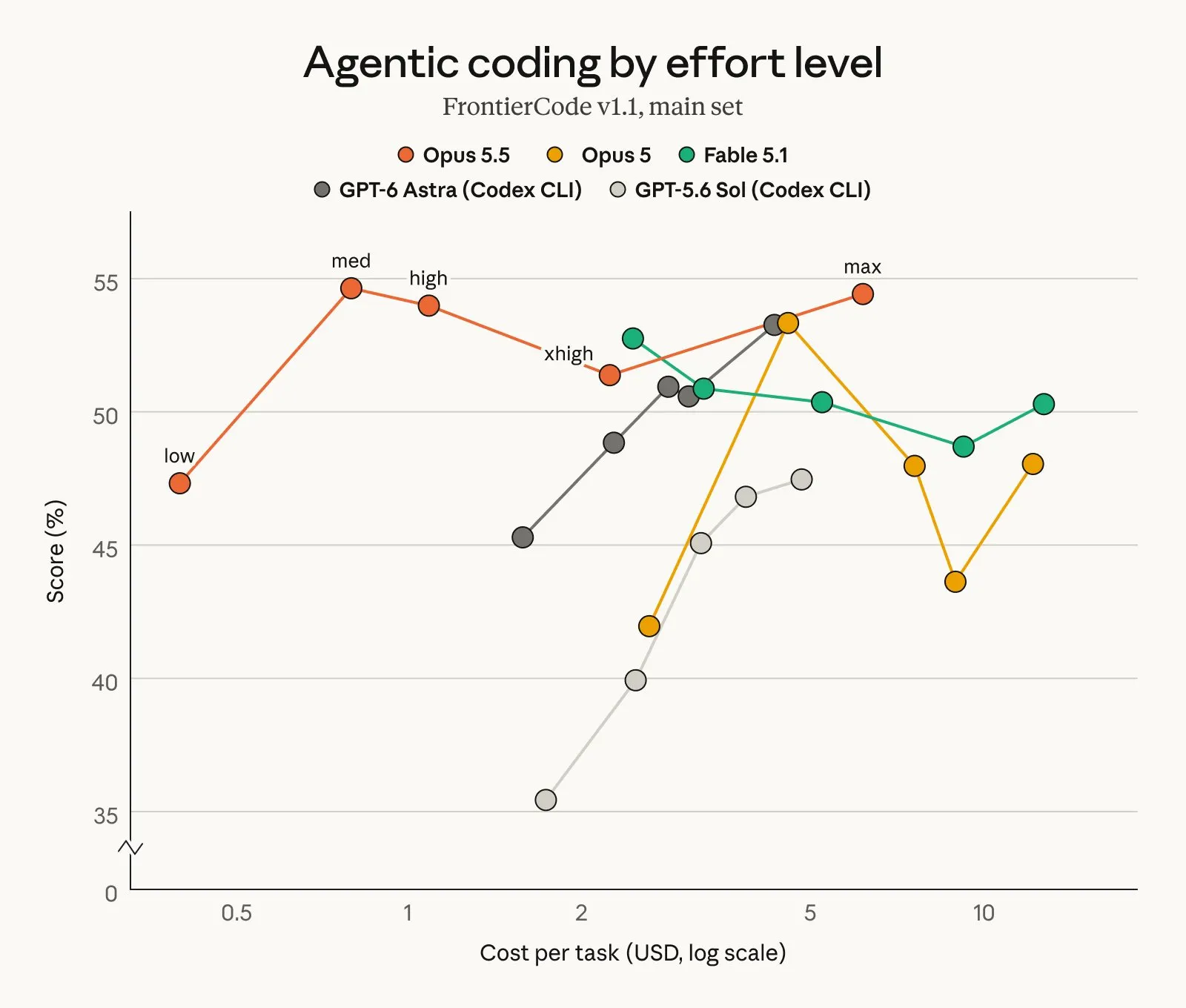
- FrontierCode: This benchmark goes a step further by checking whether an agent’s proposed code changes would actually be merged into a real engineering pipeline, using a pass-rate scoring system. On FrontierCode, Opus 5.5 scored 54.4%, again outperforming Fable 5.1’s 50.3%. This metric speaks directly to the practical utility and quality of the code generated by the AI, a crucial factor for software development teams.
These results demonstrate Opus 5.5’s robust capabilities in complex, multi-step coding scenarios, positioning it as a powerful tool for developers and engineering teams looking to leverage AI for enhanced productivity and automation.
Real-World Professional Tasks: GDPval-AA v2.1
Beyond coding, the utility of advanced LLMs extends to a wide array of professional occupations. The GDPval-AA v2.1 benchmark grades real-world professional work across 44 distinct occupations. Unlike percentage-based scores, GDPval-AA uses an Elo-style ranking system, similar to that used in chess, to measure relative skill. This system provides a more nuanced understanding of a model’s competence by comparing its performance against others. On GDPval-AA v2.1, Claude Opus 5.5 achieved a score of 1846. This is a notable improvement over Fable 5.1’s 1735 and Opus 5’s 1708, indicating that Opus 5.5 performs better across a diverse set of professional tasks, making it more adaptable and reliable for various enterprise applications.
Areas of Competition: Where Rivals Still Lead
While Opus 5.5 exhibits strong performance in many areas, Anthropic is transparent about instances where other models still hold an edge. This highlights the ongoing, dynamic competition in the AI space and the specialized strengths of different models:
- AutomationBench: Developed by Zapier, AutomationBench assesses an agent’s ability to carry out a full business workflow from start to finish without human intervention. In this benchmark, GPT-6 Astra slightly edged out Opus 5.5, scoring 41.4% compared to Opus 5.5’s 40.0%. This suggests that for certain end-to-end business process automation tasks, Astra currently maintains a marginal lead.
- Terminal-Bench-Science 0.1: This benchmark specifically tests agentic scientific research carried out within a command-line environment, again using a pass-rate method. Here, Astra demonstrated a more significant lead, scoring 64.6% against Opus 5.5’s 58.7%. This indicates that for highly specialized scientific research tasks involving complex data manipulation and experimental design within a terminal, Astra currently offers superior capabilities.
These competitive comparisons underscore that while Opus 5.5 is a formidable model, the AI landscape remains diverse, with different models excelling in particular niches. Anthropic’s transparent reporting helps users make informed decisions based on their specific application requirements.
Economic Advantage: The Cost-Efficiency Imperative
Perhaps the most compelling aspect of the Claude Opus 5.5 release is its dramatic improvement in cost-efficiency, a factor that will significantly influence its adoption and utility, especially for high-volume and agentic AI applications. In an industry where computational costs can quickly escalate, Anthropic’s focus on price reduction is a strategic move to broaden access and encourage more extensive use of its advanced models.
Token Pricing: A Significant Reduction
AI models process information in "tokens," which are chunks of text (words, sub-words, or characters) used for both input (what the model reads) and output (what the model writes). These tokens are priced per million. With Opus 5.5, Anthropic has implemented substantial price cuts:
- Input Tokens: The cost for input tokens has decreased from $5 per million for Opus 5 to $4 per million for Opus 5.5, representing a 20% reduction.
- Output Tokens: Output tokens have seen a similar reduction, dropping from $25 per million for Opus 5 to $20 per million for Opus 5.5, also a 20% saving.
These price adjustments make Opus 5.5 considerably more attractive for applications that involve extensive text processing, such as large-scale content generation, data summarization, and complex conversational AI systems.
Optimizing for Agentic Workflows: Cache Reads
A critical area of cost optimization for agentic AI applications is "cache reads." When an AI model processes a long conversation or a multi-step task, it often needs to revisit or reuse context it has already processed. Reprocessing this context from scratch can be computationally expensive. Cache reads allow the model to efficiently retrieve previously processed information, significantly driving down the cost of long, iterative sessions. Anthropic has achieved a remarkable 60% reduction in cache read costs for Opus 5.5, bringing it down to $0.20 per million tokens. This particular cost saving is transformative for agentic coding sessions and other multi-step workflows where models frequently refer back to previous states or information, making such complex operations far more economically viable.
Implications for Developers and Enterprises
The economic implications of these price reductions are profound. For individual developers and small teams, lower costs mean greater experimentation and faster iteration cycles without prohibitive expenses. For larger enterprises, these savings can translate into significant budget reallocations, enabling broader deployment of AI solutions across departments and processes. The reduced cost of cache reads, in particular, addresses a major pain point for developers building sophisticated AI agents that require sustained reasoning and memory, making the development and deployment of such agents more practical and scalable. This move by Anthropic is likely to accelerate the adoption of advanced AI, particularly in areas like automated software development, research, and complex decision-making systems.
Contextualizing the Release: Anthropic’s Vision and the Broader AI Landscape
The launch of Claude Opus 5.5 comes at a critical juncture for Anthropic and the wider AI industry, intertwining technological advancement with crucial ethical and safety discussions. Anthropic has consistently positioned itself as a leader in "responsible AI" development, a philosophy that informs its product releases and public discourse.
Anthropic’s Mission and Constitutional AI
Founded by former members of OpenAI, Anthropic has built its reputation on a commitment to AI safety and the development of "Constitutional AI." This approach involves training AI models to adhere to a set of guiding principles, or a "constitution," thereby making them more helpful, harmless, and honest without requiring extensive human feedback for every decision. This constitutional framework is designed to imbue AI with ethical guidelines, reducing the risk of harmful outputs or behaviors. The Claude series of models, including Opus 5.5, is a direct manifestation of this philosophy, aiming to balance cutting-edge capabilities with robust safety measures.
The Rapid Pace of AI Development and Safety Concerns
The AI industry is characterized by an unprecedented pace of innovation, with new, more capable models emerging frequently. This rapid advancement has fueled both excitement and concern. While the potential benefits of advanced AI are vast, there are growing anxieties about the risks associated with increasingly powerful and autonomous systems. These concerns range from job displacement and algorithmic bias to more existential threats related to AI control and misuse. The debate about the appropriate speed of AI development and the adequacy of current safety protocols is a central theme in the industry.
CEO Dario Amodei’s Call to Slow Down
Significantly, the release of Opus 5.5 is the first major model Anthropic has shipped since its CEO, Dario Amodei, published a widely discussed essay earlier this month. In his essay, Amodei called for the industry to "slow down," arguing that the gains in AI capabilities are outstripping the safety testing and alignment research meant to keep them in check. He explicitly stated, "We must slow the pace at which we improve the capabilities of AI models." This stance places Anthropic in a unique position: simultaneously pushing the boundaries of AI capability with releases like Opus 5.5, while advocating for a more cautious and deliberate approach to overall industry progress. This apparent dichotomy reflects the complex challenge of competitive pressures within the industry versus the imperative for responsible development. The company’s emphasis on efficiency and cost reduction with Opus 5.5 could be interpreted as a way to extend the utility of existing high-level capabilities rather than solely focusing on raw, unprecedented capability leaps, potentially aligning with Amodei’s call for more measured progress.
Navigating the Competitive Arena
Anthropic operates in a highly competitive market dominated by tech giants like OpenAI (with its GPT series), Google DeepMind (Gemini), and other major players. Each company vies for market share by offering models that are not only powerful but also efficient, safe, and tailored to specific enterprise needs. The strategic pricing of Opus 5.5, making high-tier capabilities more accessible, is a clear move to gain a competitive edge, especially against models like GPT-6 Astra, which showed competitive results in certain benchmarks. By offering comparable performance at a significantly lower cost, Anthropic aims to capture a larger segment of the developer and enterprise market that prioritizes both capability and economic viability.
Safety Protocols and Model Tiers
In line with its foundational commitment to AI safety, Anthropic has integrated robust safety protocols into Claude Opus 5.5, particularly for sensitive applications. This approach ensures that as models become more powerful, the safeguards evolve concurrently to mitigate potential risks.
Safeguards for Advanced Capabilities
Opus 5.5 matches the capabilities of Anthropic’s "Mythos-class" models in certain domains. Mythos-class models represent the company’s most restricted tier, typically reserved for vetted cybersecurity and biology researchers due to the sensitive nature and potential risks associated with their advanced capabilities. Consequently, Opus 5.5 launches with the same stringent safeguards as Fable 5.1. These safeguards are crucial for managing the responsible deployment of highly capable AI, especially in applications where errors or misuse could have significant consequences. This proactive approach to safety is a hallmark of Anthropic’s development philosophy, aiming to instill trust and prevent unintended harm.
Handling Sensitive Domains: Cybersecurity
One specific area where these safeguards are immediately apparent is cybersecurity tasks. Recognizing the high-stakes nature of this domain, Anthropic has implemented a policy where most cybersecurity-related requests or tasks are automatically rerouted to an older, more established model, Opus 4.8. While this measure is designed to enhance safety and prevent the misuse of cutting-edge capabilities in potentially vulnerable contexts, it has been a point of contention for some developers and users who have expressed frustrations over the limitations it imposes on the direct application of the newest models for security-related innovations. This tension highlights the ongoing challenge for AI developers: balancing the desire for maximal utility with the imperative for robust safety and ethical oversight.
Market Availability and Future Prospects
The release of Claude Opus 5.5 is not an isolated event but part of a broader rollout strategy that underscores Anthropic’s intent to make its advanced AI accessible across major cloud platforms and to extend its efficiency gains across its entire model lineup.
Broad Platform Integration
Claude Opus 5.5 is now live and available across Anthropic’s primary deployment platforms. This includes major cloud service providers such as Amazon Web Services (AWS), Google Cloud, and Microsoft Azure. This wide availability ensures that developers and enterprises already integrated into these ecosystems can readily access and deploy Opus 5.5, facilitating seamless integration into existing workflows and infrastructure. This multi-cloud strategy is crucial for reaching a diverse user base and establishing Anthropic’s models as versatile tools in the enterprise AI landscape.
Expanding the 5.5 Family
The launch of Opus 5.5 is just the beginning of the Claude 5.5 family rollout. Anthropic has announced that Sonnet 5.5 and Haiku 5.5 will follow in the coming weeks. These subsequent releases are expected to carry the same significant price cuts down the rest of the lineup, meaning that users of Anthropic’s mid-tier and lightweight models will also benefit from enhanced cost-efficiency. This staggered release strategy ensures that the entire Claude ecosystem receives a performance and economic boost, making advanced AI capabilities more affordable and accessible across various use cases, from rapid prototyping to large-scale production deployments.
The Trajectory of AI Innovation
The introduction of Claude Opus 5.5 represents a significant milestone in the evolution of large language models. By simultaneously boosting performance and dramatically reducing operational costs, Anthropic is setting a new standard for value in the AI industry. This move is likely to intensify competition, compelling other major players to re-evaluate their own pricing and efficiency strategies. Furthermore, the continued emphasis on agentic capabilities underscores a key direction for AI development, moving towards more autonomous and problem-solving systems. As AI models become more powerful, efficient, and integrated into daily operations, the industry’s ability to balance innovation with safety, as championed by Anthropic, will remain paramount in shaping the future of this transformative technology. The market will closely watch how these advancements influence enterprise adoption, developer innovation, and the broader societal dialogue around AI’s role.