The rapid ascent of Arc, Circle’s newly launched blockchain, to over $300 million in Total Value Locked (TVL) within hours of its inception has ignited a fierce debate within the cryptocurrency community. While the raw figures, independently verified by platforms like DefiLlama, undeniably establish a new benchmark for speed in chain adoption, the underlying composition of this capital has sparked skepticism and a deeper discussion about what truly constitutes organic growth and widespread adoption in the decentralized finance (DeFi) space.
The Rapid Ascent of Arc’s TVL: A Verifiable Milestone
Arc, distinguishing itself by charging gas fees directly in USDC, Circle’s flagship stablecoin, made headlines almost immediately after its launch. Publicly available data from DefiLlama, a widely respected DeFi analytics aggregator, confirms that the network swiftly surpassed the $300 million TVL threshold. As of recent checks, Arc’s live chain page on DefiLlama recorded a TVL of approximately $343.1 million. DefiLlama’s automated data notes graphically illustrate this unprecedented surge, flagging Arc’s TVL as having increased by over 1.1 billion percent since its inception. This metric, while numerically staggering, essentially communicates that the chain transitioned from a negligible base to hundreds of millions in value almost instantaneously. This isn’t merely a rumor circulating on social media; it’s a quantifiable data point residing on the same public dashboards that the entire industry relies upon to track the performance and health of other blockchain networks. The bulk of this initial TVL was observed to originate from concentrated lending activities, primarily on prominent DeFi protocols such as Morpho Blue and Aave V4, rather than a broad influx of diverse retail users.
Comparing Arc’s Speedrun to Industry Benchmarks
The extraordinary speed of Arc’s TVL accumulation stands in stark contrast to the timelines observed for other major blockchain networks in reaching the same $300 million milestone. Comparisons circulating within the industry highlight Arc’s roughly one-day sprint against a significantly broader spectrum of timelines for established chains:
- Arbitrum: Approximately 10 to 11 days. Arbitrum’s well-documented history, which saw it reach $2.2 billion in TVL within two weeks of its August 2021 launch, supports the estimation that its $300 million mark was achieved within that initial 10-11 day window, validating this comparative data point against public records.
- Robinhood Chain: Around 21 days.
- Base: Approximately 22 days.
- Monad: Close to four months.
- Optimism: Also around four months.
- Mantle: Stretched to about six months.
- Linea: Took the longest, approximately nine months.
These comparisons underscore the remarkable velocity of Arc’s initial capital aggregation, positioning it as an outlier in the historical trajectory of blockchain growth. While the exact day-by-day progression for every chain at the $300 million mark can be challenging to pinpoint retrospectively with absolute precision across all public records, the broad strokes of these comparisons are largely consistent with documented historical growth patterns.
Unpacking the Nature of Arc’s Early Capital: Beyond the Headline Number

The core of the current controversy surrounding Arc’s achievement lies not in disputing the numerical value of its TVL, but rather in scrutinizing the nature and source of this capital. The over $300 million influx was not, by most accounts, a gradual accumulation from a diverse base of retail users organically building conviction in a nascent chain. Instead, it materialized almost entirely through substantial, concentrated lending deposits into established DeFi protocols like Morpho Blue and Aave V4 within the first few hours of Arc’s operation.
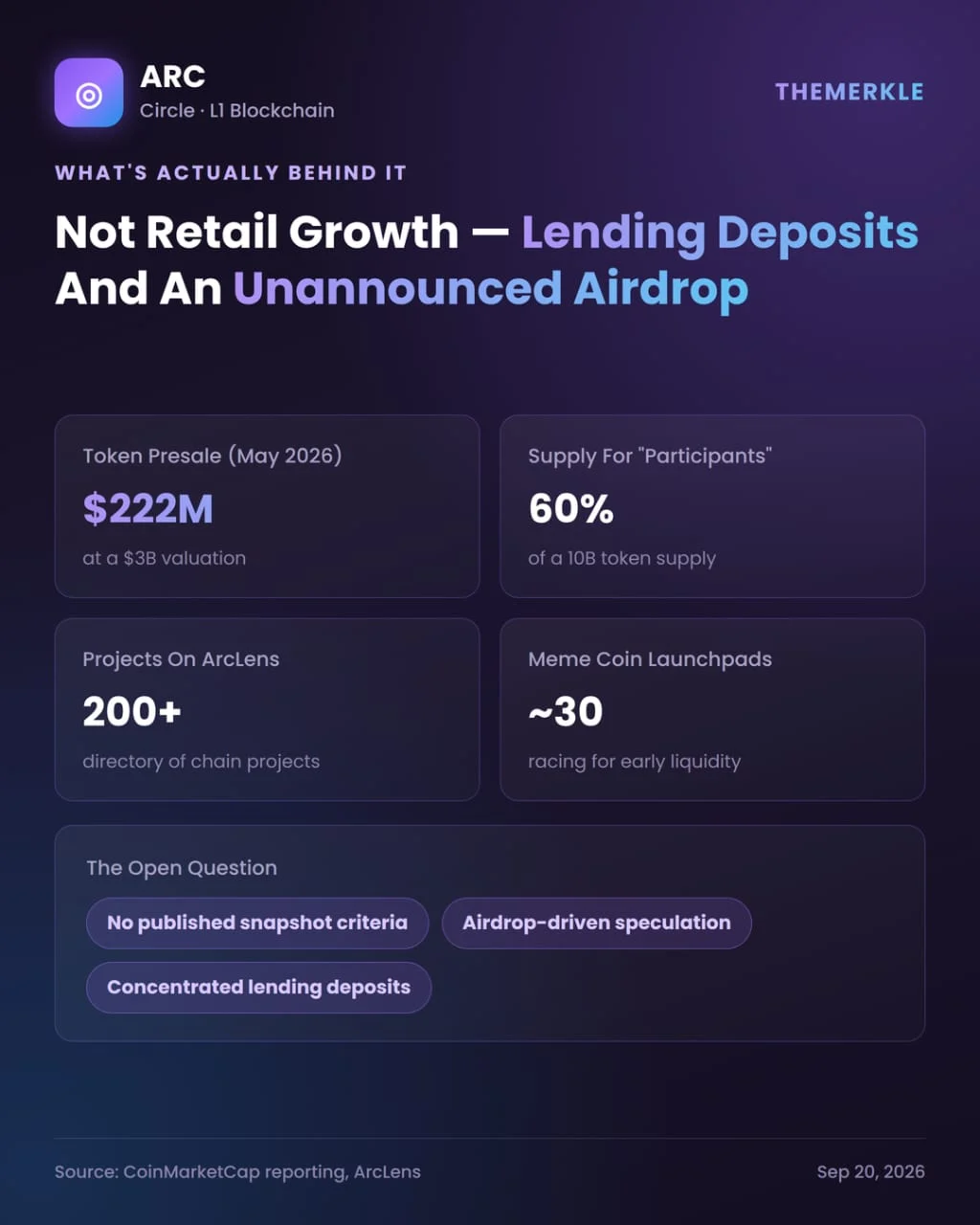
Further complicating the narrative is the nascent retail ecosystem described by various reports. For instance, CoinMarketCap’s analysis points to a "genuinely noisy" retail environment, with a directory like ArcLens already listing over 200 projects on the chain. A significant portion of these — roughly 30 — are identified as meme coin launchpads, indicative of a speculative rush to capture early liquidity in the chain’s infancy.
A primary driver behind this concentrated early activity appears to be the strategic incentive structure linked to Arc’s future. Circle, the parent company, reportedly raised $222 million in a presale for Arc’s own future native token in May 2026 (assuming a future date or a typo in the original text, interpreting as a future token sale for the chain), valuing the network at an estimated $3 billion. Crucially, 60% of a total 10 billion token supply has been earmarked for "network participants," but without any published snapshot criteria for eligibility. This lack of clear, public guidelines for token distribution effectively functions as an open invitation for speculative, "airdrop farming" behavior. Market participants, particularly institutional players and sophisticated users, are incentivized to deploy significant capital onto the network in the hopes of qualifying for a substantial token allocation once eligibility criteria are announced. This strategy can rapidly inflate a chain’s TVL and transaction volumes without necessarily reflecting a genuine, long-term belief in the chain’s fundamental utility or a robust, diversified user base.
The Role of Circle and USDC in Arc’s Strategic Launch
Circle’s decision to launch Arc is a significant strategic move, leveraging its dominant position in the stablecoin market. As the issuer of USDC, one of the largest and most widely used stablecoins, Circle possesses unparalleled access to institutional capital and a vast network of financial partners. Arc’s design, charging gas fees directly in USDC, is a testament to this strategy. This approach eliminates the need for users to acquire a separate native gas token, streamlining the user experience for those already holding USDC and reinforcing USDC’s utility.
This move positions Arc not just as another Layer 1 or Layer 2 blockchain, but as a stablecoin-native network designed to facilitate institutional DeFi and real-world asset (RWA) tokenization. Circle’s ambition extends beyond simply issuing a stablecoin; it aims to build the foundational infrastructure for a more regulated and institutional-friendly decentralized financial system. The ability to mobilize "idle institutional capital" on day one, as evidenced by Arc’s rapid TVL accumulation, is a direct consequence of Circle’s established reputation, regulatory compliance efforts, and existing relationships with major financial entities.
The Broader DeFi Landscape and Competition for Capital
The launch of Arc and its subsequent performance unfold within a highly competitive and evolving DeFi landscape. Numerous Layer 1 and Layer 2 solutions are vying for developer talent, user adoption, and, critically, TVL. Established players like Ethereum, Solana, Avalanche, and a growing cohort of Layer 2s such as Arbitrum, Optimism, Base, and Linea, are all competing for a finite pool of capital and attention.

In this environment, TVL has traditionally been a key metric for gauging a network’s health, liquidity, and perceived value. A higher TVL often correlates with greater network security (especially in proof-of-stake systems), deeper liquidity for trading, and a more robust ecosystem of applications. However, Arc’s case challenges the simplistic interpretation of this metric. While many chains have historically grown their TVL through a combination of retail interest, innovative dApps, and gradual institutional adoption, Arc’s immediate influx of capital, largely driven by specific incentives and institutional deposits, highlights a new dynamic in how chains can be bootstrapped. This trend reflects the increasing sophistication of capital deployment in DeFi, where large funds and institutions are actively seeking out opportunities with favorable tokenomics or strategic positioning.
Market Reactions and Divergent Interpretations: The Nuance of Backlash
The "hostility" or "backlash" observed in response to Arc’s TVL record is not necessarily a dispute of the raw numbers on DefiLlama. Instead, it represents a deeper questioning of what those numbers genuinely signify. Critics argue that a TVL figure accumulated almost entirely through concentrated institutional lending deposits and speculative activity—driven by the promise of an unannounced token airdrop—is a fundamentally different achievement than a chain organically earning $300 million in user trust and diversified activity over weeks or months.
Proponents, likely including Circle and its partners, might argue that mobilizing significant institutional capital quickly demonstrates the network’s capacity to attract serious investment and establish robust liquidity pools from day one. They might view this as a strategic advantage, providing a solid foundation for future retail growth and application development. The rapid injection of capital, regardless of its immediate source, still provides liquidity for DeFi protocols, potentially enabling more efficient trading and lending activities.
The divergence in opinion highlights a fundamental tension: Is the goal simply to attract capital, or is it to foster a decentralized, broad-based ecosystem? A milestone achieved in hours through concentrated lending deposits and "airdrop farmers" positioning for an unannounced token does not carry the same weight, in the eyes of many, as the same dollar figure built gradually by a genuinely growing and diverse user base, even if both appear identically on a TVL leaderboard. This discrepancy underscores a crucial point: metrics alone often fail to capture the full qualitative picture of a blockchain’s adoption and ecosystem health.
Implications for TVL as a Metric and Future Chain Growth Strategies
Arc’s unprecedented TVL surge carries significant implications for how the crypto industry evaluates chain growth and the effectiveness of different bootstrapping strategies.
Firstly, it forces a re-evaluation of TVL as a standalone metric. While still important, the Arc case demonstrates that TVL can be rapidly inflated by specific incentive structures, large institutional deployments, and speculative farming, rather than solely reflecting organic retail adoption or a diverse array of decentralized applications. Future analyses may need to look beyond headline TVL numbers to dissect the composition of that TVL: Is it concentrated in a few large wallets or distributed across many? Is it primarily institutional or retail? Is it locked in a variety of dApps or predominantly in a few lending protocols?

Secondly, Arc’s launch could signal a growing trend where established players with deep pockets and strong institutional connections can leverage their existing resources to rapidly inject liquidity into new chains. This could lead to an era where new networks, especially those backed by major entities, bypass the slow, arduous process of organic community building in favor of a "capital-first" approach. This strategy could accelerate the maturation of certain segments of DeFi, particularly those geared towards institutional use cases or real-world asset tokenization, but it might also exacerbate concerns about centralization and the influence of large capital holders.
Thirdly, the "airdrop farming" phenomenon, while not new, is clearly becoming an even more potent tool for bootstrapping liquidity. The promise of future token rewards, even without explicit criteria, can be a powerful magnet for capital. This creates a complex dynamic where early liquidity providers are often driven by speculative incentives rather than a fundamental belief in the chain’s long-term vision.
The Future Trajectory of Arc: A Nuanced Path Ahead
Ultimately, the record itself is demonstrably real, and the backlash, stemming from a critical examination of the underlying capital, is equally valid. Both observations can coexist. Arc genuinely reached $300 million faster than many comparable chains, and this speed is a direct reflection of Circle’s ability to mobilize significant institutional capital from day one, leveraging its brand, network, and the utility of USDC.
However, speed is not synonymous with depth or decentralization. A TVL primarily built on large lending deposits and speculative activity, driven by the pursuit of an unconfirmed airdrop, represents a fundamentally different kind of milestone than the slower, more retail-driven growth curves observed in chains like Arbitrum, Base, or Optimism. The ongoing debate within the crypto community reflects this dichotomy, with one side reacting to the undeniable numerical achievement and the other critically analyzing the composition and implications of that achievement. Both perspectives, when viewed through their respective lenses, draw reasonable, albeit often incompatible, conclusions from the same underlying data.
The true test for Arc will be its ability to transition from this initial, incentivized capital influx to a more diversified, organically growing ecosystem. This will require attracting a broad base of retail users, fostering innovative decentralized applications beyond lending, and clearly defining its value proposition in a crowded market. Whether Arc can evolve beyond its initial "speedrun" reputation to become a genuinely adopted and decentralized network remains to be seen, but its rapid rise has undeniably added a new chapter to the ongoing discussion about how success is measured in the ever-evolving world of blockchain and decentralized finance.