Cybersecurity researchers have identified a significant and sophisticated shift in the digital arms race as threat actors increasingly leverage public blockchains to host malicious infrastructure. According to a comprehensive analysis by Chainalysis, a technique known as blockchain dead drops (BDD) has seen a dramatic 420% surge in adoption over the past 12 months. This method involves storing command-and-control (C2) instructions, malware payloads, and infrastructure pointers directly within the immutable records of public blockchains, rendering traditional takedown methods virtually ineffective. By utilizing decentralized ledgers rather than centralized servers, threat actors ranging from profit-driven cybercriminals to state-sponsored operatives from North Korea and Iran are achieving unprecedented levels of campaign durability and resilience against digital defenders.
The core advantage of a blockchain dead drop lies in the fundamental nature of blockchain technology: it is decentralized, censorship-resistant, and permanent. In a traditional cyberattack, defenders can disrupt a campaign by seizing domains, taking down hosting servers, or removing malicious repositories from platforms like GitHub. However, once malicious code or a C2 pointer is written into a public blockchain like Bitcoin, Ethereum, or the Binance Smart Chain (BSC), it cannot be deleted or modified by any central authority. This creates a coordination layer that survives Web2 disruptions, allowing infected devices to retrieve instructions on demand without the threat actor fearing the loss of their primary communication channel.

The Mechanics of Decentralized Command and Control
A blockchain dead drop functions similarly to the "dead drops" used in traditional espionage, where intelligence officers leave materials at a pre-arranged physical location for later pickup by an operative. In the digital realm, the blockchain serves as this location. The technique typically manifests in two primary forms: transaction-based storage and contract-based storage.
In transaction-based storage, attackers embed data within specific fields of a blockchain transaction. For example, the Bitcoin protocol includes an OP_RETURN field designed for small amounts of arbitrary data. Threat actors use this space to hide encoded IP addresses or URLs. Because these transactions are part of the public ledger, any machine infected with the corresponding malware can simply query the blockchain to find the latest "post" from the attacker and decode the instructions.
Contract-based storage, often referred to as "EtherHiding," utilizes smart contracts on EVM-compatible chains like Polygon or BSC. Here, the malware is programmed to read the state of a specific smart contract. The attacker can update the contract’s data to point to new server infrastructure whenever their previous servers are blocked. Because the smart contract itself remains live on the blockchain, the "resolver" is never lost.

A more elusive variation involves "phantom wallets"—addresses that do not have a private key-pair. Attackers hide C2 server IP addresses within the bytes of the phantom address itself. By sending zero-value transactions to these addresses, they create a trail that malware can follow and decode, further obscuring the attacker’s footprint by avoiding direct interaction with a controlled contract or a recognizable memo field.
A Decade of Evolution: From Necurs to AI-Driven Surges
The use of blockchains for malicious purposes is not a new phenomenon, but its scale and complexity have evolved significantly. The earliest recorded instance dates back to 2013, when a variant of the Necurs botnet utilized Namecoin—a fork of Bitcoin—to store C2 domains. By 2019, the Glupteba botnet was actively writing malicious data into Bitcoin’s OP_RETURN field, while other banking malware encoded IP addresses into the specific amounts of Satoshis being transferred.
The landscape shifted in mid-2023 with the arrival of "EtherHiding." This technique gained prominence when operators of the ClearFake malware, facing a crackdown by Cloudflare on their traditional servers, began embedding malicious code in smart contracts on the Binance Smart Chain. The success of ClearFake served as a proof-of-concept for the wider criminal underworld. By late 2023, the Smargaft DDoS botnet had also adopted BSC-based command-and-control infrastructure.

The most recent and alarming spike in BDD activity—a 440% increase since the rise of advanced coding tools—is attributed to the explosion of open-source artificial intelligence. Researchers note that the launch of powerful, open-weight Chinese Large Language Models (LLMs) in mid-2025 significantly lowered the technical barrier to entry. These models, which often lack the stringent restrictions on generating malicious code found in other proprietary systems, allowed less-experienced threat actors to deploy complex blockchain-based infrastructure with ease. Consequently, the frequency of malicious writes to blockchains jumped from an average of 2.06 per day to 11.1 per day in less than a year.
Case Study: North Korea’s Redundant Chain Strategy
State-sponsored actors have become the primary drivers of BDD innovation. North Korean agents, specifically the group tracked as UNC5342 (linked to the regime’s Ministry of Intelligence), have integrated blockchain dead drops into their notorious "fake job interview" ruse. In early 2025, these actors began targeting cryptocurrency developers by posing as recruiters and duping them into downloading malicious payloads.
To ensure the longevity of these campaigns, UNC5342 developed a sophisticated cross-chain redundancy system. The malware is programmed to query the TRON and Aptos blockchains for encoded pointers. These pointers resolve to a specific transaction on a third chain, the Binance Smart Chain. The BSC transaction contains the encrypted malware instructions, including C2 server addresses and configuration data.

This multi-layered approach makes disruption nearly impossible; a defender would need to coordinate a simultaneous action across TRON, Aptos, and BSC to break the communication chain. For the DPRK, this technique is a vital component of its broader strategy to steal digital assets and fund the regime’s weapons programs.
Iranian and Russian Operations: Exploiting the Satoshi Legacy
The Iranian Ministry of Intelligence has also been linked to BDD activity, specifically utilizing the Bitcoin blockchain. In a move that blends technical stealth with symbolic irony, Iranian-linked wallets have been observed sending small, meaningless payments to well-known Bitcoin addresses historically associated with Satoshi Nakamoto.
The payments themselves are a smokescreen. The true value lies in the data embedded in the transactions. The malware knows to monitor these high-profile, permanent addresses for new transactions and decode the metadata to find the attacker’s current infrastructure. This reduces the attacker’s footprint because the "reference address" is a legitimate, publicly accessible point that the attacker does not need to own or control.

Meanwhile, Russian-language cybercriminals have commercialized these techniques through a Malware-as-a-Service (MaaS) model. On the Polygon blockchain, researchers have identified "resolver" toolkits sold on underground forums, complete with Russian-language operator panels and subscription tiers. These operators maintain a fleet of smart contracts, each serving a different downstream "affiliate" or criminal customer. By updating a single "primary" contract, the MaaS provider can shift the infrastructure for hundreds of individual malware campaigns simultaneously.
Supporting Data and Statistical Trends
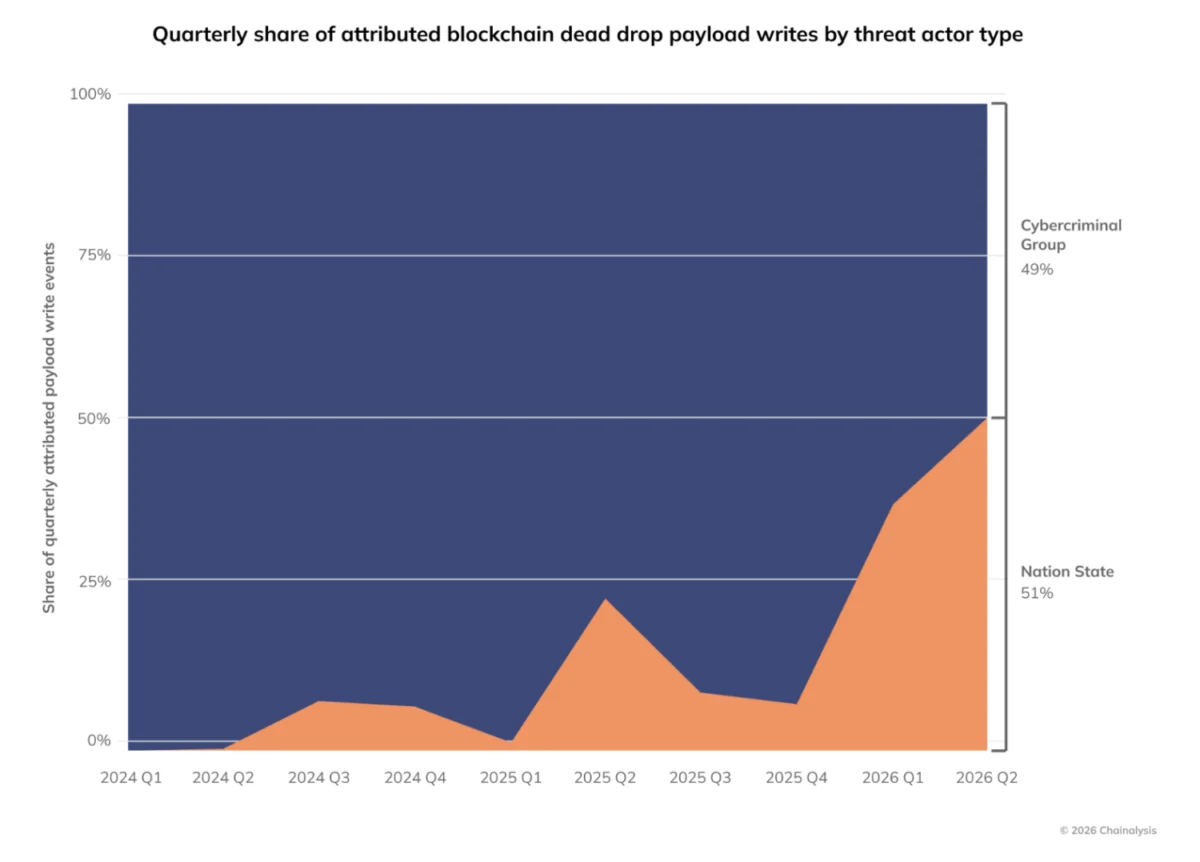
The shift from individual cybercriminals to state actors is perhaps the most telling trend in recent blockchain intelligence. Through early 2024, nearly 100% of malware instructions posted to blockchains were linked to independent cybercriminals. However, by the second quarter of 2026, state-linked groups were responsible for approximately two-thirds of all new BDD activity.
Currently, BDD activity is being tracked across five major blockchains:

- Bitcoin: Primarily used for transaction-based storage (OP_RETURN).
- Binance Smart Chain (BSC): The most popular for smart contract-based "EtherHiding."
- Polygon: Heavily utilized by Russian-language MaaS providers due to its low transaction fees.
- TRON and Aptos: Emerging as secondary or redundant layers for sophisticated state-actor campaigns.
Researchers are currently monitoring over a dozen named malware strains that rely on these decentralized coordination layers, indicating that the era of "disposable" C2 infrastructure is being replaced by a more permanent, blockchain-anchored model.
Implications and the Challenge for Global Defense
The rise of blockchain dead drops presents a unique challenge for global cybersecurity. Traditional threat-intelligence platforms are often blind to on-chain activity, creating a visibility gap that allows these campaigns to persist for years.
Defenders face a significant hurdle: they cannot simply block "blockchain traffic" at the network level. Blocking access to Ethereum or Bitcoin would require shutting down public RPC (Remote Procedure Call) endpoints operated by major infrastructure providers like Infura, Alchemy, and Cloudflare. Doing so would effectively break all legitimate decentralized finance (DeFi) applications, digital wallets, and enterprise blockchain services, causing massive economic disruption. Furthermore, determined attackers could bypass such blocks by running their own private nodes.

Industry experts and blockchain intelligence firms argue that the solution lies in "on-chain visibility." Because the blockchain is immutable, the trail of evidence left by attackers is also permanent and publicly auditable. By using advanced analytics to map operator wallets, funding chains, and contract update histories, law enforcement and security teams can profile adversaries and anticipate their moves.
As nation-states and high-level criminal syndicates continue to refine these techniques, the focus of digital defense must shift from simple takedowns to sophisticated attribution and downstream disruption. The same properties that make the blockchain a sanctuary for malicious code—its transparency and permanence—may ultimately be the tools that allow the global security community to track and neutralize these threats. In this evolving landscape, blockchain intelligence is no longer just a tool for financial compliance; it has become a critical pillar of international cybersecurity.