
Bitcoin (BTC) experienced a dip below $75,000 on Wednesday following the U.S. Senate’s failure to advance the CLARITY Act, a legislative proposal aimed at providing regulatory clarity for digital assets. While the flagship cryptocurrency subsequently rebounded above the $80,000 mark, the legislative setback has introduced a degree of uncertainty into the market. However, prominent on-chain analyst Willy Woo suggests that this short-term volatility may not derail a broader upward trend, positing that Bitcoin might have already established its market bottom and is in the nascent stages of a new bull market.
Woo’s assessment, articulated in a post on the social media platform X, assigns a 90% probability to the market bottom being in. He bases this conviction on observed improvements in liquidity conditions and a renewed influx of capital from long-term investors. "I put the probability the bottom is in at 90%. We are in an early bull market structure based on long-term investor liquidity returning," Woo stated, linking to his analysis on the platform.
The CLARITY Act’s procedural defeat in the U.S. Senate on September 15th, which garnered 49 votes in favor and 50 against, falling short of the 60 votes required for advancement, cast a shadow over the cryptocurrency market. This legislative outcome led to a period of selling pressure across a range of digital assets.
Shifting Analytical Paradigms: Beyond Traditional Cycles
Woo’s perspective diverges from a strict reliance on traditional cycle analysis, which he notes currently yields a less convincing signal, with consensus among analysts leaning towards a roughly 40% confidence in these patterns for bottom calls. He elaborated, "Shaping my view is BTC’s liquidity structure; I’m deliberately avoiding historical cycle patterns which have been very successful to date in calling bottoms."
Instead, Woo is focusing on the underlying liquidity structure of Bitcoin and the re-entry of capital from long-term investors. He maintains a bullish outlook on the current structure, provided these investor flows continue to demonstrate resilience. However, Woo acknowledges the difficulty in pinpointing the exact duration of a potential bull market, especially as historical cycle patterns become less predictable. This makes it challenging to ascertain whether the upcoming advance could span several years.

On-Chain Indicators Bolster Bullish Sentiment
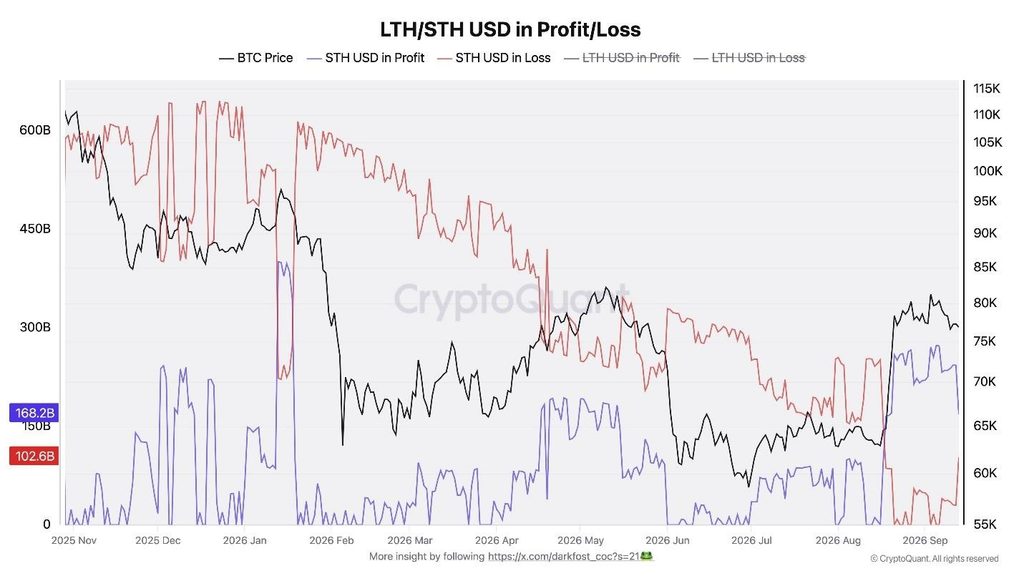
Woo’s optimistic stance is echoed by other on-chain indicators, which suggest that Bitcoin’s recent price weakness may not signal the commencement of an extended bearish phase. Darkfost, a contributor to CryptoQuant, recently highlighted that short-term Bitcoin holders have remained in profitable positions for nearly a month. In an analysis shared on X, Darkfost noted that this behavior differs from previous recovery attempts, where profitable positions were rapidly followed by renewed selling pressure.
The data indicated that approximately $168 billion worth of Bitcoin held by short-term investors were in profit, contrasting with just over $100 billion in unrealized losses. Darkfost observed that similar patterns emerged during the transition out of the bear market experienced between 2022 and 2023. The activity of long-term holders has also shown encouraging signs of improvement, though analysts emphasize that historical precedents do not guarantee identical outcomes in the future.
Divergent Views: The Risk Asset Correlation Concern
Despite the growing optimism among some analysts, a segment of the market remains cautious. Mike McGlone, a strategist at Bloomberg Intelligence, has cautioned that a significant correction in the S&P 500 could exert considerable downward pressure on Bitcoin, given its increasingly correlated relationship with broader risk assets.
McGlone articulated his concerns in a post on X, stating, "Launched during the Great Recession in 2009, Bitcoin has led the way up for risk assets and may now be leading the way back down." He further posited, "Bitcoin may be tracking toward its enduring pivot around $10,000, and one simple factor could get it there — about a 20% drawdown in the SPX that persists for a while, as has happened historically." This perspective underscores the potential vulnerability of Bitcoin to macroeconomic headwinds and the performance of traditional financial markets.
Market Context and Historical Precedents
The cryptocurrency market has been characterized by significant volatility since its inception. Bitcoin, as the pioneering digital asset, often sets the tone for the broader market. Historically, bull markets in Bitcoin have often been followed by periods of significant growth in altcoins, as capital flows into riskier, higher-potential assets. The current discussion around a potential new bull market stems from a confluence of factors, including the upcoming halving events, increasing institutional adoption, and evolving regulatory landscapes.

The CLARITY Act, while not passing in its current form, represents an ongoing effort by policymakers to grapple with the complexities of digital asset regulation. Its failure to advance highlights the challenges in achieving consensus on a framework that balances innovation with investor protection. The implications of such legislative developments can ripple through the market, influencing investor sentiment and capital allocation decisions.
The concept of a "market bottom" in cryptocurrency is often debated, with various metrics and indicators used to identify potential turning points. On-chain analysis, which examines transaction data and holder behavior on the blockchain, has become an increasingly sophisticated tool for understanding these dynamics. Willy Woo’s focus on liquidity and long-term investor behavior reflects a growing trend towards data-driven analysis that moves beyond simplistic technical patterns.
Investor Behavior and Liquidity Dynamics
The behavior of short-term versus long-term holders provides crucial insights into market sentiment. Short-term holders are typically more sensitive to price fluctuations and are quicker to take profits or cut losses. Their sustained profitability, as observed by Darkfost, suggests a market that is absorbing selling pressure and potentially building a foundation for further upward movement.
Conversely, long-term holders, often referred to as "HODLers," demonstrate a conviction in the asset’s future value. Their accumulation and retention of Bitcoin during periods of uncertainty can act as a stabilizing force in the market. The renewed participation of these investors, as highlighted by Woo, is a significant bullish signal, indicating a belief in the long-term prospects of Bitcoin.
Broader Implications for the Digital Asset Ecosystem
If Bitcoin indeed enters a new bull market, it is likely to have a cascading effect across the entire digital asset ecosystem. Altcoins, which often exhibit higher volatility than Bitcoin, could experience substantial gains as investors seek out potentially higher returns. This phenomenon, commonly referred to as "altcoin season," typically follows periods of strong Bitcoin performance.
However, the correlation with traditional risk assets, as pointed out by McGlone, introduces a significant caveat. A broader economic downturn or a significant correction in equity markets could potentially drag down Bitcoin and, consequently, the entire crypto market. This highlights the interconnectedness of digital assets with the global financial system and the ongoing debate about Bitcoin’s role as a potential inflation hedge versus a speculative risk asset.
The regulatory environment remains a critical factor influencing the long-term trajectory of the cryptocurrency market. The CLARITY Act’s journey through the U.S. Senate, despite its current setback, signifies the ongoing efforts to establish clearer rules for digital assets. Future legislative developments could significantly impact market accessibility, institutional adoption, and the overall stability of the crypto space.
At the time of reporting, Bitcoin was trading at approximately $84,752, reflecting a 1.86% increase over the preceding 24 hours. This price action, while positive, occurs within the context of these ongoing analytical debates and market dynamics. The coming weeks and months will likely provide further clarity on whether Bitcoin is indeed embarking on a new bull run, with significant implications for investors and the broader digital asset landscape.