The TRON network, long recognized as a formidable force in the stablecoin landscape, is currently demonstrating a nuanced evolution, marked by a slight dip from its recent all-time high in stablecoin market capitalization, even as it actively integrates new asset classes designed to broaden its utility. This period of consolidation follows a consistent growth trajectory throughout the year, challenging the simplistic narrative of perpetual expansion and revealing a more complex, strategically driven phase of development for the blockchain. Despite a marginal short-term decline, the underlying trends suggest a deliberate pivot towards diversifying its offerings beyond its established dominance in low-cost USDT transfers, aiming to layer sophisticated financial instruments like yield-bearing synthetic dollars and Bitcoin-backed stablecoins onto its robust infrastructure.
Current State of Tron’s Stablecoin Market: A Textured Landscape
Recent data illustrates a market that, while still overwhelmingly dominant, is experiencing a natural ebb and flow. According to DefiLlama’s comprehensive Tron stablecoin dashboard, the total stablecoin market capitalization on the network presently stands at $93.583 billion. This figure represents a minor retraction of $218.74 million, equating to a 0.23% decrease over the past seven days, and a marginal 0.09% dip within the last 24 hours. However, zooming out to a 30-day perspective reveals a more optimistic picture, with the network registering a healthy 2.3% gain in stablecoin supply. This fluctuation indicates that Tron’s stablecoin supply peaked around its recent all-time high, approaching $94.27 billion in early September, and has since eased back slightly without relinquishing the broader monthly growth. This nuanced data underscores that a network can maintain its leadership in the stablecoin sector while undergoing perfectly normal, short-term adjustments in specific metrics.
Further contextualizing these figures, Token Terminal’s project page for Tron, when examined alongside DefiLlama’s statistics, confirms that the recent dip is minor rather than a cause for alarm. Tron concluded Q2 2026 with an approximate stablecoin supply of $89.2 billion, marking a 4.1% increase quarter-over-quarter. This impressive growth positioned Tron with roughly 28.7% of the entire global stablecoin market, a figure proudly reported by TRON DAO based on Token Terminal data.
Dominance and Concentration: The USDT Factor

A critical characteristic of Tron’s stablecoin ecosystem is its profound reliance on Tether’s USDT. DefiLlama’s dominance figures reveal that USDT alone accounts for close to 98% of all stablecoins residing on the network, specifically 97.97%. This concentration highlights that Tron’s stablecoin narrative is, almost entirely, a USDT story. While various other stablecoins exist on the network, their collective market share remains comparatively tiny, positioning USDT as the undisputed cornerstone of Tron’s financial infrastructure. This singular focus on USDT has historically been a double-edged sword: it provides unparalleled liquidity and network effects but also concentrates risk and limits the diversity of financial products available natively.
Background Context: Tron’s Ascent as a Stablecoin Hub
Tron’s journey to becoming a preeminent stablecoin hub is rooted in its foundational design principles. Launched in 2017 by Justin Sun, the network quickly distinguished itself through its high transaction throughput, low transaction fees, and robust infrastructure. These attributes made it an attractive platform for stablecoin issuers, particularly Tether, which began issuing USDT on Tron via the TRC-20 standard.
The primary driver for Tron’s stablecoin adoption, especially for USDT, has been its efficacy as a settlement and remittance layer. In many emerging markets, where traditional banking infrastructure can be slow, expensive, or inaccessible, Tron’s TRC-20 USDT offers a fast, cheap, and reliable alternative for transferring value across borders. This utility has resonated strongly with over-the-counter (OTC) desks, individual users, and businesses engaged in international trade, solidifying Tron’s position as a preferred network for moving digital dollars efficiently. The network’s architectural advantages, combined with strategic partnerships and a proactive approach to ecosystem development, have fostered an environment where stablecoin growth has been not just consistent, but explosive over several years.
Key Strategic Integration 1: Ethena Brings Yield-Bearing USDe to Tron
A significant development signaling Tron’s evolving strategy emerged on September 11, when TRON DAO and Ethena Labs jointly announced the integration of Ethena’s USDe and its yield-bearing counterpart, sUSDe, onto the Tron network. This integration was facilitated through Stargate Finance, a cross-chain bridge protocol. This move is particularly noteworthy because it introduces a fundamentally different class of asset to Tron’s predominantly payment-centric stablecoin environment.

Ethena Labs is known for its "internet bond" protocol, which offers USDe as a synthetic dollar that maintains its peg through a delta-hedging strategy on staked Ethereum and corresponding short perpetual futures positions. The yield-bearing sUSDe further allows holders to earn a return generated from these underlying strategies. Historically, USDT on Tron has served primarily as a conduit for cheap and fast dollar transfers—a tool for moving money rather than necessarily growing it. The arrival of USDe and sUSDe signifies a strategic shift, introducing a savings and yield-generation use case directly onto the Tron blockchain.
The announcement also indicated that integrations with prominent Tron-native DeFi protocols like JustLend DAO and SUN.io are slated to roll out in the coming weeks. These integrations are crucial as they will provide avenues for Tron users to actively engage with USDe and sUSDe, enabling them to deposit, lend, or stake these assets to earn yield. This expansion marks an intentional effort by Tron to diversify its ecosystem’s financial utility, moving beyond its established dominance in pure payments to cater to users seeking passive income opportunities within the stablecoin space. It positions Tron not just as a transactional layer, but as a potential hub for decentralized finance (DeFi) innovation around various stablecoin types.
Key Strategic Integration 2: Ducat Connects Bitcoin-Backed Dollars to Tron’s Rails
Adding another layer of strategic diversification, Ducat announced its integration with Tron on September 17. This collaboration aims to expand stablecoin utility by connecting Ducat’s Bitcoin-backed financial infrastructure with Tron’s high-speed rails. The mechanics of this integration are distinct from a typical stablecoin bridge. Ducat’s native stablecoin, UNIT, remains issued and collateralized against Bitcoin directly on the Bitcoin network itself, leveraging Bitcoin’s inherent security model. However, wUNIT, its TRC-20 representation, is brought onto Tron specifically to facilitate settlement against the deep USDT liquidity pools available on the network.
This innovative approach allows users to hold wUNIT directly on Tron or easily swap it for USDT through dedicated liquidity pools. The significance of this integration lies in Tron’s role transformation. Instead of merely absorbing another dollar-pegged stablecoin issuer, Tron is becoming a critical settlement layer for a completely different collateral base—Bitcoin. This enables Bitcoin-backed assets to access the vast dollar liquidity and efficient transaction capabilities of the Tron network without compromising the security assurances of their native chain. It represents a sophisticated move to bridge two major blockchain ecosystems, offering Bitcoin holders a novel way to leverage their assets within a dollar-denominated DeFi environment, while simultaneously enhancing Tron’s appeal as a versatile and interconnected financial platform.
Competitive Landscape: Widening Gap with Ethereum

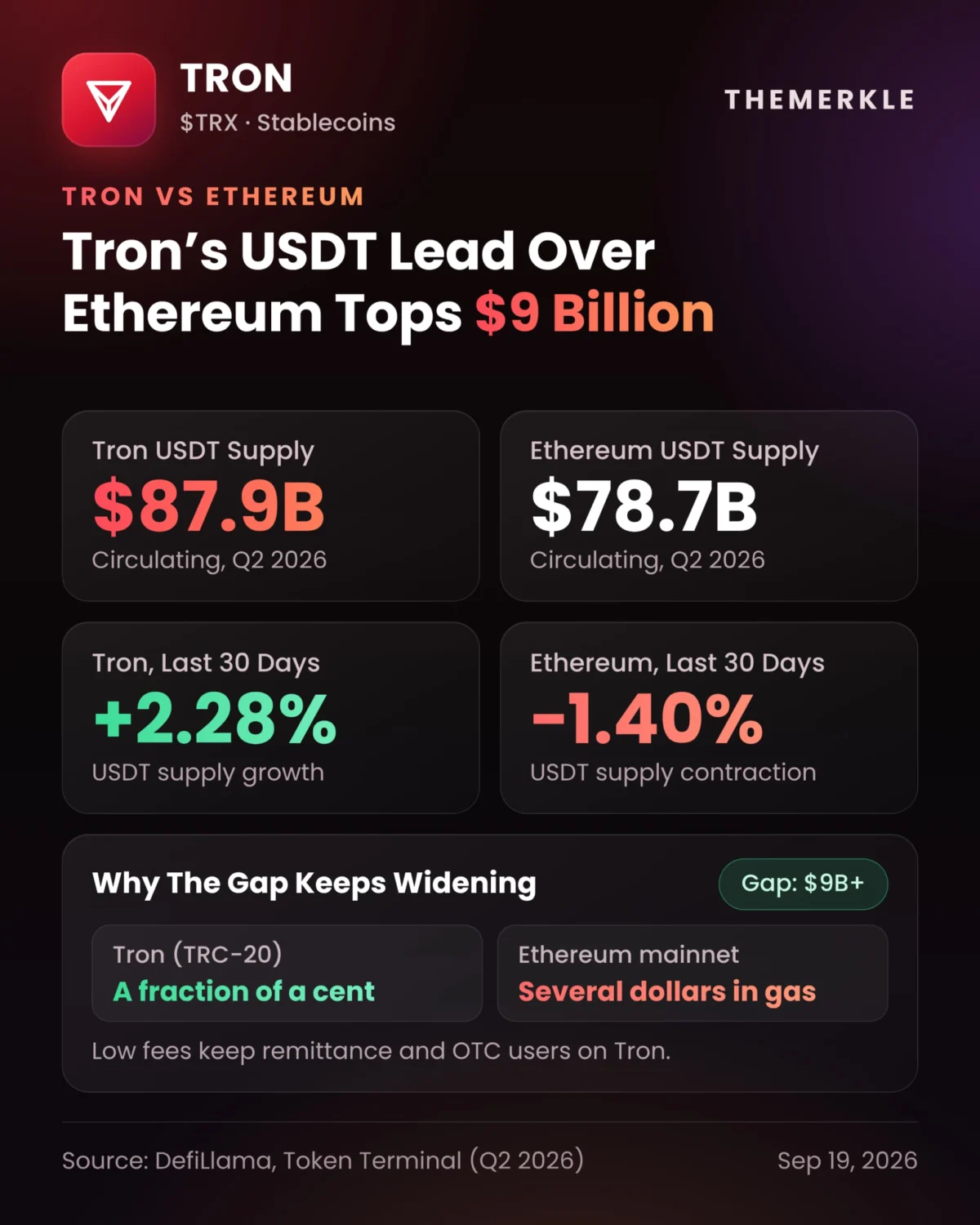
The broader competitive landscape further underscores Tron’s enduring strength in the stablecoin arena, particularly concerning USDT supply. The trend of Tron’s lead over Ethereum in USDT circulation has continued to widen rather than narrow, a pattern that persisted throughout the recent reporting period. Over the past 30 days, Tron’s USDT supply expanded by 2.28%, while Ethereum’s contracted by 1.40% during the same timeframe.
As of Q2 2026 figures, Tron hosted an impressive $87.9 billion in circulating USDT, significantly outpacing Ethereum’s $78.7 billion. This represents a substantial gap of more than $9 billion, solidifying Tron’s position as the dominant network for USDT. The primary reason for this growing disparity is largely mechanical and deeply rooted in economic incentives. Sending USDT on Tron’s TRC-20 standard typically incurs transaction costs of merely a fraction of a cent. In stark contrast, the same transfer executed on the Ethereum mainnet can cost several dollars in gas fees, depending on network congestion and demand.
For the core demographic that utilizes Tron for stablecoin transactions—including remittance corridors, OTC desks, and everyday users in emerging markets—this cost differential is not a minor detail; it is often the decisive factor. The ability to conduct transactions quickly and affordably is paramount for these users, making Tron an undeniably attractive and practical choice over Ethereum, which, despite its robust DeFi ecosystem, remains comparatively expensive for basic value transfers. This cost efficiency forms the bedrock of Tron’s competitive advantage in the stablecoin remittance sector and continues to drive its market share expansion.
Broader Implications and Future Outlook
Synthesizing these developments, the recent performance of Tron’s stablecoin ecosystem suggests not a slowdown, but rather a period of strategic digestion and proactive diversification. While the raw stablecoin supply number experienced a slight tick downward from its peak, the simultaneous integration of two distinct and significant projects—Ethena’s yield-bearing synthetic dollar and Ducat’s Bitcoin-collateralized stablecoin—marks a pivotal moment. These integrations are not mere additions to Tron’s asset list; they fundamentally expand the network’s role beyond its established niche of plain USDT transfers.
If Tron’s stablecoin narrative until now has been predominantly defined by its status as the cheapest and fastest platform for moving digital dollars, the events of this month lay the early groundwork for a more expansive vision. This vision entails Tron evolving into an ecosystem where diverse types of dollars, backed by entirely different asset classes (synthetic positions, Bitcoin), can not only coexist but also seamlessly settle against each other. This strategic diversification aims to build a more robust and multifaceted financial infrastructure, capable of catering to a broader spectrum of user needs, from basic remittances to sophisticated yield generation and inter-chain asset liquidity.

The critical question for the coming months will be whether this diversification meaningfully alters Tron’s overall growth trajectory, propelling it into new market segments, or if it primarily serves to add variety around the edges of an already dominant USDT base. Analysts and market participants will be closely observing how these new integrations are adopted, what new applications they enable, and whether they can attract a significant influx of capital and users beyond Tron’s traditional stablecoin demographic. The network’s ability to successfully integrate and foster these new asset classes will be a key indicator of its long-term potential to solidify its position as a comprehensive and indispensable hub in the global stablecoin and decentralized finance landscape.
Disclosure: This is not trading or investment advice. Always do your research before buying any cryptocurrency or investing in any services.
Follow us on Twitter @themerklehash to stay updated with the latest Crypto, NFT, AI, Cybersecurity, and Metaverse news!