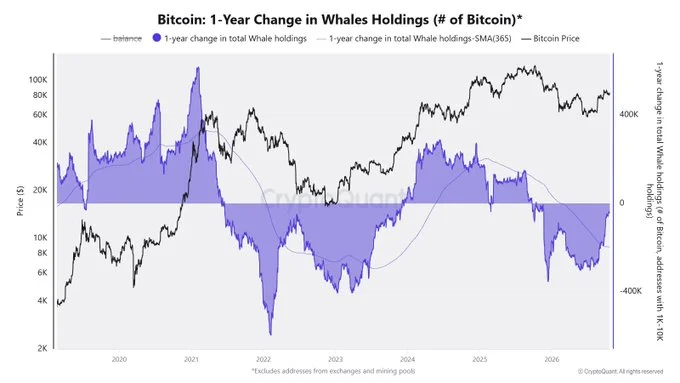
Two Bitcoin (BTC) wallets that had remained dormant for roughly 13 years have suddenly become active, moving a tiny amount of BTC from holdings worth approximately $115 million. According to blockchain analytics platform Lookonchain, the wallets transferred 0.0005 BTC, worth around $43, as a test transaction after years of inactivity. The addresses collectively hold 1,346 BTC, making the movement notable despite the relatively insignificant amount transferred. Notably, the wallets acquired the Bitcoin about 13 years ago for approximately $240,000, when BTC traded at an average price of just $178. At current valuations, the holdings represent a return of roughly 479 times the original investment.
This reactivation adds to a growing list of early Bitcoin wallets that have recently started moving coins accumulated when the cryptocurrency traded for only a few dollars. These "whale" movements, especially from wallets held since the nascent days of Bitcoin, often spark significant interest and speculation within the cryptocurrency community. Their re-emergence can signal a shift in market sentiment, a potential redistribution of wealth, or even a precursor to larger market movements.
Historical Context: The Genesis of Bitcoin Wealth
The wallets in question represent some of the earliest adopters of Bitcoin. In 2010 and 2011, when these Bitcoins were likely acquired, the digital asset was far from the mainstream financial instrument it is today. Bitcoin was primarily the domain of cypherpunks, early tech enthusiasts, and a few forward-thinking investors willing to take a chance on an experimental decentralized currency. The average price of Bitcoin during 2011, for instance, hovered around $10, with occasional spikes and dips. Acquiring 1,346 BTC for a mere $240,000 in that era signifies an investment made at a time when Bitcoin’s future was highly uncertain and its value proposition was largely theoretical.
The colossal return on investment – nearly 500-fold – underscores the transformative potential of early adoption in the cryptocurrency space. These early holders, often referred to as "Bitcoin OGs" or "pre-miners," amassed substantial fortunes by simply holding onto their digital assets through years of volatility, skepticism, and technological evolution. The movement of even a minuscule portion of these holdings, as seen in the recent test transaction, is a clear indicator that these long-term investors are still active and monitoring their investments.
A Pattern of Dormant Wallet Activity
The recent activity from these two wallets is not an isolated incident. Over the past year, there has been a discernible trend of dormant Bitcoin wallets, some untouched for over a decade, suddenly becoming active. This pattern suggests a coordinated or at least a parallel awakening among early Bitcoin holders.
Last week, another early Bitcoin wallet moved 20.43 BTC, worth about $1.7 million at the time of transfer, after remaining inactive for nearly 15 years. This particular movement was highlighted by Galaxy Research, indicating that the transaction caught the attention of institutional players in the crypto space. The coins were reportedly acquired when Bitcoin was trading at a fraction of its current value, further amplifying the magnitude of the profit realized.

Furthermore, on September 5th, a significant event occurred when twelve wallets, each containing 50 BTC, moved a combined total of 600 BTC. These coins were reportedly received as mining rewards in March 2010 and had remained untouched for over 16 years. This means these specific wallets were active from the very early days of Bitcoin mining, when obtaining BTC was a relatively straightforward process for those with the technical means.
Speculation and the Satoshi Nakamoto Connection
The sheer age and substantial holdings of these reactivated wallets inevitably fuel speculation about their origins. In particular, the possibility that these wallets might be linked to Bitcoin’s pseudonymous creator, Satoshi Nakamoto, is a recurring theme in crypto discussions. Satoshi Nakamoto is believed to have mined approximately one million Bitcoins in the early days of the network.
While blockchain researchers have diligently analyzed these movements, no concrete evidence has emerged to directly link the recent 600 BTC movement, or the activity of the two wallets discussed, to Satoshi Nakamoto. The nature of Bitcoin’s blockchain, with its pseudonymous addresses, makes it incredibly challenging to definitively tie specific wallets to individuals, especially those who have deliberately maintained a low profile. However, the sheer volume and age of these holdings continue to keep the Satoshi narrative alive in the collective imagination of the crypto world.
Market Conditions: A Resurgence in Demand?
The reactivation of these old wallets coincides with a period where Bitcoin’s broader market is attempting to solidify its recovery. After experiencing a significant downturn, with prices slumping by as much as 20% in the preceding three months, the market has shown signs of renewed life.
CryptoQuant contributor "MAC-D" noted last Friday that Bitcoin’s 30-day apparent demand growth rate had improved. Between September 24th and October 1st, this metric shifted from a negative 182,000 BTC to a negative 101,000 BTC. While this still indicates a net outflow or lack of sustained new demand, the narrowing of the negative gap suggests a potential bottoming out or a period of accumulation.
However, demand has yet to turn decisively positive, meaning that the rate at which new Bitcoins are being acquired by the market still lags behind the rate at which they are being moved or consumed. The Coinbase Premium Index, a metric that tracks the difference between Bitcoin’s price on Coinbase and other exchanges, also remains negative. This indicates that buying pressure from US-based spot investors has not yet fully recovered, implying that institutional and retail investors in the United States are not yet aggressively entering the market.
"Bitcoin demand is currently in a recovery phase, but there’s still no confirmation of this from the United States," MAC-D elaborated, emphasizing the need for stronger signals from key markets.

Broader Market Activity and Future Outlook
Beyond the raw demand metrics, analysts are also observing shifts in trading volumes across major exchanges, which can provide further insights into market sentiment and liquidity. Analyst Darkfost, also of CryptoQuant, pointed to improving spot-market activity in September.
Trading volumes on Binance, the world’s largest cryptocurrency exchange by trading volume, exceeded $50 billion in September, a notable increase from $42 billion in July. Bybit, another significant derivatives and spot trading platform, recorded $19 billion in September, up from $14 billion in July. Kraken, a long-standing and reputable exchange, also saw its volume rise to $8 billion from $4 billion during the same period.
This surge in trading volume suggests increased participation and liquidity in the spot markets. For Bitcoin to achieve new all-time highs and sustain its upward momentum, Darkfost argued that both spot volumes and overall demand need to accelerate significantly. This implies that while recovery is underway, the market is still in a crucial phase of rebuilding confidence and attracting sustained buying interest.
Implications of Whale Movements
The recent movements from dormant whale wallets, while seemingly small in terms of the amount transacted, carry significant weight due to the history and potential size of these holdings. When large, long-term holders begin to move their assets, it can have several implications:
- Market Sentiment Indicator: Such movements can be interpreted as a signal that early investors are either diversifying their holdings, rebalancing their portfolios, or preparing for potential market shifts. A test transaction, in particular, might precede larger movements as holders assess network fees and transaction times.
- Liquidity Injection: If these movements are part of a larger strategy to sell, they could introduce significant liquidity into the market. However, given the age of the holdings and the substantial unrealized gains, a complete liquidation is less likely than strategic repositioning.
- Psychological Impact: The reactivation of such old wallets often generates buzz and speculation, which can influence broader market sentiment and attract media attention, potentially drawing in new investors.
- Network Health Check: For holders who have kept their Bitcoin inactive for over a decade, initiating a transaction can also be seen as a way to ensure their wallets are still accessible and functioning correctly, and to test the current transaction costs.
At the time of reporting, Bitcoin was trading at approximately $85,504, reflecting a modest increase of 0.23% in the past 24 hours. This price point is indicative of a market in a delicate balance, where positive developments like increased trading volumes and whale activity are being weighed against the still-developing demand signals. The coming weeks and months will be critical in determining whether these underlying market dynamics can propel Bitcoin towards new historical highs, with the actions of these early adopters serving as a fascinating subplot in the ongoing narrative of the world’s leading cryptocurrency.