The collective market capitalization of every euro-pegged stablecoin currently in existence falls significantly short of the typical USDT holdings of even a single mid-sized crypto fund, highlighting a profound disparity in the global stablecoin landscape. Live data from CoinGecko reveals the entire euro stablecoin category stands at a modest $759.9 million, a stark contrast to the dollar stablecoin market which has surged past the $300 billion mark. This immense gap represents not merely a difference in scale, but an entirely different order of magnitude, underscoring the entrenched dominance of the U.S. dollar within the burgeoning digital asset economy.
The current figures, meticulously gathered rather than relying on outdated snapshots, emphasize the dynamic nature of this nascent sector, where market rankings and valuations can shift rapidly within weeks. Despite this volatility, the fundamental reality remains: the euro stablecoin market, while exhibiting genuine activity in terms of trading volume and new entrants, is dwarfed by its dollar-denominated counterpart, a trend that shows little sign of immediate reversal. In fact, rather than growing, the category has experienced a slight contraction, with its combined market cap declining by 0.3% on the day of observation. This figure also sits below some earlier estimates from this year, which pegged the category closer to $900 million to $1 billion, indicating that the path for euro stablecoins is not a linear upward trajectory but rather subject to redemptions, protocol adjustments, and shifting liquidity dynamics, much like any other segment of the broader stablecoin ecosystem.
The Foundational Role of Stablecoins and the Dollar’s Ascent
To fully grasp the current state of euro stablecoins, it is essential to understand the fundamental role stablecoins play within the cryptocurrency ecosystem and the historical context of the dollar’s preeminence. Stablecoins are cryptocurrencies designed to minimize price volatility relative to a "stable" asset, typically fiat currencies like the U.S. dollar or the Euro, or commodities like gold. They serve as critical bridges between the volatile world of cryptocurrencies and the stability of traditional finance, facilitating trading, lending, remittances, and payments without the friction of conventional banking rails.
The rise of stablecoins began in earnest with Tether (USDT) in 2014, followed by Circle’s USDC in 2018, both pegged to the U.S. dollar. Their rapid adoption was fueled by several factors: the dollar’s status as the global reserve currency, the vast liquidity of USD-denominated markets, and the early establishment of crypto exchanges and DeFi protocols predominantly operating in dollar pairs. This created a powerful network effect: as more users and institutions adopted dollar stablecoins, more services integrated them, further cementing their position as the default settlement asset. This first-mover advantage, coupled with the sheer economic weight of the U.S. dollar on the global stage, allowed dollar stablecoins to capture an overwhelming share of the market, exceeding $300 billion, with USDT and USDC alone often accounting for over 70-80% of this total. This dominance is not solely a function of superior technology but rather a reflection of deep-seated market infrastructure and liquidity.

MiCA: A Regulatory Catalyst for Euro Stablecoins
While dollar stablecoins benefited from organic growth in a largely unregulated environment, the emergence of euro stablecoins has been significantly influenced by regulatory developments, most notably the European Union’s Markets in Crypto-Assets (MiCA) regulation. MiCA, adopted in April 2023 and set to be fully implemented by December 2024, is a landmark legislative framework designed to provide comprehensive regulation for crypto-assets across all 27 EU member states. For stablecoins, MiCA introduces stringent requirements for issuance, operation, and redemption, categorizing them into "asset-referenced tokens" (ARTs) and "e-money tokens" (EMTs), with specific rules for fiat-backed stablecoins like those pegged to the euro.
The European Commission’s motivation behind MiCA, particularly for stablecoins, was multifaceted: to protect consumers and investors, ensure financial stability, and foster innovation within a clear legal framework. For euro stablecoins, MiCA represents a significant turning point, aiming to pull this segment out of a multi-year slump characterized by uncertainty and fragmented national regulations. By providing a harmonized regulatory landscape, MiCA is intended to encourage reputable institutions to issue euro-denominated stablecoins, thereby increasing trust, liquidity, and adoption. The explicit aim is to ensure that stablecoin issuers are adequately capitalized, maintain proper reserves, and operate with transparency, thereby mitigating risks of collapse or de-pegging that have plagued other stablecoin models. This regulatory clarity is a crucial step towards attracting institutional capital and integrating euro stablecoins into mainstream finance.
The Current Landscape: A Concentrated and Shrinking Category
Despite MiCA’s promise, the current data paints a picture of a concentrated and still nascent euro stablecoin market. With a combined market capitalization of approximately $759.9 million and a 24-hour trading volume of just over $25 million, the segment struggles with thin liquidity. This limited trading depth presents a significant barrier to institutional adoption and widespread utility, as large-scale transactions are susceptible to high slippage and volatility, deterring serious traders and investors.
Circle’s EURC: The Undisputed Leader

Within this modest market, EURC, issued by Circle, stands as the undisputed leader. Boasting a market capitalization of $457.09 million, EURC comfortably accounts for roughly 60% of the entire euro stablecoin category. This level of concentration is noteworthy; it suggests that the euro stablecoin market is not a diversified playing field but rather heavily reliant on a single dominant player, with a long tail of smaller competitors. Circle, the issuer of the second-largest dollar stablecoin USDC, leverages its robust full-reserve model for EURC, aiming to replicate the trust and operational excellence that has defined USDC. EURC currently trades close to its $1.14 peg (the USD equivalent of 1 EUR), with no significant de-peg pressure visible in the category overview, indicating its relative stability within its niche. Circle’s strategic move into euro stablecoins aligns with its broader vision of facilitating global, digital-native payments, seeing a clear opportunity in a regulated European market.
Société Générale’s EUR CoinVertible: A Traditional Bank’s Foray
Holding a distant but significant second place is EUR CoinVertible, issued by Société Générale-FORGE, the digital asset subsidiary of the major French bank, Société Générale. With a market cap of $190.97 million, it represents the clearest example of a traditional financial institution issuing its own stablecoin at a meaningful scale. Its market capitalization, however, is less than half that of EURC, illustrating the considerable ground even a well-capitalized institutional entrant must cover to challenge the category leader. Société Générale-FORGE’s initiative is particularly important as it signals growing confidence from established financial players in the utility of blockchain technology for regulated financial products. Their focus is often on interbank settlements, wholesale markets, and potentially tokenized assets, rather than retail use, which requires deep integration into existing financial infrastructure and compliance frameworks. This venture is a direct response to the opportunities presented by MiCA, demonstrating how traditional finance is beginning to leverage digital assets for enhanced efficiency and new business models within a compliant framework.
The Fragmented Remainder: Volatility and Legacy Tokens
Beyond the top two, the euro stablecoin field rapidly thins out but remains surprisingly fragmented. Royal Euro (REUR), currently at $62.00 million, has climbed into the top three, largely on the back of an extraordinary price surge, reportedly up 262.8% on the day it was observed. Such a dramatic swing is more characteristic of a small-cap speculative token than the stable, boring behavior expected from a fiat-pegged asset, highlighting the inherent volatility and speculative tendencies that can still influence smaller stablecoin projects, even if they are theoretically pegged.
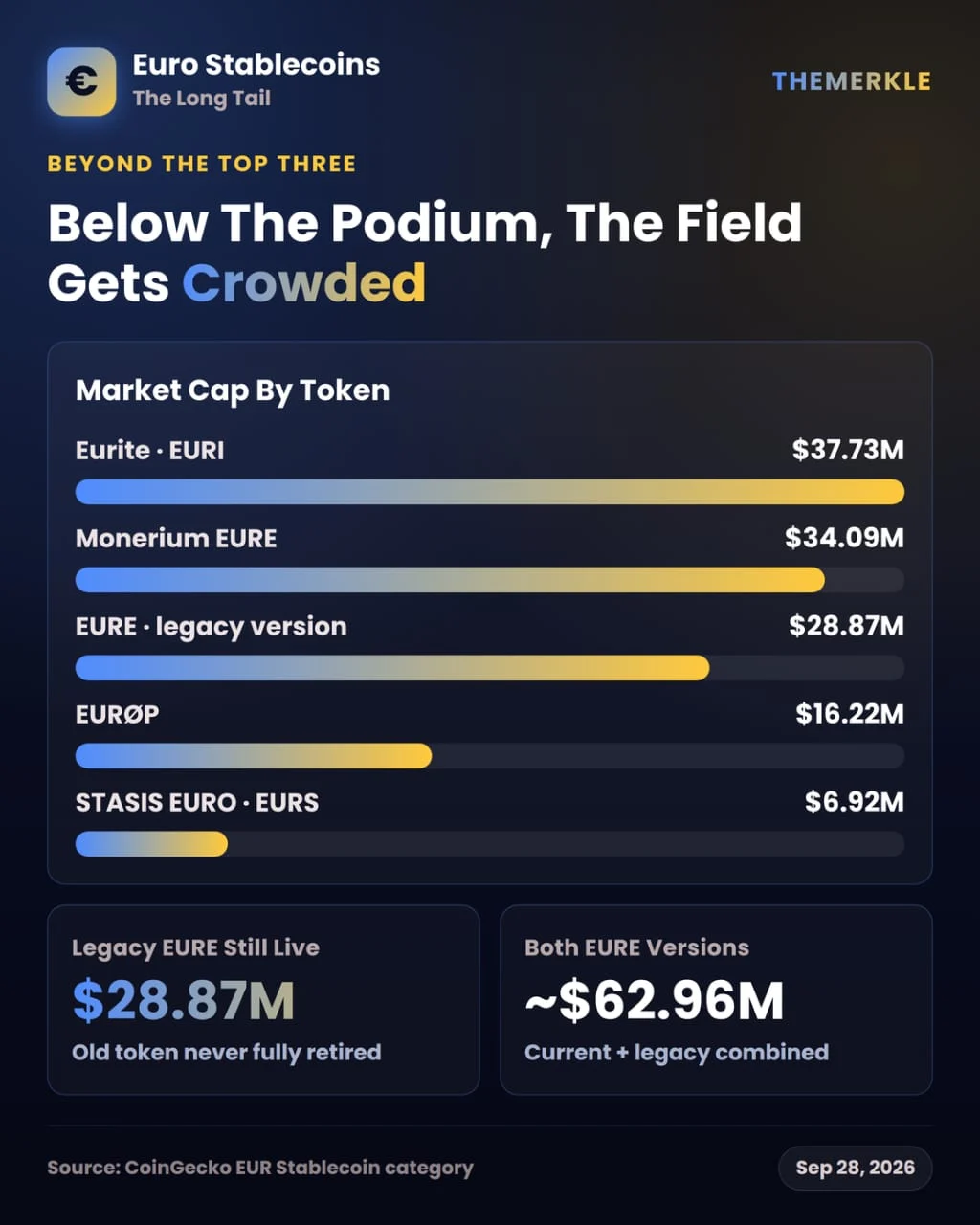
Further down the list, Eurite (EURI), issued by Banking Circle, registers a market cap of $37.72 million. Monerium’s EUR emoney token (EURE) presents an interesting case, appearing twice in the rankings with $34.08 million for its current version and $28.87 million for an older, legacy version still in circulation. This phenomenon is a common reminder that stablecoin migrations and upgrades do not always result in the immediate and complete retirement of older token versions, leading to potential fragmentation of liquidity and confusion.

Other notable mentions include EURxP at $16.22 million, and STASIS EURO (EURS), one of the oldest euro stablecoins still active, trailing at $6.92 million. Despite its smaller size, EURS was among the day’s stronger movers, up 32.8%, again reflecting the higher volatility often seen in less liquid assets. Euro Tether also appeared among the day’s gainers, up 39.7%, though its market cap remains a mere fraction of its dominant dollar counterpart, USDT, issued by the same company. This diverse but highly fragmented landscape underscores the "small pie" problem, where numerous issuers compete for a limited pool of capital and users.
The Structural Problem: Liquidity Depth and Network Effects
The enduring challenge for euro stablecoins is not a lack of options or innovative issuers, but rather a profound issue of liquidity depth and the prevailing defaults within crypto’s global trading infrastructure. The entire euro category generating just $25 million in daily trading volume stands in stark contrast to the billions, sometimes tens of billions, transacted daily in dollar stablecoins. This thin liquidity means that euro-denominated tokens simply cannot support the kind of large-scale swaps, sophisticated lending markets, and efficient cross-chain routing that dollar stablecoins handle seamlessly across nearly every decentralized finance (DeFi) protocol and centralized exchange globally.
This scarcity of liquidity creates a self-reinforcing cycle. Traders and institutions tend to avoid euro pairs because slippage – the difference between the expected price of a trade and the price at which the trade is executed – is significantly worse due to limited order books. This avoidance, in turn, keeps liquidity thin, perpetuating the cycle. Dollar stablecoins did not achieve their $300 billion-plus market position purely through technological superiority; they earned it through years of being the default settlement asset everywhere, establishing unparalleled network effects and liquidity pools. Euro stablecoins are only just beginning to build towards such a position, facing the uphill battle of dislodging an deeply entrenched incumbent.
Implications and the Path Forward
The current state of euro stablecoins, while representing a significant regulatory milestone with MiCA and the emergence of institutional players like Société Générale, remains a rounding error next to the dollar-denominated market. The category’s slight contraction on a day when individual tokens posted double-digit gains further illustrates that much of this space is still driven by small-cap volatility rather than the deep, predictable liquidity that characterizes a mature stablecoin market.

For euro stablecoins to genuinely close the gap, several critical developments are necessary:
- Full MiCA Implementation and Adoption: The complete rollout of MiCA by December 2024 will provide the long-awaited regulatory clarity and certainty. This must be followed by widespread adoption of MiCA-compliant stablecoins by European financial institutions and businesses, fostering trust and encouraging broader use.
- Increased Institutional Participation: While Société Générale’s entry is positive, more major European banks and financial service providers need to issue and integrate euro stablecoins into their operations. This would bring significant capital, credibility, and liquidity.
- Compelling Use Cases and Integration: Euro stablecoins need to find and dominate specific use cases where they offer clear advantages over traditional banking or dollar stablecoins. This could include intra-Eurozone cross-border payments, specific DeFi applications catering to European users, or tokenized asset markets denominated in euros.
- Enhanced Liquidity Pools and Trading Pairs: Crypto exchanges and DeFi protocols need to incentivize deeper euro stablecoin liquidity pools. This could involve liquidity mining programs, dedicated euro-centric trading venues, or integration into major fiat on/off-ramps for European users.
- Addressing Network Effects: Overcoming the dollar’s network effect requires a concerted effort to build an alternative, robust ecosystem around the euro. This is a long-term endeavor that will involve collaboration between regulators, financial institutions, and blockchain innovators.
The journey for euro stablecoins is one of evolution and adaptation. While the current numbers might paint a challenging picture, the foundational regulatory work of MiCA, coupled with strategic moves by key players, sets the stage for potential future growth. However, closing the monumental gap with dollar stablecoins will require far more than regulatory frameworks; it will demand the establishment of euro-denominated liquidity as the default in contexts where it currently is not, fostering a robust, liquid, and trusted ecosystem that can genuinely compete on the global stage.
Disclosure: This is not trading or investment advice. Always do your research before buying any cryptocurrency or investing in any services.
Follow us on Twitter @themerklehash to stay updated with the latest Crypto, NFT, AI, Cybersecurity, and Metaverse news!