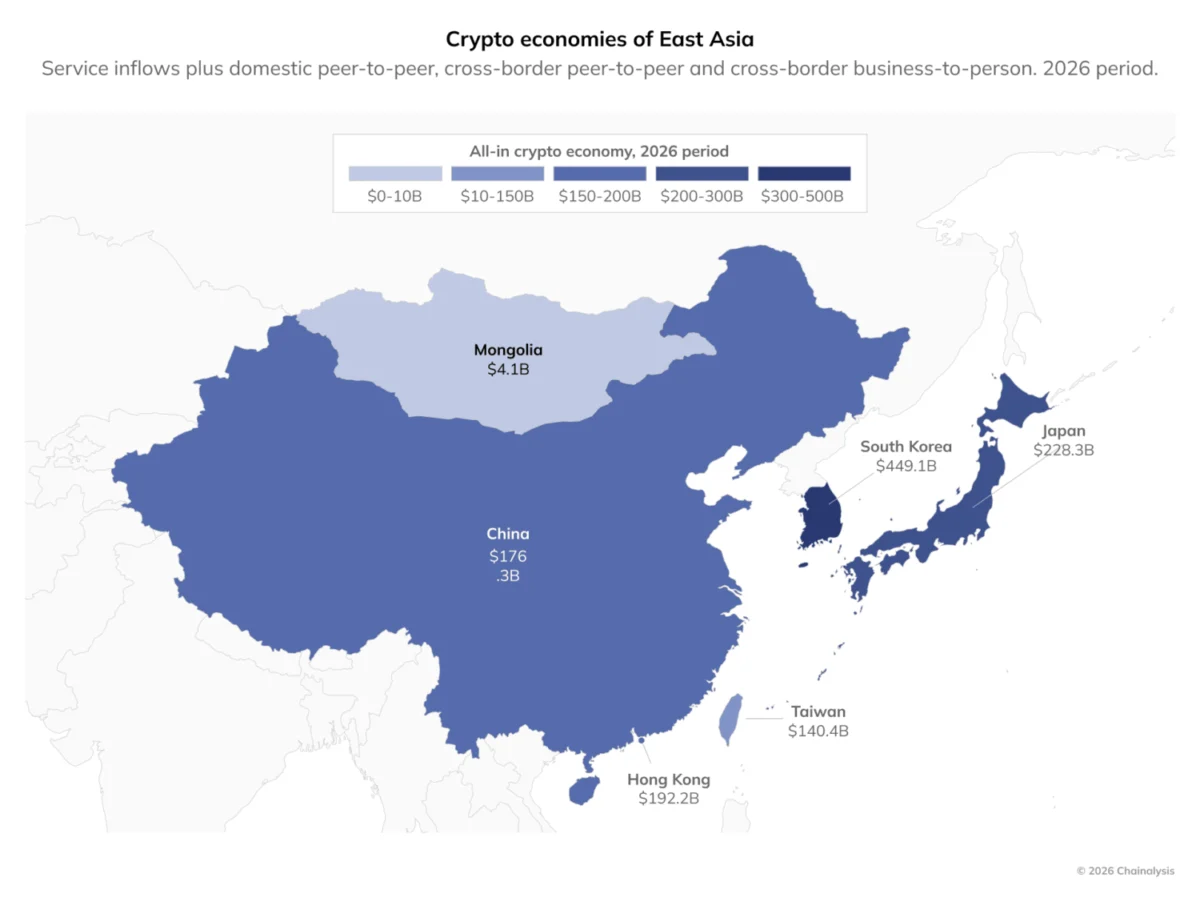
The crypto economy of East Asia has emerged as one of the most complex and diverse financial landscapes in the world, characterized by a stark divergence in regulatory approaches, investor risk appetites, and localized business objectives. During the period spanning July 2025 to June 2026, the region experienced a modest overall contraction in line with the global cryptocurrency bear market; however, this headline figure obscures a series of robust growth stories within specific jurisdictions. While the broader market tightened, institutional inflows into Hong Kong surged by 87%, and Japanese retail users increasingly migrated toward decentralized exchanges (DEXs), where inflows rose by 36%. Meanwhile, South Korea maintained its position as a regional titan, boasting a $449 billion crypto economy driven by an unprecedented pivot toward artificial intelligence (AI)-linked digital assets.

This period of transformation highlights the dual nature of the Asian market. As Daniel Kim, CEO of Tiger Research, observed, the region remains a rare global outlier that possesses both immense grassroots retail depth and sophisticated institutional firepower. The following analysis explores the specific drivers of these trends, the regulatory shifts shaping the landscape, and the unique socio-economic factors influencing adoption across South Korea, Japan, Hong Kong, and Mainland China.
South Korea: The Epicenter of Retail Activity and the AI-Crypto Trade
South Korea remains the largest crypto economy in East Asia, with its $449 billion total valuation representing a 12.3% increase over the previous reporting period. This growth was fueled primarily by a 16.3% expansion in the domestic exchange ecosystem. Unlike other global markets where institutional participation drives volume, South Korea’s market remains "famously retail-driven," according to Francis Kang, Executive Director of Korea Blockchain Week.

The defining characteristic of the South Korean market during this period was the massive shift toward "AI-crypto assets." This trend developed in tandem with the country’s mainstream equity market, which is heavily dominated by semiconductor giants like SK Hynix. As global interest in AI-focused data centers exploded, Korean retail investors sought exposure through digital assets associated with AI infrastructure and projects. By June 2026, AI cryptocurrencies became the single most popular thematic investment category by share of won-denominated trading volume.
The scale of this "AI trade" in South Korea is a global anomaly. Won-denominated trading of AI assets was 19.5 times higher than Japanese yen-denominated trading during the same period. To put this in a broader perspective, while AI tokens represented a significant portion of Korean volume, they accounted for only 1.02% of Euro-denominated activity and a mere 0.03% of British Pound-denominated activity. Worldcoin (WLD) led the surge with $7.41 billion in volume, followed by newcomers like SAHARA ($3.2 billion) and VIRTUAL ($2.7 billion).

Despite this retail fervor, South Korea’s institutional sector remains in a "preparatory mode." Legislative roadblocks have historically prevented major financial firms from investing directly in crypto. However, a significant shift began in February 2026 when the government started easing a long-standing ban on corporate crypto trading. Furthermore, a roadmap released by the Financial Services Commission in early 2025 has paved the way for nonprofits and listed companies to eventually enter the market. The looming 22% tax on crypto profits, scheduled for 2027, remains a point of contention that could suppress retail demand while potentially signaling the start of a more regulated, institutional era.
Japan: The Rise of On-Chain Trading and Institutional Integration
Japan’s $228 billion crypto economy presents a different narrative, one increasingly defined by the integration of digital assets into the traditional financial system. While Japan is often viewed through the lens of its massive banks and brokerage firms, the 2026 data reveals a surprisingly vibrant consumer sector.

One of the most notable trends in Japan was the 36% rise in inflows to decentralized exchanges (DEXs). Currently, DEXs hold a 34.5% market share of the Japanese services industry—the highest in the region for a market with a mature centralized exchange (CEX) sector. This shift is driven by a sophisticated retail base. Approximately 25% of users who withdraw funds from Japanese CEXs later deposit them into DeFi protocols.
Taishi Sato, CEO of DeFimans (a subsidiary of SBI), notes that Japanese traders are particularly active in perpetual futures (perps). Sato attributes this to Japan’s historically high population of foreign exchange (FX) traders, who are well-versed in hedging and macro exposure. These traders are now using on-chain venues like Hyperliquid to manage risk alongside their traditional equity portfolios.

On the institutional side, the focus has shifted toward "digital assets" as a broad business line, including stablecoins, real-world assets (RWA), and tokenized deposits. The launch of yen-denominated stablecoins, such as JPYC in October 2025 and SBI Group’s JPYSC in June 2026, marks a critical step toward connecting the existing financial system to on-chain markets. Experts anticipate that recent tax reforms—which aim to lower the maximum marginal tax rate on crypto from 55% to a flat 20%—will catalyze a significant boost in both retail and institutional volume in 2027.
Hong Kong: A Strategic Institutional Hub
Hong Kong has successfully positioned itself as the institutional settlement layer for East Asia’s crypto economy. With a $192 billion economy, the city’s growth is a direct result of government policy that places digital assets at the core of its financial strategy. According to SB Seker, Head of APAC at Binance, Hong Kong has proven that regulatory clarity and financial innovation can advance in parallel.

The data supports this: institutional platforms, including OTC desks and custody providers, accounted for 16% of Hong Kong’s service inflows during the 2026 period. This is nearly three times the institutional share of any other regional neighbor. Furthermore, Hong Kong received $24 billion in inbound business-to-business (B2B) service-to-service transfers—six times more than Japan and 44 times more than South Korea.
This institutional capital is not merely passing through; it is settling within Hong Kong’s regulated perimeter. Since mid-2022, cumulative net B2B inflows have reached $17.4 billion. This trend suggests that while unregulated wallet activity is leaving the city, licensed services are capturing the market. Hong Kong’s Five-Year Plan and its focus on stablecoin licensing and central bank digital currencies (CBDCs) have created a "flight to quality" that favors large, compliant operators.

Mainland China: The Peer-to-Peer Economy and the Social Credit Link
Mainland China remains a paradox. Despite a long-standing official ban on crypto services, its crypto economy is estimated to be at least $176 billion. The most striking development in China is the explosion of the peer-to-peer (P2P) economy, which now accounts for 59.1% of the country’s total crypto activity—a 3.5-fold increase in share over the previous year.
This surge in P2P activity appears to be linked to domestic policy changes. In March 2025, Chinese officials expanded the national social credit system to include financial and internet behavior. This system can restrict access to banking, travel, and employment based on behavioral scores. Consequently, there has been a clear shift toward using stablecoins for domestic payments. Monthly stablecoin activity grew from $240 million in March 2025 to nearly $5 billion by June 2026.

The velocity of money in China further illustrates this trend. Chinese users turn over their self-custodied stablecoin holdings at a rate of 33.2 times per year—more than three times the world average. This suggests that stablecoins are being used as functional working capital and a domestic payment rail rather than a long-term store of value. Users blacklisted by the social credit system or those seeking to avoid monitoring are increasingly concluding transactions via crypto addresses shared over encrypted messaging apps like Telegram.
Chronology of Key Regional Events (2025–2026)
- February 2025: Hong Kong’s Financial Services Commission announces a roadmap for corporate crypto participation.
- March 2025: China updates and expands its Social Credit System, triggering a steady climb in domestic P2P stablecoin payments.
- July 2025: Start of the reporting period; East Asia enters a period of diverse regulatory testing.
- October 2025: Launch of JPYC, the first major yen-denominated stablecoin in Japan.
- February 2026: South Korean government begins easing the ban on corporate crypto trading.
- June 2026: Launch of JPYSC by SBI Group; South Korean AI-crypto trading hits record highs.
- July 2026: Japan advances major tax reforms to transition crypto gains to a 20% separate taxation bracket.
Broader Impact and Future Implications
The developments in East Asia provide a definitive case study on the impact of regulation. While China’s prohibition has not eliminated activity but rather pushed it into a high-velocity P2P shadow economy, the "supervised-access" regimes in Hong Kong, Japan, and South Korea are successfully channeling capital into licensed perimeters.

The divergence between these markets suggests that there is no "one-size-fits-all" model for crypto adoption. South Korea proves that retail enthusiasm can sustain a massive economy even without institutional support. Hong Kong demonstrates that regulatory clarity can attract global B2B capital. Japan shows how traditional financial expertise can be repurposed for on-chain trading.
As the region moves into 2027, the primary question will be whether these regulated channels can continue to absorb the activity currently moving offshore or through unregulated P2P networks. With South Korea’s upcoming tax implementation and Japan’s tax relief, the next twelve months will likely see a rebalancing of the retail and institutional sectors, further solidifying East Asia’s role as the primary engine of global crypto innovation.