Ethereum, the second-largest cryptocurrency by market capitalization, is currently navigating a critical juncture, exhibiting indecision and signs of potential exhaustion as its price hovers below the $2,700 mark. This prolonged period of consolidation over the past week suggests a pivotal moment for the digital asset, with significant implications for its short-term trajectory and the broader altcoin market. The current trading range, characterized by a lack of decisive upward or downward momentum, has drawn the attention of analysts and investors alike, all keen to understand whether this period of stagnation will precede a bullish surge or a bearish correction.
Analysis of Key Price Levels and Market Sentiment
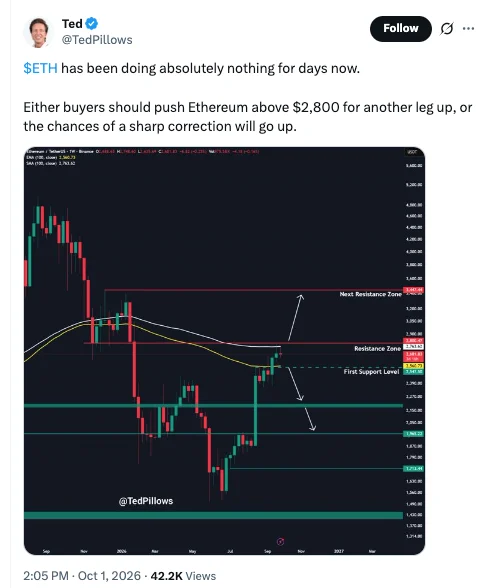
Prominent crypto analyst Ted Pillows recently articulated his perspective on the cryptocurrency’s immediate future via a widely shared social media post. According to Pillows, the $2,800 level represents the next crucial battleground. For Ethereum’s bulls to maintain control and potentially initiate a renewed upward trend, a decisive and sustained break above this resistance is paramount. Failure to achieve this could embolden the bears, paving the way for a significant price decline. The analyst’s commentary underscores the delicate balance of power between buyers and sellers in the current market environment.
At the time of this report, Ethereum was trading around the $2,620 mark. This price point positions ETH between two key moving averages, indicating a lack of clear directional bias. The 100-day Simple Moving Average (SMA) stands as a resistance at approximately $2,780, while the 100-day Exponential Moving Average (EMA) offers support near $2,560. This proximity to both averages suggests that either bulls or bears could gain the upper hand with a decisive move. If the bears succeed in pushing the price below the $2,560 EMA, a cascade of further price drops could ensue, with critical support levels to watch at $2,547, $1,965, and even $1,713. These levels represent significant historical price floors, and a breach of any of them would signal a substantial downturn for the asset.
The October Conundrum: Historical Trends vs. Recent Realities
The month of October has historically been viewed with optimism by cryptocurrency enthusiasts, often dubbed "Uptober" due to a statistically observed tendency for positive price action. Data analysis over the past decade indicates that in 13 out of the last 10 Octobers, the cryptocurrency market has experienced net bullish activity. This historical precedent typically provides a psychological boost to investors anticipating a seasonal upturn.
However, recent market memory serves as a stark reminder that historical trends are not guarantees. Last October, for instance, witnessed one of the most significant events in the history of cryptocurrency derivatives trading: massive liquidations exceeding $15 billion. This event was widely interpreted as a premature end to the 2024-2025 bull market, demonstrating the potential for unforeseen and dramatic shifts in market sentiment and liquidity.

This year’s October has, thus far, failed to ignite the anticipated bullish fervor. The initial week, often considered a bellwether for the month’s performance, has seen major cryptocurrencies trading sideways or experiencing modest declines. This lack of upward momentum is a cause for concern among those who were banking on a strong start to the month. While there is still ample time for bulls to assert their dominance, the current trading patterns are not indicative of a robust recovery. The fact that key levels just below multi-month highs are still being defended offers a sliver of hope, but the overall sentiment remains cautious.
Ethereum’s Pivotal Role in the Broader Crypto Ecosystem
The performance of Bitcoin (BTC) and Ethereum (ETH) is frequently seen as a barometer for the entire cryptocurrency market. As the two largest and most influential digital assets, their price movements and market dominance often dictate the trends for a vast array of altcoins. Ethereum, in particular, holds a significant position due to its integral role in the decentralized finance (DeFi) ecosystem and its continued adoption as a platform for non-fungible tokens (NFTs) and other decentralized applications.
The current vulnerability of Ethereum’s price, if it continues, could have a ripple effect across the altcoin market. A sustained downturn in ETH’s price could lead to reduced investor confidence and capital outflow from the broader altcoin space, as many smaller projects are closely correlated with Ethereum’s performance. The strength and stability of the altcoin market are intrinsically linked to Ethereum’s positioning, making its current indecisive state a source of anxiety for many participants in the decentralized economy.
Underlying Technical Factors and Potential Catalysts
The technical indicators surrounding Ethereum suggest a market at a crossroads. The convergence of the 100-day SMA and EMA around the current trading price indicates a period of equilibrium, where neither buyers nor sellers have a clear advantage. This equilibrium is inherently unstable and often precedes a significant price breakout or breakdown.
Several factors could potentially act as catalysts for a decisive move. On the bullish side, positive developments in Ethereum’s network upgrades, such as advancements in its scaling solutions like Ethereum 2.0 (now referred to as the consensus layer and execution layer upgrades), could reignite investor interest. Announcements regarding increased institutional adoption, significant partnerships, or favorable regulatory clarity would also serve as powerful bullish catalysts.
Conversely, negative sentiment could be triggered by macroeconomic factors such as rising inflation, interest rate hikes by central banks, or increased regulatory scrutiny of cryptocurrencies. Technical breakdowns below key support levels, coupled with large-scale sell-offs in Bitcoin, could also push Ethereum into a more pronounced bearish phase.

Historical Performance and Market Cycles
To understand the current situation, it is helpful to consider Ethereum’s historical performance within the context of broader market cycles. Ethereum experienced a significant bull run in late 2020 and throughout 2021, reaching an all-time high of over $4,800 in November 2021. This surge was driven by a confluence of factors, including the growing popularity of DeFi, the NFT boom, and a general surge in cryptocurrency adoption fueled by retail and institutional interest.
Following this peak, Ethereum, like the rest of the crypto market, entered a prolonged bear market in 2022. This downturn was characterized by a sharp decline in prices, attributed to a combination of macroeconomic headwinds, the collapse of major crypto entities like Terra/Luna and FTX, and a general deleveraging across financial markets.
The recovery that began in late 2023 and continued into early 2024 saw Ethereum regain significant ground, approaching its previous all-time highs. However, the recent price action suggests that the upward momentum has stalled, raising questions about the sustainability of this recovery and whether the market is poised for another correction or a continuation of the bull trend. The current consolidation phase could be interpreted as a healthy pause before a further ascent, or as a precursor to a more significant pullback.
Broader Implications for the Digital Asset Landscape
The current trading behavior of Ethereum carries significant implications beyond its own price chart. As a foundational platform for a vast ecosystem of decentralized applications, its stability and growth are crucial for the entire Web3 narrative. A prolonged period of stagnation or a sharp decline in ETH’s price could dampen innovation and investment in the DeFi, NFT, and metaverse sectors, which rely heavily on the Ethereum network.
Furthermore, the correlation between Bitcoin and Ethereum means that any significant movement in ETH’s price will likely be mirrored, to some extent, by Bitcoin and the broader altcoin market. If Ethereum succumbs to bearish pressures, it could signal a broader market downturn, impacting the investment strategies of both retail and institutional players. Conversely, a successful breakout above the key resistance levels could provide the necessary catalyst for a renewed wave of optimism and investment across the digital asset space.
The market’s attention is now firmly fixed on the $2,800 resistance level. The ability of Ethereum’s bulls to overcome this hurdle will be a critical determinant of its near-term trajectory. The coming days and weeks will likely reveal whether October will indeed live up to its "Uptober" moniker for Ethereum, or if the bears are poised to assert their dominance, leading to a period of price depreciation. The ongoing battle between bullish and bearish forces at this critical price point will shape the narrative for Ethereum and the wider cryptocurrency market in the immediate future. The interplay of technical indicators, market sentiment, and potential external catalysts will be closely monitored by all participants as they navigate this period of heightened uncertainty.