The cryptocurrency market is abuzz with anticipation as major financial institutions, including BlackRock and Fidelity, have formally submitted applications to the U.S. Securities and Exchange Commission (SEC) for spot Ether Exchange Traded Funds (ETFs). This significant development signals a potential watershed moment for Ethereum (ETH) and the broader digital asset ecosystem, moving it closer to mainstream financial integration. Adding to the bullish sentiment, Tom Lee, Chief Executive of Bitmine, has projected a remarkable price target of $6,000 for ETH by the end of the year, reigniting optimism among strategic investors.
The Growing Momentum for Spot Ether ETFs
The recent filings by financial titans like BlackRock and Fidelity represent a crucial step in the ongoing efforts to bring spot Ether ETFs to market. These applications follow a period of intense speculation and strategic maneuvering within the crypto industry, particularly after the SEC’s approval of spot Bitcoin ETFs earlier this year. The approval of spot Bitcoin ETFs marked a significant milestone, offering traditional investors a regulated avenue to gain exposure to Bitcoin without directly holding the cryptocurrency. The success and substantial inflows into these Bitcoin products have naturally fueled demands for similar vehicles for other major digital assets, with Ethereum being the most prominent.
BlackRock, the world’s largest asset manager, and Fidelity, a long-standing player in the financial services industry, bring immense credibility and market reach to the table. Their involvement suggests a growing conviction among institutional players that digital assets, and specifically Ethereum, are poised for further growth and wider adoption. The SEC’s decision on these spot Ether ETF applications will be closely watched, as it will not only impact Ethereum’s price but also set a precedent for future digital asset investment products. The regulatory landscape remains a key determinant in the pace of institutional adoption, and a positive ruling could unlock substantial capital inflows into the Ethereum market.
Tom Lee’s Bold Prediction for Ethereum
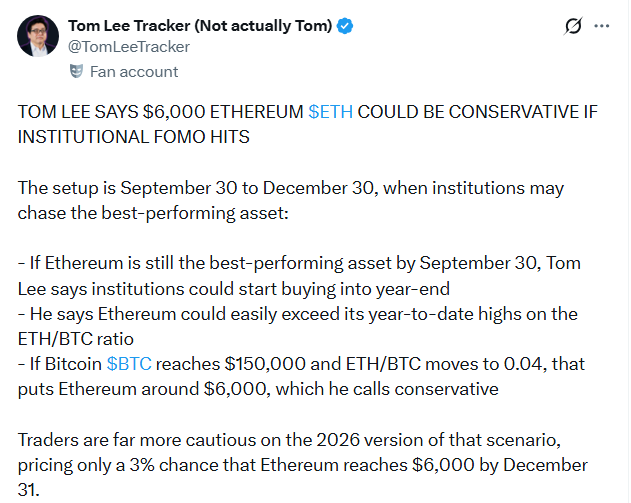
Amidst this institutional push, prominent financial analyst Tom Lee, CEO of Bitmine, has offered a particularly optimistic outlook for Ethereum. In a recent broadcast, Lee articulated a bullish case for ETH, forecasting a potential surge to $6,000 by the close of the current year. This projection is not merely speculative; it is rooted in Lee’s deep understanding of Ethereum’s market dynamics, historical performance, and its evolving utility within the digital economy.

Lee’s conviction in Ethereum is well-established. Bitmine, under his leadership, has strategically incorporated ETH into its investment portfolio, demonstrating a long-term belief in its growth potential. This strategic approach, honed through years of navigating the volatile crypto markets, provides a solid foundation for his price targets. Lee’s analysis transcends short-term trading fluctuations, focusing instead on the interplay of fundamental drivers, technological advancements, and macroeconomic factors.
Underlying Factors Driving the Bullish Outlook
Tom Lee’s prediction of $6,000 ETH is underpinned by several key factors:
1. Historical Price Sensitivity and Market Cycles: Lee acknowledges that ETH’s price history is intrinsically linked to technological catalysts and broader market cycles. The significant bull run in 2021, for instance, was largely propelled by the explosive growth of Non-Fungible Tokens (NFTs) and Decentralized Finance (DeFi), both of which are built on the Ethereum blockchain. As these sectors continue to mature and innovate, they are expected to provide ongoing demand and utility for ETH.
2. Macroeconomic Influences and Regulatory Clarity: Beyond internal market dynamics, Lee emphasizes the critical role of macroeconomic conditions. Factors such as regulatory clarity from bodies like the SEC, the increasing adoption of digital assets by institutional investors, and shifts in global interest rate policies are all seen as significant drivers for ETH’s trajectory. A more favorable regulatory environment, coupled with sustained institutional interest, could significantly boost investor confidence and capital allocation towards Ethereum.
3. The Bitcoin-Ethereum Correlation and Market Dominance: Lee’s projection is also contingent on a strong performance from Bitcoin. He posits that if Bitcoin reaches $150,000, a scenario he deems plausible, Ethereum’s market strength would proportionally increase. This correlation is often observed in the crypto market, where Bitcoin’s price movements tend to influence the broader altcoin market. However, Lee also anticipates ETH’s ability to strengthen relative to BTC as adoption rises, suggesting a potential for outperformance.
4. Emerging Use Cases: Tokenization and Institutional Utility: The growing trend of asset tokenization, where real-world assets are represented on the blockchain, is expected to be a significant tailwind for Ethereum. As a leading platform for smart contracts and decentralized applications, Ethereum is well-positioned to facilitate this transition. Furthermore, the increasing exploration of Ethereum for institutional use cases, beyond simple investment, is likely to drive demand for ETH as a transactional asset and a component of broader financial infrastructure.
5. On-Chain Activity and Network Demand: The underlying health of the Ethereum network, measured by on-chain activity, is another crucial indicator. Robust transaction volumes, growing developer engagement, and the increasing utilization of decentralized applications (dApps) all contribute to sustained demand for ETH, which is used to pay for transaction fees and power smart contracts. Lee’s analysis likely incorporates these fundamental metrics, suggesting that the network’s utility is growing in line with its potential price appreciation.
Ethereum’s Current Market Position: Consolidation and Anticipation
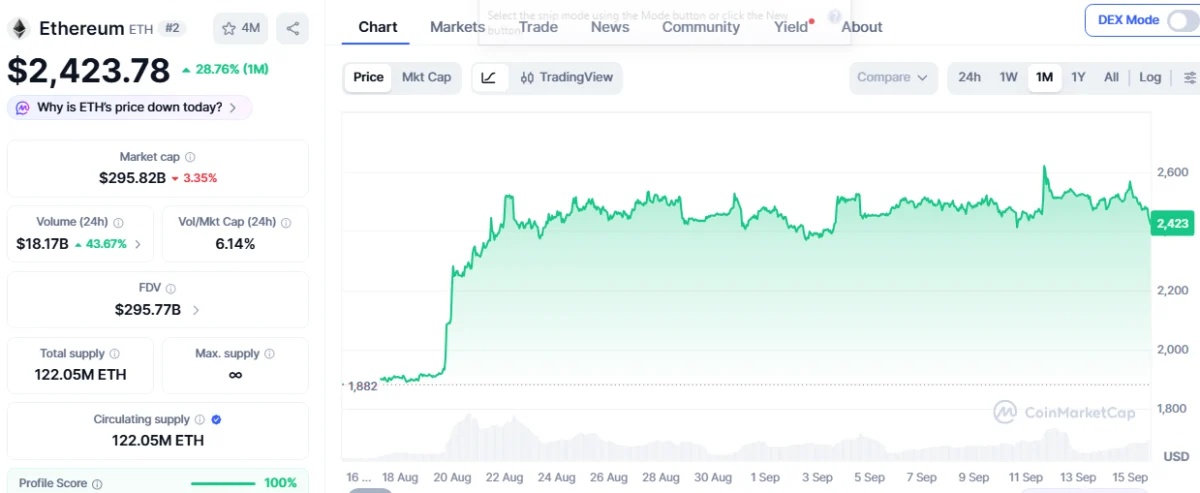
As of the latest reporting, Ethereum is trading around the $2,400 mark, exhibiting a slight decline of approximately 0.9% over the past week. This period of consolidation follows a recent rally that saw ETH climb back towards the $2,600 level observed on September 7th. The asset has managed to maintain support above the $2,400 threshold, a crucial psychological and technical level.
This consolidation phase can be interpreted as a natural pause after a period of upward momentum. The market appears to be digesting recent gains and awaiting further catalysts. Technical analysts are closely watching the next resistance level at $2,546. Market data suggests that institutional buyers may continue to exert upward pressure, potentially pushing ETH towards the $2,600-$2,670 range in the short term. This sustained buying interest from institutional players is a critical factor that could propel ETH towards Lee’s ambitious year-end target.
Broader Implications and Future Outlook
The confluence of institutional interest in spot Ether ETFs and optimistic price predictions from analysts like Tom Lee paints a picture of a maturing and increasingly accepted asset class. The potential approval of spot Ether ETFs by the SEC would represent a significant validation of Ethereum as an investment vehicle, potentially attracting a new wave of capital from retail and institutional investors alike. This influx of funds could not only drive up the price of ETH but also foster further development and innovation within the Ethereum ecosystem.

The broader impact extends beyond mere price appreciation. The increased accessibility through ETFs could democratize investment in Ethereum, making it easier for a wider range of individuals to participate in its growth. Moreover, the regulatory clarity that often accompanies such approvals can reduce perceived risks, encouraging more conservative investors to consider digital assets.
However, it is crucial to acknowledge the inherent volatility and risks associated with cryptocurrency investments. The SEC’s decision-making process is complex and subject to various considerations, including market manipulation concerns, investor protection, and the overall stability of the cryptocurrency market. While the outlook is promising, the path to widespread institutional adoption is likely to be iterative and dependent on ongoing regulatory developments and market performance.
In conclusion, the pursuit of spot Ether ETFs by major financial institutions, coupled with robust price forecasts from industry experts, underscores a pivotal moment for Ethereum. The coming months will be critical in determining whether these developments translate into sustained price growth and deeper integration of ETH into the global financial landscape. Investors and observers will be keenly watching the SEC’s pronouncements and the subsequent market reactions, anticipating what could indeed be Ethereum’s "big moment."