The Middle East and North Africa (MENA) region navigated a period of profound geopolitical volatility and economic recalibration between July 2025 and June 2026, a year defined by the dual pressures of a global crypto bear market and regional armed conflict. Despite these headwinds, the regional crypto economy demonstrated remarkable resilience, slipping only 1.4% in total value to $443.3 billion, down from $449.6 billion the previous year. This minor contraction, which mirrored global trends, masks a deeper narrative of institutionalization and the emergence of digital assets as critical financial infrastructure. While the total regional volume remained relatively flat, 16 out of 24 measurable markets in the region saw growth, offset primarily by a licensing transition in Türkiye and the broader economic drag of the Iran conflict that erupted on February 28, 2026.

Regional Chronology and Geopolitical Catalysts
The reporting period was punctuated by a series of events that fundamentally altered the trajectory of crypto adoption across the MENA landscape. The timeline of the year reflects a market responding in real-time to external shocks:
- July 2025: The period begins with the MENA region holding a dominant share of global retail crypto activity, particularly in high-inflation markets.
- September 2025: International regulatory bodies, including OFAC, increased scrutiny on Iranian shadow banking networks, pushing more grassroots activity toward decentralized and peer-to-peer (P2P) platforms.
- January 2026: Domestic economic protests in Iran led to a state-mandated 20-day internet blackout. Simultaneously, the Turkish Ministry of Treasury and Finance announced the Precious Metal Tracking System (KMTS), signaling a crackdown on the informal gold economy.
- February 28, 2026: The outbreak of the Iran conflict created immediate cross-border economic pressure. Iran entered a second, more severe 88-day internet shutdown.
- March 2026: Direct drone and missile strikes impacted Emirati territory, prompting a sharp shift in investment behavior within the UAE, as holders moved from Bitcoin into tokenized gold.
- April 2026: Türkiye began full enforcement of the KMTS, effectively banning cash transactions for physical gold and driving record volumes into tokenized gold assets.
- June 2026: The reporting period concludes with a regional market in transition, as the UAE narrows the gap with Türkiye for the title of the region’s largest crypto economy.
Türkiye’s $144.5 Billion Market: From Parallel Systems to Institutional Integration
Türkiye remains the undisputed leader of the MENA crypto economy, accounting for roughly one-third of the region’s total value received. However, the $144.5 billion market is undergoing a structural metamorphosis. The modest year-over-year contraction in volume does not indicate a retreat but rather a shift from unregulated, exchange-dominated activity to a sophisticated institutional landscape.

The primary driver of this change is a new regulatory regime requiring all Crypto Asset Service Providers (CASPs) to secure licenses from the Capital Markets Board of Türkiye (SPK). By mandating that crypto firms adhere to the same compliance protocols as traditional financial institutions, the law has "raised the operational bar for the whole industry," according to Burcu Küçükünal, CEO of the Turkish exchange Stablex. This sentiment is echoed by Salim Karaman, CEO of BtcTurk, who noted that the past 12 months marked a pivot from merely assessing market potential to developing regulated services. "Crypto in Türkiye is becoming part of traditional finance rather than a parallel system," Küçükünal observed.
Despite this institutionalization, a flourishing grassroots economy persists. Türkiye’s P2P market grew fivefold to $3.56 billion, nearly triple the combined P2P activity of the rest of the MENA region. This growth is almost entirely centered on stablecoins, which serve as a vital hedge against the persistent inflation of the Turkish lira. Because the Central Bank of the Republic of Türkiye prohibits crypto for direct payments, these funds primarily circulate as a dollar-denominated savings and transfer mechanism.

The UAE as a Global Institutional Hub
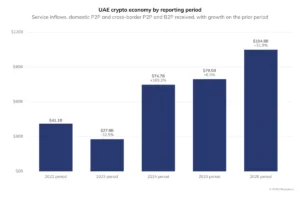
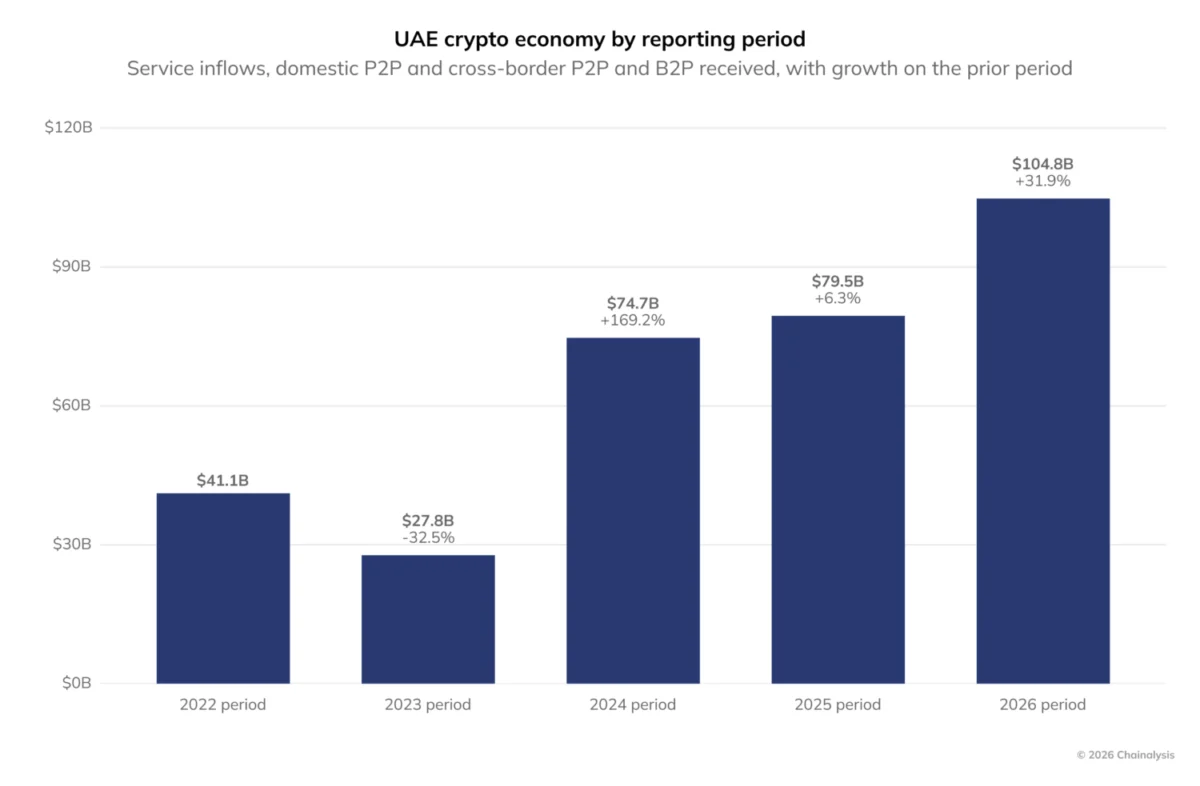
While Türkiye’s market underwent a regulatory transition, the United Arab Emirates (UAE) emerged as the region’s growth engine. The Emirates’ crypto economy expanded by 32% to reach $104.8 billion, a feat achieved despite the regional instability caused by the Iran war. Without the UAE’s contribution, the rest of the MENA region would have seen an 8.6% contraction rather than a 1.4% dip.
The UAE’s success is attributed to its proactive regulatory environment, led by Dubai’s Virtual Assets Regulatory Authority (VARA). Henri Arslanian, co-founder of Nine Blocks Capital Management, pointed out that the UAE has become a primary hub for global crypto operations outside the United States. The data supports this: institutional platform inflows in the UAE surged by 75% to $11.7 billion, while centralized exchange inflows grew by 22% to $55 billion.

Perhaps the most significant trend in the UAE is the maturation of use cases. Laurent Girouille, Senior Executive Officer at Rain Trading Limited, noted that the conversation has shifted from retail access to operational reconciliation. Large-scale transfers of $1 million or more in stablecoins have spiked by nearly 400%, signaling that stablecoins are increasingly viewed as essential financial infrastructure for B2B transactions and cross-border settlement.
The Surge of Tokenized Real-World Assets
A defining feature of the 2026 period was the explosive growth of tokenized gold, particularly in Türkiye and the UAE. In Türkiye, the catalyst was the KMTS cash-for-gold ban. Historically, Turkish households have hoarded an estimated 5,000 tons of physical gold "under the mattress." When the government restricted cash purchases of physical jewelry and bars to curb the informal economy, demand surged on-chain. Tokenized gold trading in Türkiye reached nearly $1 billion, making the Turkish lira the second most popular currency globally for buying digital gold, trailing only the U.S. dollar.

In the UAE, the shift toward tokenized gold was driven by the uncertainty of the Iran conflict. While Bitcoin initially served as a safe haven at the onset of the war, its popularity waned during brief periods of ceasefire. In contrast, tokenized gold holders demonstrated "stickiness," continuing to accumulate the asset even as Bitcoin holders sold off their positions. This suggests that in the Middle East, gold remains the ultimate store of value, and digital rails are simply the modern method of acquisition.
Iran’s Digital Resilience Amidst Blackouts
The Iranian crypto story remains one of the most complex in the world. Faced with two significant internet blackouts—a 20-day shutdown in January and an 88-day shutdown during the war—Iranian users demonstrated remarkable technical resilience. During the first week of the war-related blackout, Bitcoin transactions dropped by 80%. However, as the shutdown dragged on, activity gradually climbed back to 75% of the baseline, likely facilitated by satellite connections such as Starlink and other bypass methods.

Interestingly, while the blackouts prevented Iranians from spending crypto domestically, they did not stop the inflow of funds. Cross-border stablecoin transfers into Iranian personal wallets spiked to 150% of the baseline immediately before the blackouts, as users sought to move value into the country before the "digital doors" closed. Once the restrictions were lifted in late May, activity nearly doubled the baseline, suggesting that the blackouts had merely "bottled up" demand rather than extinguishing it.
Israel’s Retail Maturation and Stablecoin Bridging
Israel’s crypto economy remained an outlier, holding steady with a marginal 0.7% growth to $37.9 billion. Unlike its neighbors, Israel showed no visible reaction to the 2026 Iran conflict. Analysts suggest this is because the Israeli market had already undergone its major adjustment following the events of October 7, 2023.

The Israeli market remains predominantly retail-driven, with 98.4% of transfers into services valued at under $10,000. Stablecoins have become the primary bridge for Israeli users, accounting for 57% of service inflows. According to Ilan Sterk, CEO of Horizon, Israelis typically buy stablecoins locally and send them to offshore exchanges to access trading opportunities not available on domestic platforms. Only 0.06% of stablecoin inflows stayed within Israel-domiciled exchanges, highlighting a market that is functionally hosted abroad.
Broader Impact and Future Implications
The 2026 reporting period has solidified the MENA region’s status as a laboratory for the future of digital finance. The transition from speculative retail trading to institutional infrastructure is most evident in the UAE and Türkiye, which together account for 56% of the regional economy. The formalization of tokenized gold markets and the rise of B2B stablecoin settlements suggest that the region is moving beyond the "crypto for crypto’s sake" phase and into a period where digital assets solve real-world economic problems, such as inflation and inefficient cross-border payments.

Looking ahead to 2027, the trajectory of the UAE suggests it is on pace to surpass Türkiye as the region’s largest crypto economy. However, the true story of the region lies in its adaptation to crisis. Whether through the bypassing of internet blackouts in Iran, the regulatory integration of exchanges in Türkiye, or the institutional embrace in the UAE, the MENA region has proven that crypto adoption is no longer a luxury—it is a strategic necessity in an era of regional and economic uncertainty. The maturity of the Israeli market further suggests that once a population integrates digital assets into its financial toolkit, those assets become a permanent, stable fixture that no longer swings wildly with every new round of geopolitical conflict.