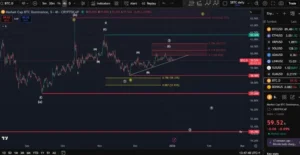
The digital asset market is currently witnessing a significant structural shift as Bitcoin, the world’s largest cryptocurrency by market capitalization, has breached a critical technical trendline that has supported its price action for several months. According to recent data and market observations from analysts including Justcryptopays, this technical breakdown suggests that the period of absolute Bitcoin dominance may be transitioning into a broader market rally, colloquially known as an "altcoin season." This phenomenon typically occurs when investors, having realized profits from Bitcoin’s primary ascent, begin reallocating capital into higher-beta assets such as Ethereum, Solana, and various mid-cap tokens in search of greater percentage returns.
As of early 2026, the cryptocurrency landscape is navigating a complex recovery phase following a volatile 2025. The recent price action around the $90,000 psychological threshold has become a focal point for institutional and retail traders alike. While Bitcoin briefly touched levels above this mark, its inability to maintain a sustained foothold has led to a cooling of momentum. Bitcoin is currently trading near $90,525, but the underlying technical indicators—specifically the break below its primary ascending trendline—indicate that the "path of least resistance" for the flagship coin may be sideways or downward in the short term, providing the necessary vacuum for altcoins to gain traction.
The Mechanics of Capital Rotation
In the cryptocurrency market, capital flow traditionally follows a predictable hierarchy. Money typically enters the ecosystem through Bitcoin, which serves as the primary gateway for institutional liquidity. Once Bitcoin reaches a state of relative price exhaustion or enters a consolidation phase, that liquidity begins to "trickle down" into the broader market. The first beneficiary is usually Ethereum (ETH), followed by large-cap assets like Solana (SOL) and XRP, before eventually reaching decentralized finance (DeFi) protocols, Web3 tokens, and speculative assets such as memecoins.
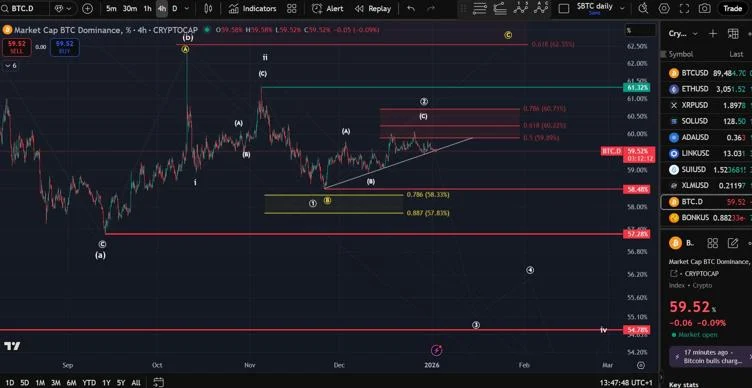
The current market data suggests we are in the early stages of this rotation. While Bitcoin’s market dominance—a measure of its share of the total crypto market cap—remains high, it has begun to show signs of topping out. Analysts point to the "Altcoin Season Index," which tracks the performance of the top 50 altcoins against Bitcoin over a 90-day period, as a key metric to watch. If 75% of the top 50 coins outperform Bitcoin during this window, a full-scale altcoin season is officially declared. Current trends indicate a narrowing gap, with several major assets already beginning to outpace Bitcoin’s daily percentage gains.
Technical Breakdown and the $90,000 Threshold
The significance of the $90,000 level for Bitcoin cannot be overstated. From a psychological standpoint, round numbers act as powerful magnets for buy and sell orders. For much of the previous quarter, $90,000 served as a formidable resistance level. When Bitcoin finally breached it, many expected a parabolic run toward $100,000. However, the failure to flip $90,000 into a reliable support floor has introduced a "fake-out" scenario.
When an asset breaks below a major trendline, it often signals a change in the prevailing trend from "bullish" to "neutral" or "corrective." For Bitcoin, this break suggests that the aggressive buying pressure seen in late 2025 is waning. This exhaustion is not necessarily a sign of a market crash, but rather a maturation of the current cycle. As Bitcoin stabilizes, volatility often decreases, creating a "low-volatility environment" that is historically favorable for altcoins, which thrive when the market leader is moving sideways.

The Role of Large-Cap Altcoins: Ethereum and Solana
Ethereum remains the primary bellwether for the altcoin market. As the foundational layer for the vast majority of decentralized applications, its price action often dictates the health of the broader ecosystem. Recent reports indicate that Ethereum is beginning to recover from its 2025 lows, driven by increased activity in Layer 2 scaling solutions and a resurgence in institutional interest via spot ETFs. If Ethereum can break through its own local resistance levels, it is expected to lead the charge for the rest of the altcoin market.
Solana, on the other hand, has emerged as a high-performance alternative that has captured a significant portion of the retail trading volume. Known for its high throughput and low transaction costs, Solana has become the preferred hub for memecoin launches and decentralized exchange (DEX) activity. The rotation of capital into SOL is often seen as a sign of "risk-on" sentiment, where traders are willing to move further down the risk curve in exchange for the potential of outsized gains.
DeFi and Web3: The Next Frontier
Beyond the top three assets, the DeFi and Web3 sectors are showing signs of life. Chainlink (LINK), often considered the "oracle" of the crypto industry, has recently broken its 21-day Moving Average (MA), a technical indicator that often precedes a multi-month upward run. Chainlink’s role in connecting blockchain networks with real-world data makes it a fundamental component of the "Real World Asset" (RWA) tokenization trend, which is expected to be a major theme in 2026.
Similarly, projects focused on decentralized identity, cross-chain interoperability, and AI-integrated blockchain services are attracting renewed venture capital interest. The bearish momentum of 2025 led to a "cleansing" of the market, where projects with weak fundamentals were weeded out. The remaining protocols are now leaner and more focused on utility, making them attractive targets for investors looking for long-term positioning as the market dynamics shift.
Historical Context and Market Sentiment
To understand the potential of a 2026 altcoin rally, one must look at the historical context of previous cycles. In 2017 and 2021, Bitcoin reached new all-time highs and then consolidated for several weeks. During those consolidation periods, the "altcoin dominance" chart surged, with many tokens experiencing 5x to 10x gains in a matter of months.
The sentiment in early 2026 is one of cautious optimism. While the memory of the 2025 downturn is still fresh, the underlying infrastructure of the crypto market has never been stronger. Institutional participation is at an all-time high, with major financial institutions offering custody services and investment products tailored to digital assets. This institutional "floor" provides a level of stability that was absent in previous cycles, potentially dampening the severity of corrections while allowing for more sustainable growth in the altcoin sector.
Analyst Perspectives and Projections
Market analysts are divided on the duration of this potential altcoin season. Some, like Justcryptopays, argue that the rotation is a natural evolution of the market cycle and could last for several months. Others caution that the global macroeconomic environment—including interest rate policies and geopolitical tensions—could still play a spoiler role.
"We are seeing a clear migration of liquidity," noted one senior analyst at a leading digital asset research firm. "Investors are no longer satisfied with the 5-10% moves in Bitcoin when they see the technological milestones being hit by projects like Cardano and XRP. The break of the Bitcoin trendline was the signal many were waiting for to hit the ‘buy’ button on their favorite altcoins."
Cardano (ADA) and XRP are particularly noteworthy in this context. XRP has benefited from increasing regulatory clarity in various jurisdictions, positioning it as a primary candidate for cross-border payment solutions. Cardano, meanwhile, continues to roll out its governance and scaling upgrades, appealing to investors who prioritize academic rigor and long-term network stability.
Risks and Challenges for Altcoin Bulls
Despite the bullish signals, the path forward for altcoins is not without obstacles. The primary challenge remains the "bearish hangover" from 2025. Many investors are still underwater on positions taken during the previous year’s peaks, leading to "overhead resistance" as these investors look to break even and exit their positions.
Furthermore, Bitcoin remains the ultimate arbiter of market health. If Bitcoin were to experience a sudden, sharp crash below $80,000, it would likely drag the entire market down with it, regardless of individual altcoin fundamentals. The "correlation" between Bitcoin and altcoins remains high during periods of extreme volatility, meaning that a stable Bitcoin is a prerequisite for a successful altcoin season.
Broader Impact and Market Implications
The shift toward an altcoin-centric market has broader implications for the blockchain industry. A successful altcoin season often leads to increased funding for developers, higher engagement with decentralized applications, and a general surge in innovation. It also validates the "multi-chain" thesis, proving that the future of finance is not limited to a single blockchain but rather a web of interconnected networks.
For retail investors, this period offers a window of opportunity to diversify portfolios. However, the increased volatility associated with altcoins requires a more disciplined approach to risk management. As capital continues to rotate and market dynamics evolve, the coming months will likely define the trajectory of the digital asset market for the remainder of 2026.
In conclusion, the breach of Bitcoin’s key trendline and its struggle to maintain the $90,000 level are not necessarily bearish omens for the industry at large. Instead, they represent a recalibration of the market. As capital flows from the "store of value" (Bitcoin) into the "utility and innovation" sectors (altcoins), the stage is set for a more balanced and diverse ecosystem. Vigilant traders and investors who can navigate this transition stand to benefit from what could be one of the most significant market shifts in recent years.