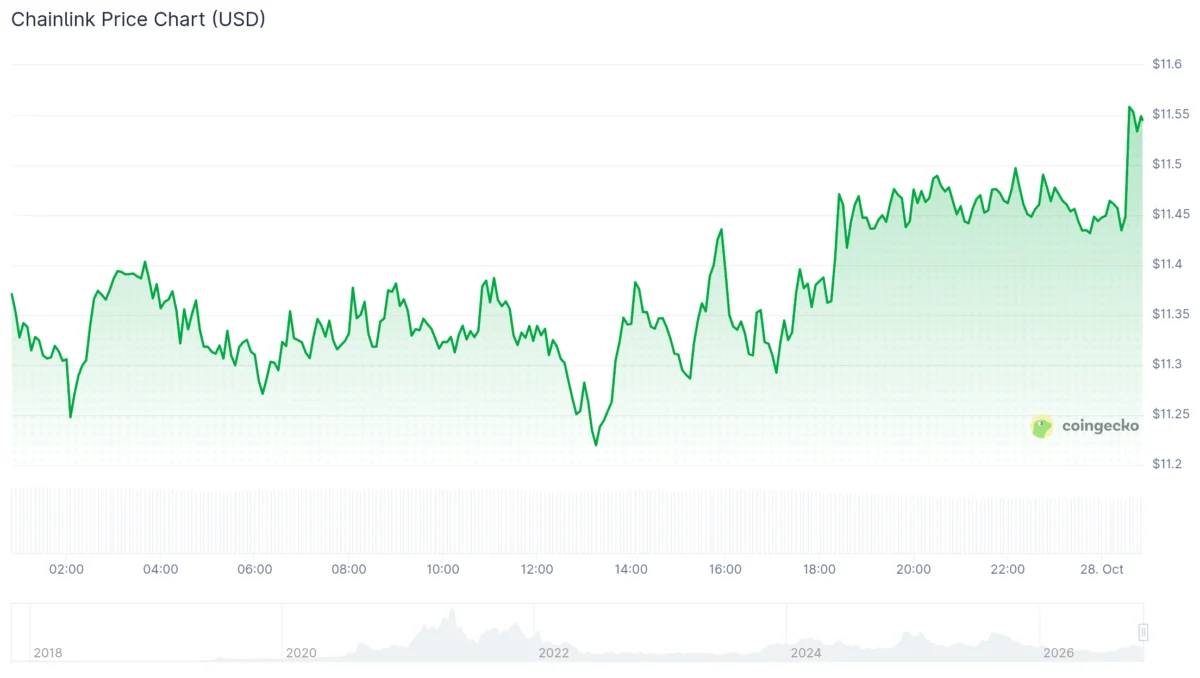
Chainlink, a leading decentralized oracle network, has significantly advanced its real-world asset (RWA) strategy through two pivotal institutional integrations: the onboarding of a gold-backed token from the Hong Kong Gold Exchange (HKGX) onto its Cross-Chain Interoperability Protocol (CCIP) and the adoption of its Automated Compliance Engine (ACE) by Further Asset Management in the Abu Dhabi Global Market (ADGM). These developments underscore Chainlink’s deepening role as foundational infrastructure for bridging traditional finance with blockchain technology, while its native token, LINK, currently navigates a critical technical support zone between $9 and $11.
The strategic move to integrate tokenized gold and robust compliance tools positions Chainlink at the forefront of the institutional adoption of blockchain-based financial instruments. Real-world assets, encompassing everything from commodities like gold and real estate to government bonds and private equity, are increasingly being tokenized – represented digitally on a blockchain. This process promises enhanced liquidity, fractionalization, increased transparency, and global accessibility, revolutionizing how these assets are managed and traded. Chainlink’s oracle network is crucial for this paradigm shift, providing secure and reliable connections between off-chain data sources and on-chain smart contracts, enabling the verifiable and efficient operation of tokenized assets.
Pioneering Tokenized Gold: The Hong Kong Gold Exchange Integration
Central to Chainlink’s expanding RWA ecosystem is the collaboration with the Hong Kong Gold Exchange (HKGX), identified as the world’s fourth-largest gold trading venue by volume. HKGX is bringing its gold-backed XGZ token to Chainlink’s CCIP, a move facilitated by technical partners GoldZip and Midas Labs. This integration marks a significant milestone, extending Chainlink’s infrastructure to encompass a major commodity-backed asset and bridging the traditional, highly regulated gold market with the burgeoning world of decentralized finance.
The XGZ token represents a direct digital claim to physical gold held by the HKGX, offering holders the benefits of digital asset management combined with the stability and historical value of gold. Tokenized gold solutions like XGZ provide enhanced transparency, traceability, and the potential for greater liquidity compared to traditional gold holdings. By leveraging blockchain technology, XGZ can facilitate easier transfer, fractional ownership, and integration into a broader array of financial applications.
Chainlink’s Cross-Chain Interoperability Protocol (CCIP) is the lynchpin for this integration. CCIP is designed to enable secure and reliable transfer of both tokens and arbitrary messages between different blockchain networks. Its robust architecture addresses the critical challenge of interoperability in a fragmented blockchain landscape, ensuring that assets and data can move seamlessly and securely across disparate chains. For XGZ, this means the gold-backed token could potentially be transferred across multiple supported blockchains, significantly broadening its accessibility and utility within various decentralized finance (DeFi) protocols and other blockchain services. This capability is paramount for unlocking the full potential of tokenized RWAs, allowing them to flow freely and participate in a wider range of financial activities without being confined to a single blockchain ecosystem.
While the announcement did not detail specific launch schedules, the names of supported chains, or report live transfer volumes, industry observers anticipate that such an integration could unlock substantial value. For HKGX, tapping into Chainlink’s cross-chain capabilities represents a forward-thinking strategy to modernize its offerings and attract a new generation of digital-native investors seeking secure and efficient ways to hold and transact gold. For Chainlink, it reinforces its strategic position as the leading interoperability layer for institutional finance, demonstrating CCIP’s capability to handle high-value, regulated assets. The partnership effectively combines HKGX’s expertise in asset issuance and custody with Chainlink’s unparalleled cross-chain infrastructure, laying a critical foundation for the future of commodity trading on blockchain. However, the exact supply, detailed custody arrangements, and expected transaction volumes for XGZ remain key details that stakeholders will be keen to see disclosed as the integration progresses.

Ensuring Compliance: Further Asset Management Adopts Chainlink ACE in ADGM
In a parallel but equally significant development, Chainlink has further solidified its institutional footprint with the adoption of its Automated Compliance Engine (ACE) by Further Asset Management. This ADQ-backed entity, supported by Abu Dhabi’s sovereign wealth fund, has selected ACE for its tokenized asset platform within the Abu Dhabi Global Market (ADGM). This move highlights the critical importance of regulatory adherence in attracting and safeguarding institutional capital within the blockchain space.
The Abu Dhabi Global Market (ADGM) is an internationally recognized financial center located in the UAE, renowned for its progressive regulatory framework and its proactive stance on digital assets. ADGM has positioned itself as a hub for innovation in financial services, providing a robust and secure environment for blockchain and fintech companies. Further Asset Management’s decision to deploy Chainlink’s ACE within this regulated environment underscores the growing need for sophisticated on-chain compliance solutions that meet stringent institutional requirements.
Chainlink’s Automated Compliance Engine (ACE) is designed to enforce complex compliance rules directly on the blockchain. In the context of tokenized assets, ACE can automate and verify adherence to various regulatory mandates, including Know Your Customer (KYC), Anti-Money Laundering (AML), sanctions screening, and investor accreditation requirements. This is a crucial innovation for institutional players, who face immense pressure to comply with global financial regulations. Traditional compliance processes are often manual, time-consuming, and prone to error, making them ill-suited for the dynamic and high-velocity nature of blockchain transactions. ACE offers a programmatic, real-time solution that ensures only authorized and compliant entities can participate in specific tokenized asset transactions.
The adoption by Further Asset Management, an entity supported by ADQ – one of the world’s largest sovereign wealth funds – sends a powerful signal to the global financial community. It demonstrates that major institutional players are not only exploring tokenization but are actively seeking and implementing the necessary infrastructure to do so in a fully compliant manner. This integration places Chainlink’s software directly within an asset manager’s core tokenization process, moving beyond mere asset transfers to encompass the entire lifecycle of a tokenized asset. The ability of ACE to enforce compliance rules within the platform de-risks institutional participation, paving the way for broader adoption of tokenized securities, funds, and other financial products.
Broader Strategic Implications for Chainlink’s Ecosystem
These two distinct yet complementary integrations—the gold-backed token via CCIP and the compliance engine via ACE—illustrate Chainlink’s multi-faceted approach to building foundational infrastructure for the RWA ecosystem. CCIP addresses the challenge of interoperability, enabling the secure and efficient movement of tokenized assets across different blockchain networks. ACE, on the other hand, tackles the equally critical challenge of regulatory compliance, ensuring that these tokenized assets adhere to institutional and jurisdictional requirements. Together, they form a robust toolkit that can facilitate the end-to-end lifecycle of institutional tokenized assets, from issuance and transfer to regulatory oversight.
This strategic expansion is in line with Chainlink’s long-term vision of becoming the universal gateway for connecting all real-world data and assets to blockchain environments. By providing secure oracle services, verifiable off-chain computation, and cross-chain interoperability, Chainlink aims to unlock trillions of dollars in value currently locked in traditional financial systems. The integration of a significant commodity like gold and the endorsement from a prominent sovereign wealth fund-backed entity in a key regulatory hub like ADGM are powerful validations of Chainlink’s technological capabilities and its strategic direction.
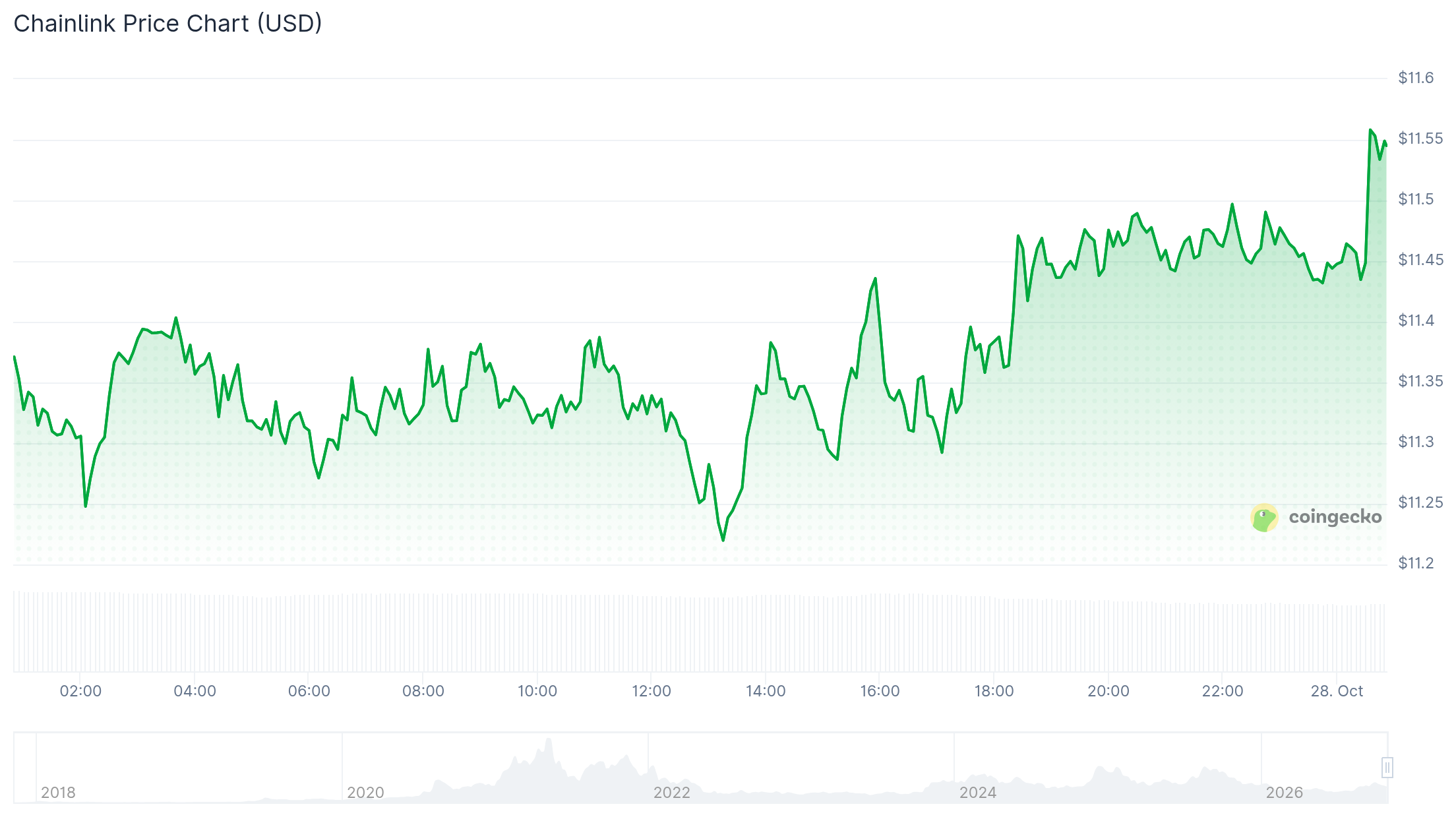
While these integrations represent significant fundamental developments, it is important to note that their immediate impact on the demand for the LINK token is subject to various factors. The actual usage, transaction activity generated by these products, and the specific mechanisms through which each product connects with and utilizes the LINK token (e.g., through staking, oracle services payments, or CCIP fees) will ultimately determine any longer-term effect on its value. Chainlink has consistently emphasized that its network’s growth and the utility of its services are critical drivers for the LINK token’s economic model.
LINK Price Tests Critical Support Amidst Fundamental Growth
Against the backdrop of these significant infrastructure developments, the native cryptocurrency of the Chainlink network, LINK, has been navigating a crucial technical juncture. The price of LINK is currently testing a significant support zone, broadly identified between $9 and $11. This price action has captured the attention of market analysts, including CryptoTanx, who observed a potential double bottom formation on the daily chart.
A double bottom is a bullish technical reversal pattern that typically forms after a prolonged downtrend. It is characterized by two distinct troughs (lows) at approximately the same price level, separated by a moderate peak. The pattern suggests that selling pressure is waning and buyers are stepping in at a particular support level, signaling a potential trend reversal. However, the pattern remains unconfirmed until the price breaks above a specific resistance level, often the peak between the two bottoms, accompanied by increased trading volume.
A key indicator being closely watched by analysts for confirmation of this potential double bottom is the 200-day Exponential Moving Average (EMA). The 200-day EMA is a widely respected long-term trend indicator, providing insights into the overall direction of an asset’s price over an extended period. A daily close above the 200-day EMA would be a strong technical signal, suggesting a shift in momentum from bearish to bullish and lending significant credibility to the double bottom setup. Conversely, a failure to hold the $9-$11 support zone or a rejection from the 200-day EMA could invalidate the bullish pattern and suggest further downward pressure.
Should LINK successfully hold the critical $9-$11 support area and achieve a confirmed daily close above the 200-day EMA, CryptoTanx outlined potential price targets ranging from $15 to $20. These levels represent conditional technical scenarios, predicated on the successful confirmation of the double bottom and a sustained increase in buying activity. A breakout would ideally be accompanied by a notable surge in trading volume, indicating strong conviction from market participants. However, the analyst did not specify a precise breakout date or a specific volume threshold, emphasizing the dynamic nature of market conditions.
For the immediate future, the critical levels for LINK remain the $9-$11 support zone and the overhead resistance presented by the 200-day EMA. A decisive move above the EMA would significantly bolster the bullish case, while a breakdown below the established support would negate the double-bottom pattern. The broader cryptocurrency market sentiment and overall trading conditions will also play a pivotal role in LINK’s near-term price trajectory.
In conclusion, Chainlink’s strategic advancements in the real-world asset space, marked by the HKGX gold token integration and Further Asset Management’s adoption of its compliance engine, solidify its position as a critical infrastructure provider for institutional finance. These fundamental developments paint a long-term picture of growth and utility for the Chainlink network. Simultaneously, the LINK token’s price action remains at a crucial technical juncture, with analysts closely monitoring key support levels and indicators for signs of a potential reversal. The interplay between these robust fundamental developments and the ongoing technical analysis will continue to shape Chainlink’s trajectory in the evolving digital asset landscape.