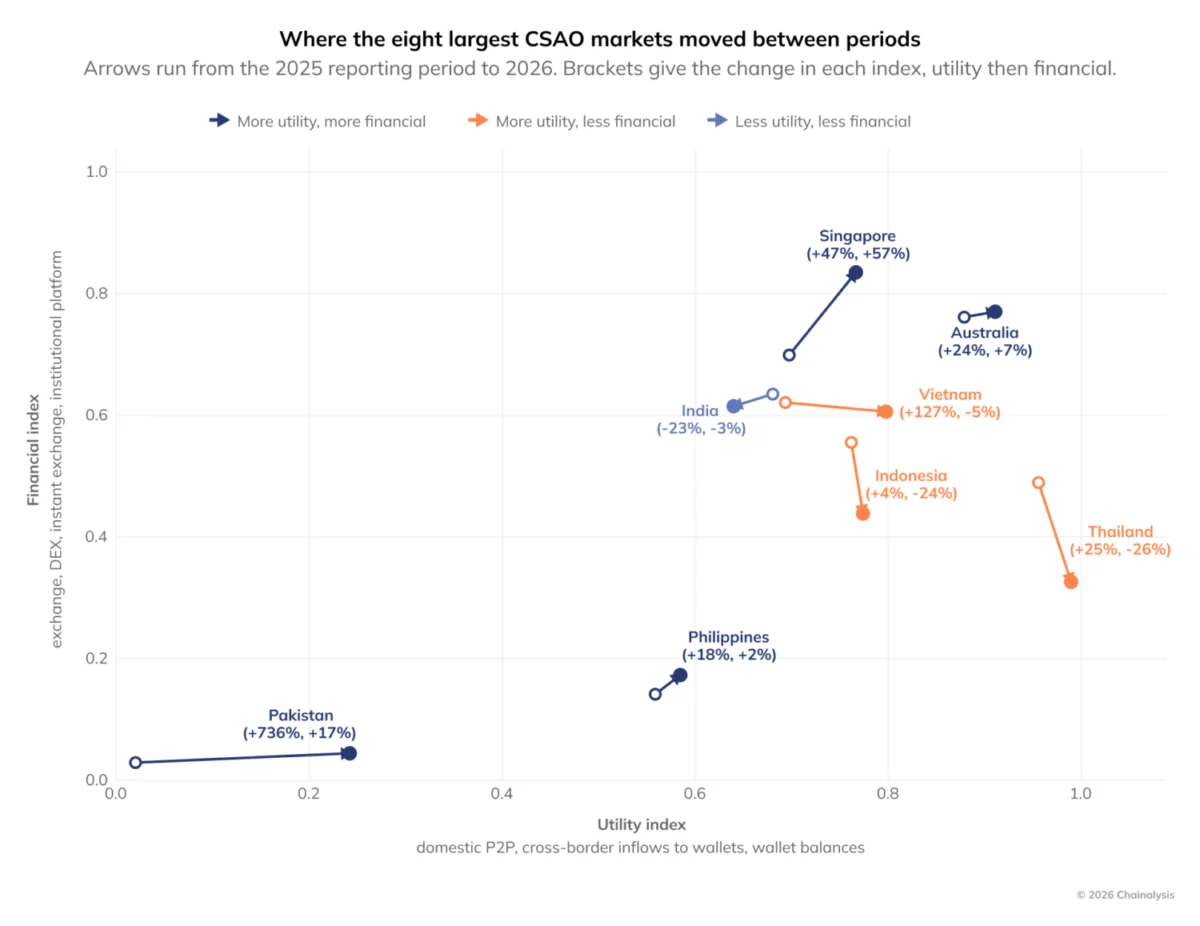
The crypto economy across Central & Southeast Asia and Oceania (CSAO) is undergoing a profound structural transformation, shifting from a retail-driven speculative market toward a sophisticated ecosystem defined by institutional participation and practical cross-border utility. Despite a moderate contraction of 6.8% in the region’s overall crypto economy between July 1, 2025, and June 30, 2026, the period was marked by significant advancements in tokenization, institutional brokerage, and peer-to-peer (P2P) financial services. As the sixth-largest cryptocurrency region globally, CSAO serves as a diverse laboratory for digital asset adoption, where mature financial hubs like Singapore and Australia coexist with high-growth utility markets such as the Philippines, Vietnam, and Pakistan.

Regional Overview and the Growth of Institutional Hubs
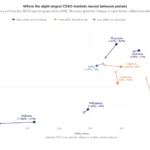
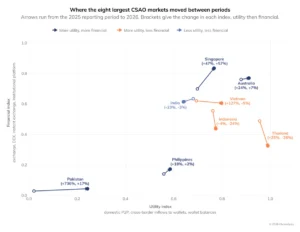
During the 2025-2026 reporting period, the CSAO region recorded a total of hundreds of billions of dollars in crypto-related economic activity. While the global bear market conditions contributed to a slight dip in total volume, the underlying data reveals a resilient and maturing landscape. Singapore emerged as the undisputed leader of the region’s crypto economy, recording $284 billion in activity, a staggering 55.4% increase year-over-year. This growth was primarily catalyzed by institutional-platform activity, which surged 94% to reach $60 billion.
The concentration of wealth and activity in Singapore is largely attributed to a small but highly active group of market makers, over-the-counter (OTC) trading firms, and institutional brokerages. Furthermore, the city-state demonstrated a balanced growth profile, with a 30% increase in flows into centralized exchanges (CEX) and a 69% rise in decentralized exchange (DEX) activity. This suggests that while institutions are leading the charge, the broader ecosystem—including decentralized finance (DeFi)—continues to expand within Singapore’s robust regulatory framework.

Australia followed as the second-largest digital assets economy in the region, processing $173.1 billion in transactions. Although its overall activity saw a minor decline of 5.6%, primarily due to a reduction in DEX flows, the institutional sector remained a pillar of strength. Inflows into custodians and OTC desks drove a 33.3% increase in institutional platform activity, totaling nearly $40 billion. This divergence between declining retail-centric DEX flows and rising institutional participation signals a "broadening" of the Australian market, where digital assets are increasingly viewed as legitimate financial instruments rather than mere speculative tokens.
The Resilience of the Indian Market Amid Regulatory Friction
India remains a critical, albeit complex, player in the CSAO region. Occupying the third spot in terms of total economic activity, India recorded $135 billion in crypto movements during the 2026 period. However, the market faced a sharp contraction of 14.7%, a decline more severe than the regional average. Despite this, India remains the region’s largest market by centralized exchange (CEX) inflow, highlighting a persistent appetite for digital assets among the local population.

The Indian story is one of maturation and regulatory challenge. Ashish Singhal, co-founder of the Indian exchange CoinSwitch, noted that the investor base is broadening to include a more mature demographic. Investors aged 35 and older, often with larger portfolios, are increasingly entering the space. Edul Patel, CEO of Mudrex, corroborated this trend, stating that the prevailing mindset has shifted from "flipping" assets for quick gains to long-term "accumulation," with crypto being treated as a diversifying asset alongside gold and mutual funds.
However, domestic exchanges in India face significant headwinds due to tax policy. The 1% Tax Deducted at Source (TDS) introduced in 2022 has created a "capital exodus" toward offshore platforms. Data shows that the share of exchange volume received by domestic Indian platforms plummeted from 7% in mid-2022 to a mere 0.7% by 2026. This friction underscores the ongoing tension between high organic adoption and a restrictive domestic tax environment.

The Utility Index: P2P Activity and Remittances in Southeast Asia
While Singapore and Australia lead in financial metrics, the Philippines, Thailand, and Vietnam are setting global benchmarks for the "utility index"—a measure of how digital assets support day-to-day life. These three nations accounted for 5.4 million small-value P2P transfers (under $10,000) during the 2026 period. This represents 14.4% of the global total of such transfers, despite these countries accounting for only 2.5% of the global crypto economy.
In the Philippines, the growth is inextricably linked to the remittance market, the fourth largest in the world. Nichel Gaba, CEO of the Philippine Digital Asset Exchange (PDAX), estimated that 5% to 10% of inbound remittances are now settled via stablecoins. Major remittance companies are actively launching initiatives to integrate stablecoin settlements, providing a faster and cheaper alternative to traditional banking rails.

In Vietnam, crypto serves a different but equally practical purpose. Nicole Nguyen, co-founder of APAC DAO, explained that stablecoins have become an "informal dollar savings vehicle" for retail users looking to hedge against the depreciation of the local currency, the dong. Additionally, the country’s burgeoning freelance and digital nomad communities have embraced P2P crypto payments as a standard method of receiving international income.
The Dominance of Stablecoins in Cross-Border Settlement
Across the entire CSAO region, stablecoins have emerged as the primary tool for moving value across borders. The study found that in every analyzed market, cross-border stablecoin activity significantly exceeded domestic activity. The regional average ratio for cross-border versus domestic stablecoin use stands at 3.2 to 1, with Malaysia showing the most extreme gap at 29.5 to 1.

The preference for stablecoins in international transactions is a result of the region’s well-developed domestic payment systems. As David Low, CEO of the Malaysian exchange Hata, pointed out, domestic payment rails in many CSAO countries are already fast and efficient, leaving little room for stablecoins to compete in everyday local payments. However, for business-to-business (B2B) payments and international settlements, stablecoins offer a "deployed reality" that bypasses banking inefficiencies, cuts fees, and enables instant settlement.
Srivatsan Tirumalai, a former executive at Singapore’s UOB, noted that corporate treasuries and regional merchants are increasingly utilizing regulated stablecoins for wholesale liquidity management. This trend is particularly evident in Thailand and Vietnam, where cross-border markets were 50% to 100% larger than their domestic counterparts.

Chronology of Regulatory Evolution and Market Shifts
The 2025-2026 period was marked by several pivotal regulatory milestones that have shaped the current landscape:
- April 2026: Pakistan officially dropped a seven-year ban that prohibited domestic banks from working with cryptocurrency companies. This led to a 736% surge in utility activity, albeit from a very low base, as the industry began to reintegrate with the formal financial system.
- Late 2025 – Mid 2026: Singapore finalized its stablecoin regulatory framework and expanded its Digital Payment Token (DPT) licensing regime, providing the legal clarity necessary for the 94% surge in institutional activity.
- Early 2026: Australia expanded its AML/CFT (Anti-Money Laundering and Counter-Terrorism Financing) regime to include a broader range of service providers, including crypto-to-crypto exchanges.
- Looking Ahead (2027): The Australian Securities and Investments Commission (ASIC) is scheduled to implement a comprehensive licensing regime for digital asset platforms and tokenized custody providers, a move expected to further bolster institutional confidence.
Institutional Maturation and Tokenization
The shift in Australia and Singapore is perhaps best summarized by Nicolas Gilardi of BTC Markets, who stated that 2026 was the year crypto "stopped being a retail story." The focus has moved toward what the asset is being used for: collateral, settlement, and tokenized instruments.

In Australia, Project Acacia—a joint effort by the Reserve Bank of Australia and the Digital Finance Cooperative Research Centre—has been instrumental in exploring how tokenized assets and digital money can be utilized in wholesale financial markets. Similarly, in Singapore, the narrative has moved beyond speculative trading returns to encompass treasury management and market infrastructure.
This institutionalization is also reflected in custody preferences. In Singapore, the share of crypto held in self-custody wallets dropped from a peak of 88% in 2023 to just 28% by mid-2026. This shift indicates that more users are opting for regulated third-party custodians and exchange-based services, a hallmark of a professionalized financial market.

Broader Impact and Future Implications
The transition of cryptocurrency from a speculative asset to a foundational layer of financial infrastructure carries significant implications for the CSAO region. As digital assets become more deeply embedded in corporate treasuries and cross-border commerce, the stakes for regulatory oversight and industry stability have never been higher.
Ashwin Chockalingam, CFO of the Malaysian fintech firm Blox, cautioned that while institutional participation is a positive sign of maturity, it also increases the systemic risk. A major failure within the digital asset sector could now have broader repercussions for traditional financial institutions that have begun to integrate blockchain technology into their operations.

Ultimately, the 2025-2026 data suggests that the CSAO region is leading the world in defining the "utility phase" of blockchain technology. Whether it is through the $284 billion institutional engine of Singapore or the millions of small-value P2P transfers in the Philippines and Vietnam, the region is proving that digital assets are no longer just about the price of Bitcoin—they are about the plumbing of the modern global economy. As Mudrex’s Edul Patel aptly concluded, the region has successfully navigated the transition "from crypto as an asset to crypto and blockchain as infrastructure." Success in the coming years will depend on whether regulatory frameworks can continue to evolve at the pace of innovation while providing the necessary safeguards to maintain hard-won institutional and public trust.