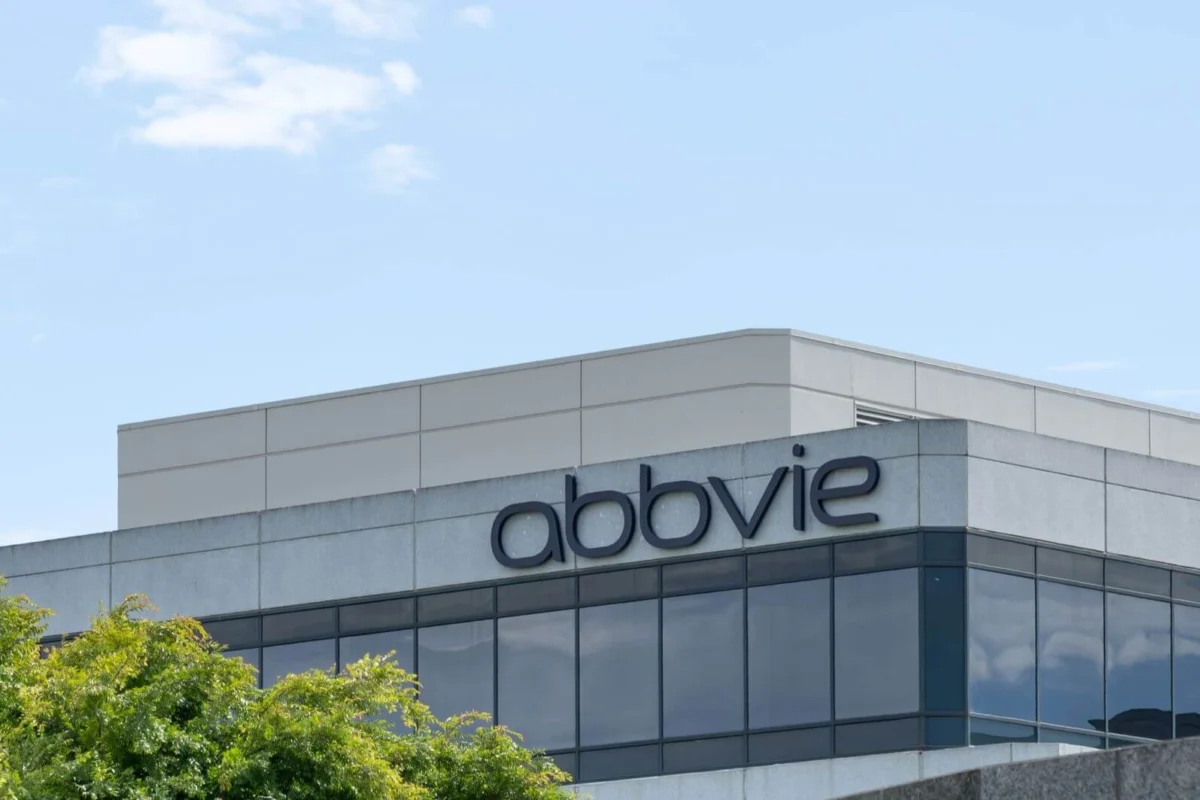
AbbVie Inc. (NYSE: ABBV) experienced a significant surge in its stock value, with shares advancing 1.72% to $295.79 following the pharmaceutical giant’s announcement of exceptionally strong third-quarter results. The upward movement, representing a gain of $4.99 per share, was underpinned by robust revenue growth and higher earnings that surpassed analyst expectations. Further bolstering investor confidence, the company concurrently raised its full-year 2026 earnings guidance and committed to an increased dividend distribution for 2027, signaling a confident outlook for its future financial performance and a steadfast dedication to shareholder value.
The North Chicago-based biopharmaceutical company reported total third-quarter revenue of $17.404 billion, marking an impressive 10.3% increase compared to the same period in the previous year. On an operational basis, revenue growth was even stronger at 10.5%, reflecting a broad-based demand across its diverse portfolio of pharmaceutical businesses. This strong top-line performance translated into adjusted diluted earnings per share (EPS) of $3.82. The GAAP diluted EPS, which includes certain non-recurring items and accounting adjustments, stood at $2.37, highlighting the underlying operational strength when factoring out these specific impacts.
These compelling results underscored continued, dynamic growth within AbbVie’s pivotal immunology and neuroscience segments, successfully offsetting areas of weaker performance, notably within its aesthetics portfolio and certain oncology products. A significant strategic move during the quarter included the completion of its acquisition of Apogee Therapeutics. This transaction is poised to fortify AbbVie’s already robust immunology development pipeline, expanding its potential for groundbreaking treatment discoveries and solidifying its leadership in this critical therapeutic area. The dual announcement of elevated 2026 earnings guidance and increased shareholder distributions further cemented the narrative of a company successfully navigating market dynamics and executing its long-term growth strategy.
Navigating the Post-Humira Landscape: Immunology Drives Growth
AbbVie’s immunology portfolio, a cornerstone of its strategic transition following the patent expiration of its blockbuster drug Humira, generated an impressive $9.165 billion in third-quarter revenue. This represented a substantial 16.3% year-over-year increase, demonstrating the successful pivot to its next-generation immunology treatments.
Leading this charge were Skyrizi (risankizumab) and Rinvoq (upadacitinib), two key assets designed to succeed Humira. Skyrizi, approved for indications such as psoriasis, psoriatic arthritis, and Crohn’s disease, contributed a remarkable $5.776 billion, recording an astounding 22.7% growth on a reported basis. Rinvoq, which treats conditions including rheumatoid arthritis, psoriatic arthritis, atopic dermatitis, and ulcerative colitis, also delivered stellar performance, generating $2.706 billion and marking an impressive 23.9% increase during the quarter. The robust growth of Skyrizi and Rinvoq is particularly significant as they represent AbbVie’s strategic response to the anticipated decline of Humira, once the world’s best-selling drug.
In contrast, Humira (adalimumab) revenue continued its expected trajectory downward, declining 31.2% to $683 million as intensified biosimilar competition in the United States and established competition in international markets continued to impact its sales. The combined, stellar performance of Skyrizi and Rinvoq was instrumental in supporting overall immunology growth, effectively mitigating the decline from Humira. Their surging revenue contributions vividly highlighted the portfolio’s evolving composition and the successful execution of AbbVie’s diversification strategy away from its long-standing flagship product. This transition, a multi-year effort, has been closely watched by the pharmaceutical industry and investors alike, and the third-quarter results provided clear evidence of its effectiveness.
Neuroscience Portfolio: A Pillar of Consistent Expansion
Beyond immunology, AbbVie’s neuroscience division emerged as another significant growth engine, generating $3.389 billion in the third quarter. This represented a robust 19.4% annual growth, underscoring the company’s expanding presence and success in addressing a wide range of neurological conditions.
Several key products contributed to this strong performance. Vraylar (cariprazine), an antipsychotic medication used to treat schizophrenia and bipolar disorder, saw its revenue increase by 14.3% to $1.068 billion. Botox Therapeutic, utilized for various medical conditions including chronic migraine, spasticity, and cervical dystonia, maintained its strong market position, with sales reaching $1.080 billion.
Furthermore, newer migraine treatments continued their upward trajectory. Ubrelvy (ubrogepant), an oral CGRP receptor antagonist for the acute treatment of migraine, generated $449 million. Qulipta (atogepant), an oral CGRP receptor antagonist for the preventive treatment of episodic and chronic migraine, recorded particularly impressive growth, with 38.2% reported revenue growth to $398 million, positioning it as one of the portfolio’s strongest performers. Additionally, Vyalev (foscarbidopa/foslevodopa), an investigational Parkinson’s disease treatment, generated $286 million, signaling AbbVie’s continued expansion and innovation within the neuroscience business. These collective results demonstrated broad-based growth across several critical treatments, solidifying the division’s role as a reliable contributor to AbbVie’s overall financial health. The global market for neurological disorders is substantial and growing, driven by an aging population and increasing awareness, positioning AbbVie well for continued success in this area.
Mixed Performance in Oncology and Aesthetics Segments
While immunology and neuroscience shone brightly, AbbVie’s oncology and aesthetics portfolios delivered more mixed results during the third quarter. The oncology portfolio generated $1.696 billion in revenue, showing a modest 0.8% increase year over year. Within this segment, Venclexta (venetoclax), an oral BCL-2 inhibitor used to treat chronic lymphocytic leukemia (CLL) and acute myeloid leukemia (AML), saw its revenue rise by 10.7% to $803 million. Elahere (mirvetuximab soravtansine), a folate receptor alpha (FRα)-targeting antibody-drug conjugate for ovarian cancer, also demonstrated strong growth, increasing 31% to $224 million. However, the overall growth of the division was significantly limited by a substantial decline in Imbruvica (ibrutinib) revenue, which fell 26.1% to $522 million. Imbruvica has faced increasing competition from newer therapies and combination regimens in the blood cancer space, impacting its market share.
The aesthetics portfolio, acquired as part of the Allergan acquisition, recorded $1.176 billion in revenue, representing a 1.4% annual decline. This segment’s performance was bifurcated: Botox Cosmetic, a perennial leader in the neurotoxin market, generated $669 million, increasing a healthy 4.9% compared with the previous year. This growth highlights the continued demand for minimally invasive cosmetic procedures. In contrast, Juvederm, a leading dermal filler product line, experienced an 11.9% decline in revenue to $222 million during the quarter. The aesthetics market can be sensitive to economic fluctuations and increased competition from a wider array of non-invasive cosmetic solutions.
From a profitability standpoint, AbbVie reported a GAAP gross margin of 75.4%, while its adjusted gross margin, which typically excludes amortization of acquired intangible assets and other non-GAAP items, reached a robust 85.1%. Selling, general, and administrative expenses represented 23.5% of revenue on a GAAP basis. Additionally, the adjusted operating margin, a key indicator of operational efficiency, reached 48.7%, significantly higher than the 36% reported under GAAP accounting, underscoring the company’s ability to manage costs effectively within its core operations.
Strategic Acquisitions and Enhanced Shareholder Value
Following its strong third-quarter performance, AbbVie demonstrated significant confidence in its future trajectory by increasing its full-year 2026 adjusted diluted EPS guidance. The company raised its forecast from a previous range of $13.76–$13.96 to an updated range of $13.95–$13.99 per share. This updated guidance range notably includes a $0.69 per-share impact attributed to acquired research and development expenses and milestone payments, reflecting the strategic investments made to bolster its pipeline. Raising guidance is a powerful signal to investors, indicating management’s conviction in continued operational strength, pipeline potential, and efficient capital allocation.
A key strategic initiative contributing to this optimistic outlook was the successful completion of the acquisition of Apogee Therapeutics during the quarter. Apogee is focused on developing novel antibody therapeutics for inflammatory and autoimmune diseases. This transaction is specifically designed to strengthen AbbVie’s already formidable immunology pipeline and expand its potential treatment development opportunities in a high-growth area. The acquisition forms an integral part of the company’s broader, forward-looking strategy to support sustainable future pharmaceutical growth and maintain its leadership position in complex disease areas. Such targeted acquisitions are crucial in the pharmaceutical industry to replenish pipelines and secure long-term revenue streams as existing patents expire.
In a further demonstration of its commitment to returning value to shareholders, AbbVie announced a 5.2% increase in its 2027 dividend. This higher dividend payout is scheduled to commence with the payment in February 2027. This announcement extends the company’s long-standing shareholder distribution strategy, which is deeply valued by income-focused investors, and aligns with its improving financial performance and positive future outlook. AbbVie has a strong track record of consistent dividend increases, often earning it a place among "Dividend Aristocrats" or "Dividend Kings," categories reserved for companies with decades of consecutive dividend growth.
Leadership Commentary and Broader Implications
While specific direct quotes were not provided in the original dispatch, company leadership typically emphasizes the driving factors behind such strong performance. Richard A. Gonzalez, Chairman and Chief Executive Officer of AbbVie, would likely have underscored the company’s successful execution of its long-term strategy, particularly its adept navigation of the Humira patent cliff through the accelerated growth of Skyrizi and Rinvoq. He would also likely highlight the strength of the diversified portfolio, the successful integration of strategic acquisitions like Apogee, and the relentless pursuit of innovation across therapeutic areas. Robert A. Michael, Vice Chairman and Chief Financial Officer, would typically reinforce the company’s robust financial health, disciplined capital allocation, and commitment to generating sustainable shareholder value through both earnings growth and consistent dividend increases.
The latest results unequivocally reflect continued revenue expansion across AbbVie’s major pharmaceutical businesses, showcasing a well-executed strategy to diversify and innovate. The robust performance of its immunology and neuroscience sales effectively offset anticipated declines in selected oncology and aesthetics products, demonstrating the resilience and strategic agility of the company. The combination of higher earnings guidance and a significant dividend increase provides further granular detail about the company’s strong financial outlook and its unwavering confidence in its pipeline and market position.
Looking ahead, AbbVie’s strategic investments in R&D, coupled with targeted acquisitions, are critical for sustaining long-term growth in the highly competitive pharmaceutical landscape. The company’s ability to successfully launch and scale new blockbuster drugs like Skyrizi and Rinvoq, while simultaneously nurturing a diverse pipeline in other high-growth areas such as neuroscience, positions it favorably for continued success. Challenges remain, including managing ongoing biosimilar competition for Humira, the inherent risks of drug development, and navigating evolving regulatory environments. However, AbbVie’s third-quarter performance, coupled with its forward-looking guidance and shareholder returns, strongly suggests that it is well-equipped to meet these challenges and continue its trajectory as a leading global biopharmaceutical company. Investors and analysts will undoubtedly continue to monitor the performance of its key growth drivers and the progression of its pipeline, particularly as it moves further into the post-Humira era.