The landscape of World Liberty Financial’s (WLFI) staking program has undergone significant shifts since its launch, with recent data revealing a robust increase in locked tokens but simultaneously exposing a critical challenge concerning the long-term viability of its reward pool. Initially capturing attention with 54.18 million tokens locked within its first two weeks, representing a modest 0.17% of the circulating supply, the program has since seen substantial growth, escalating to 81,783,738 WLFI as of October 30. This impressive 51% surge in staked assets, now valued at approximately $4.14 million, reflects a growing participant base. However, a deeper analysis into the reward mechanisms indicates that the available USD1 reward pool is projected to deplete approximately 100 days before the earliest 180-day staking locks are set to expire, posing a significant question mark over the promised returns for long-term stakers.
Evolution of WLFI Staking: From Launch to Current State
World Liberty Financial introduced its WLFI staking program with the stated aim of fostering community engagement, promoting long-term holding of its native token, and supporting decentralized governance. Staking, a common practice in the blockchain ecosystem, allows token holders to lock their assets to support the network’s operations and, in return, earn rewards. For WLFI, the incentive structure included variable annual percentage yields (APYs) and participation in governance, with a crucial mandate for stakers to vote at least once every 90 days to remain eligible for rewards. The program also implemented a mandatory 180-day lock-up period for all staked tokens, a measure designed to demonstrate commitment and stabilize the token’s circulating supply.
The initial period following the staking program’s debut on October 1 saw an enthusiastic uptake. By October 14, just two weeks in, 54.18 million WLFI tokens were already committed to the contract, an amount widely cited and reflecting approximately 0.17% of the circulating supply. This initial traction suggested a healthy appetite within the WLFI community for participating in the project’s long-term vision and earning passive income. The public, through various crypto news outlets, began monitoring this figure as a key indicator of project health and community trust.
Updated Staking Metrics: Growth and Slowdown
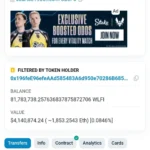
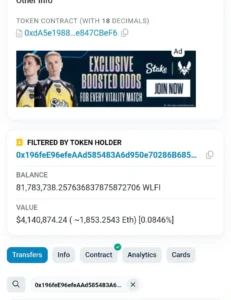
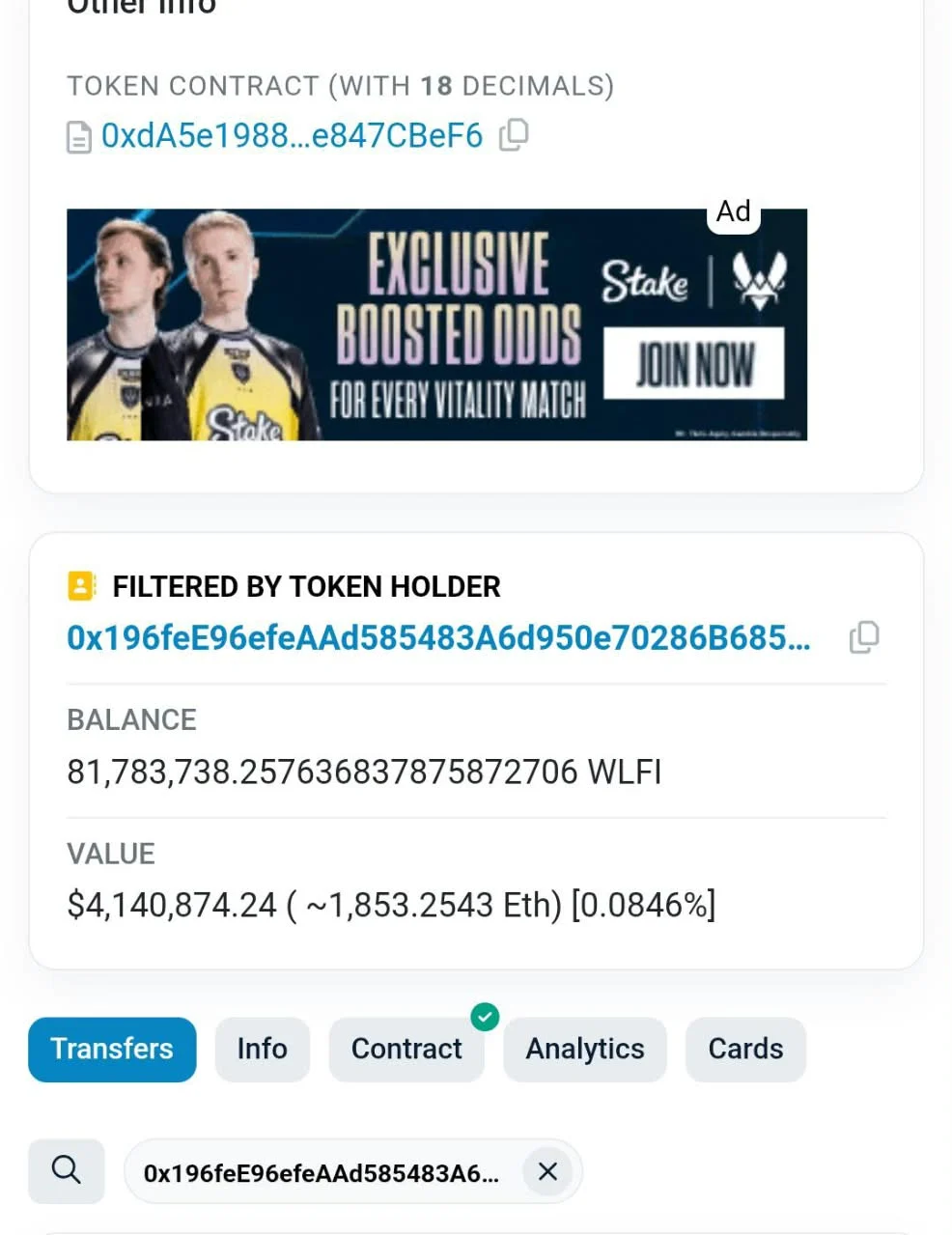
Our recent review of the official WLFI staking contract, identified as 0x196feE96efeAAd585483A6d950e70286B6851923 in World Liberty Financial’s documentation, confirms a significant accumulation of assets. As of October 30, the contract holds precisely 81,783,738.26 WLFI tokens. This figure, corroborated by both Etherscan data and the protocol’s own staking dashboard, represents a substantial increase of over 27.6 million WLFI tokens in just 16 days, marking a 51% growth from the October 14 baseline. The total value of these staked tokens currently stands at approximately $4.14 million, indicating robust financial commitment from the community.

However, while the absolute growth is notable, a deeper look into the staking pace reveals a discernible slowdown. In the initial 13 days of the program (October 1 to October 14), an average of approximately 4.17 million WLFI tokens were deposited into the contract daily. In contrast, the subsequent 16 days (October 15 to October 30) witnessed a reduced average daily inflow of about 1.73 million WLFI. This represents a significant deceleration of approximately 59% in the staking rate. The data suggests that much of the early demand, possibly driven by initial excitement and early adopter incentives, has tapered off, with later participants joining at a considerably slower pace. This trend could be influenced by several factors, including the market’s evolving perception of risk-reward ratios, broader cryptocurrency market sentiments, or the inherent commitment required by WLFI’s specific staking rules.
Recalibrating Circulating Supply and Staked Percentage
The initial 0.17% figure was calculated against an estimated circulating supply of 31.78 billion WLFI tokens. While CoinGecko still reports this figure, the updated staking total necessitates a recalculation. Using the same circulating supply, the new total of 81.78 million WLFI staked now represents approximately 0.26% of the circulating supply.
It is also important to consider the broader supply context. The maximum supply of WLFI is often quoted as 100 billion tokens. Etherscan, however, reports a slightly smaller total on-chain supply of approximately 96.72 billion. Regardless of whether one uses the 100 billion maximum or the 96.72 billion on-chain figure, the proportion of staked WLFI remains well under 1% of the total token supply. This indicates that while growth has been significant in percentage terms relative to the initial staked amount, the overall impact on the token’s circulating supply remains relatively contained. The growth of staked tokens, even with the recent slowdown, demonstrates a gradual but consistent commitment from a segment of the WLFI holder base.
The Intricacies of Reward Rate Dynamics
One of the more perplexing aspects of the WLFI staking program has been the behavior of its displayed reward rate. The staking dashboard explicitly states that the variable rate "can decrease as more WLFI is staked." Counterintuitively, despite a 51% increase in staked WLFI, the displayed annual percentage yield (APY) has risen from 82.41% on October 14 to a current rate of 92.07%. This apparent contradiction can be attributed to two primary factors:
- Falling WLFI Token Price: The rewards are paid out in USD1, a stablecoin. As the price of WLFI tokens declines, the protocol needs to distribute fewer WLFI tokens (or, more accurately, the equivalent USD1 value is spread across more WLFI, making the percentage return on WLFI appear higher if the underlying value of the reward pool remains stable in USD1 terms). This mechanism can create the illusion of a higher APY in a depreciating token environment, as the USD1 value of the reward is divided by a lower WLFI token value.
- Increased USD1 in the Reward Pool: The reward pool has also seen a slight expansion. The total "all-time rewards" have grown from 1.25 million USD1 to 1.30 million USD1 since the program’s inception, indicating an additional 50,000 USD1 has been injected into the pool. This injection, while modest, contributes to maintaining or even slightly increasing the displayed APY, especially when combined with token price fluctuations.
These factors highlight the complex interplay between token price, reward pool size, and the calculation methodology for displayed APY in decentralized finance (DeFi) staking protocols. Stakers, therefore, must look beyond the headline APY figure and understand the underlying dynamics to assess the true value and sustainability of their potential returns.

The Looming Reward Pool Depletion
The most critical concern emerging from the current data revolves around the sustainability of the USD1 reward pool. The difference between "all-time rewards" and "available rewards" indicates how much has already been allocated to stakers. On October 14, this gap stood at 80,000 USD1. By October 30, it had widened significantly to 230,000 USD1, implying that approximately 150,000 USD1 was distributed as rewards over a mere 16-day period.
At the current implied payout rate, which translates to an approximate annual expenditure of $3.81 million, the remaining 1.07 million USD1 in the available reward pool is projected to last for approximately 103 days. This projection raises a significant red flag when juxtaposed with the mandatory 180-day lock-up period for new stakes. A participant who stakes WLFI today would have their tokens locked until approximately April 28, 2027. However, if the current reward payout rate persists and no additional funds are added to the pool, the USD1 rewards would be exhausted by early February 2027.
This creates a substantial discrepancy of roughly 100 days where stakers would theoretically remain locked into the contract without receiving the expected rewards, assuming the current rate holds and no interventions occur. This situation is more acute than it was on October 14, when the remaining 1.17 million USD1 in the pool was projected to last for about 167 days at that day’s rate, making the gap between pool depletion and lock-up expiry less pronounced.
World Liberty Financial’s dashboard includes a clear disclaimer: "today’s rate does not represent what you will earn over your staking period." This standard disclaimer in DeFi is crucial, as it mitigates the project’s liability for future reward fluctuations. However, the current projections underscore the very real possibility that the advertised 92% rate cannot be sustained for the entire duration of the 180-day lock period without further top-ups to the reward pool. While World Liberty Financial has demonstrated a willingness to replenish the pool once, having added 50,000 USD1 since launch, the current burn rate necessitates more substantial and frequent injections to maintain the advertised APY throughout the locked periods.
Timeline of Lock-Ups and Governance Mandates
The earliest stakers, who committed their WLFI tokens on October 1, will have their 180-day lock-up periods conclude around March 30, 2027. Subsequently, each week of staking activity adds another batch of tokens that will unlock approximately 26 weeks later. This staggered unlocking schedule means that the issue of reward pool depletion could affect an increasing number of stakers as time progresses, potentially leading to widespread dissatisfaction if not addressed.

The 180-day lock-up requirement itself stems from a governance vote conducted in March. The proposal, accessible on World Liberty Financial’s Snapshot page, overwhelmingly passed with over 99% of votes in favor. This democratic process established not only the lock-up period but also introduced a "super node" tier for wallets staking 50 million WLFI or more. For context, the entire WLFI staking contract currently holds enough tokens to support barely more than one and a half such super nodes, highlighting the significant capital required for this elite tier. These governance decisions, while reflecting community consensus at the time, now form the framework within which the current reward sustainability challenges must be navigated. The mandate for stakers to vote every 90 days further emphasizes the active participation expected, making the potential for unfulfilled reward expectations particularly sensitive for engaged community members.
Implications and Future Outlook for World Liberty Financial
The current state of WLFI’s staking program presents a complex picture for World Liberty Financial and its community. On one hand, the significant growth in staked tokens signals continued trust and interest in the project. The expansion of the staking contract to 81.78 million WLFI, now representing 0.26% of the circulating supply, demonstrates a commitment from a segment of token holders. This long-term commitment is further reinforced by the 180-day lock-up periods and the requirement for active governance participation.
On the other hand, the projected early depletion of the reward pool poses a substantial risk to staker confidence and the overall reputation of the WLFI ecosystem. If the reward pool runs dry before stakers can unlock their assets, it could lead to widespread disillusionment, potentially triggering sell-offs once tokens are unlocked and discouraging future participation in staking initiatives. Such an outcome could also cast a shadow over World Liberty Financial’s ability to manage its tokenomics effectively and fulfill its promises to the community.
The challenge for World Liberty Financial is to balance the attractive high APY with sustainable reward distribution. While the displayed 92% rate is enticing, its reliance on a depreciating token price and a reward pool that is rapidly diminishing underscores the need for proactive measures. The project has a precedent for adding to the reward pool, indicating a potential avenue for intervention. However, the scale of future top-ups would need to be significant to cover the projected shortfall for all stakers through their 180-day lock-up periods.
In the broader context of decentralized finance, managing reward pools and ensuring their sustainability is a common challenge. Projects often employ dynamic reward structures, treasury management strategies, or periodic community votes to adjust parameters. World Liberty Financial may need to consider similar mechanisms, or transparently communicate its strategy for addressing the reward pool’s longevity. This could involve further injections of USD1, adjusting the reward rate downward through governance, or exploring alternative reward mechanisms.
For current and prospective WLFI stakers, a thorough understanding of these dynamics is paramount. The high displayed APY should be viewed in conjunction with the reward pool’s projected lifespan and the explicit disclaimer regarding guaranteed returns. The decision to commit tokens for 180 days is a significant one, and the current data highlights the importance of evaluating not just the headline percentage but also the underlying sustainability of the rewards. The coming months will be crucial for World Liberty Financial to demonstrate its capacity to navigate these challenges and maintain the trust of its growing staking community.