The incident, which unfolded on the Stacks blockchain, highlights critical vulnerabilities within decentralized autonomous organizations (DAOs), particularly those with lower liquidity and less engaged governance participation. What appeared on paper to be a five-day voting period for Arkadiko’s Proposal 12 was, in practice, decided in less than an hour by a single entity that had acquired its voting power just hours before the decisive moment. This swift action, meticulously reconstructed through on-chain investigations by Bitquery, reveals a calculated attack that leveraged governance mechanisms against the protocol itself, illustrating a stark reality where control can be purchased for a fraction of the assets held.
The Arkadiko Protocol and Its Governance Framework
Arkadiko is a lending protocol operating on the Stacks blockchain, a layer-2 solution that enables smart contracts and decentralized applications to leverage the security and finality of Bitcoin. As a decentralized finance (DeFi) platform, Arkadiko allows users to collateralize assets like STX and sBTC to mint USDA, a stablecoin pegged to the US dollar. Its operations, like many DeFi protocols, are ostensibly governed by a DAO, where holders of its native token, DIKO, can propose and vote on changes to the protocol’s parameters, smart contracts, and overall direction.
The governance rules, as outlined in Arkadiko’s documentation, dictate that a proposal requires a minimum 0.25% of the total eligible DIKO supply to be submitted. To pass, a proposal must achieve a quorum of 5% of the eligible supply voting in favor. Historically, Arkadiko’s governance had been characterized by a centralized pattern: all 54 prior proposals originated from the core team’s wallet, with voters accustomed to routinely approving upgrades and maintenance tasks without extensive scrutiny. This established norm of passive approval inadvertently cultivated an environment ripe for exploitation, as community vigilance waned.
A Precision-Timed Exploit: The Chronology of Events
The attacker’s methodical approach began weeks before the final drain, suggesting a period of reconnaissance and preparation. Bitquery’s investigation provides a detailed timeline of the exploit:

- October 3 – October 22: The attacker initiated funding of their Ethereum-side wallets through Tornado Cash, a cryptocurrency mixer, withdrawing a total of 12.2 ETH. This demonstrates a clear intent to obscure the origin of funds, indicating premeditation for illicit activities.
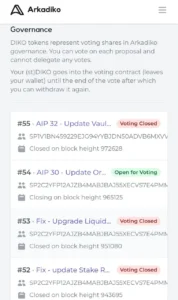
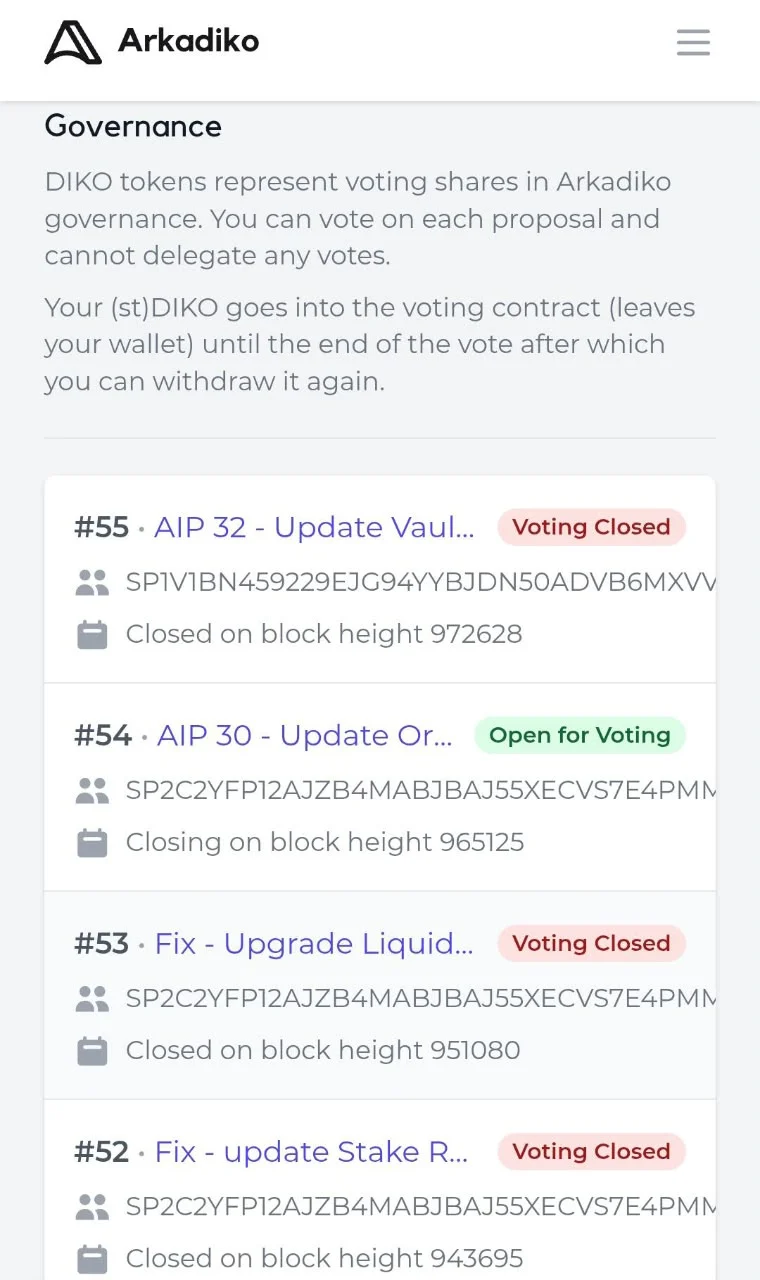
- October 17, 20:35 UTC: The attacker officially filed Proposal 12 on Arkadiko. Titled "AIP 32 – Update Vaults Operations for Reward Distribution," the proposal was designed to appear innocuous, masquerading as a routine operational update. On the same day, the wallet acquired 193,091 DIKO tokens, just enough to clear the 0.25% submission threshold. The attacker then strategically waited, allowing the proposal to sit without votes for nearly five days, likely observing community engagement and avoiding premature detection.
- October 20: In a precursor to the Arkadiko attack, the same wallet operator executed a similar governance exploit on StackSwap, another Stacks-based exchange. This attack, which passed with a mere 37,755 votes (0.19% of supply), allowed the attacker to empty 49 StackSwap pools, totaling approximately $70,500, in under a minute through 51 rapid calls. This successful preceding exploit provided a significant portion (77%) of the STX required to fund the subsequent Arkadiko attack, demonstrating a multi-protocol exploitation strategy.
- October 22: The decisive phase of the Arkadiko attack commenced.
- 16:00 UTC: Approximately half an hour before the critical voting window, the attacker’s main Ethereum wallet sent 5.23 ETH to ChangeNOW, a non-custodial instant crypto exchange, facilitating the rapid acquisition of STX on the Stacks blockchain.
- 16:08 UTC: The attacker began acquiring substantial amounts of DIKO tokens, accumulating a total of 4,379,106 DIKO. This massive purchase, costing approximately 158,139 STX (valued at around $51,000 at the time), was precisely calculated to exceed the quorum requirements.
- 17:00 UTC: The attacker’s wallet cast its vote in favor of Proposal 12.
- 17:58 UTC: The voting period officially closed, with Proposal 12 passing unopposed. The final tally recorded 4,573,197 DIKO in favor and zero against, representing 6.7% of the eligible supply. This comfortably surpassed Arkadiko’s 5% quorum, which required approximately 3.4 million DIKO.
- Minutes after 17:58 UTC: Immediately following the successful vote, the attacker executed a series of transactions to drain the protocol’s vaults.
- 18:08 UTC: Arkadiko team members became aware of the exploit and switched off the malicious contract, halting further drainage.
- 18:14 UTC: Arkadiko formally paused its governance mechanism to prevent further unauthorized actions.
- 19:21 UTC: The team burned 1.499 billion of the newly minted USDA tokens, attempting to mitigate the damage and stabilize the stablecoin’s peg, though the underlying collateral had already been siphoned.
The Anatomy of a Governance Exploit: How Arkadiko Was Compromised
The core of the Arkadiko exploit lay in the attacker’s ability to manipulate the governance process to deploy a malicious smart contract. Proposal 12, deceptively titled, claimed to link to a GitHub pull request (#624). However, Bitquery’s investigation revealed this link pointed to an unrelated, long-standing, and unmerged fix from an external account, a deliberate misdirection.
Instead of a benign update, the proposal’s true payload was to replace Arkadiko’s legitimate vaults-operations contract with a new, attacker-controlled contract named arkadiko-vaults-operations-v2-1. This new contract contained two critical, yet deceptively simple, functions: mint-usda and burn-collateral-and-return-to-user. The crucial flaw in these functions was a complete lack of access control. Neither function checked who was calling it, only that the contract was enabled and the amount specified was greater than zero.
Once Proposal 12 passed, effectively installing this malicious contract as the new operational standard for Arkadiko’s vaults, the attacker gained unfettered control. They could call these functions at will, initiating the minting of new USDA tokens without corresponding collateral and subsequently withdrawing existing collateral from the protocol. This direct subversion of the protocol’s core logic demonstrated a profound understanding of Arkadiko’s contract architecture and governance mechanics.
The Financial Fallout: Drained Assets and Collateral Collapse
The immediate aftermath of the governance vote saw a rapid succession of transactions designed to extract maximum value from Arkadiko’s vaults. The attacker’s control over the new arkadiko-vaults-operations-v2-1 contract allowed them to:
- Print USDA: The
mint-usdafunction was exploited to generate 1.5 billion USDA tokens. This massive, unbacked issuance instantly de-pegged USDA, causing its value to plummet to approximately $0.13 per token, severely impacting its stability and user trust. - Drain Collateral: Using the
burn-collateral-and-return-to-userfunction, the attacker systematically emptied the vaults of their valuable backing assets. Bitquery’s detailed breakdown of the stolen funds included:- 2,100,000 STX (Stacks tokens)
- 584,000 stSTX (Staked STX)
- 1.25 sBTC (Synthetic Bitcoin)
Valuing STX at $0.32 and stSTX at 1.18 STX (as per Bitquery’s analysis), and factoring in the price at which stSTX was actually sold, the total value extracted from Arkadiko amounted to approximately $1.09 million, potentially reaching $1.11 million based on sale prices. When combined with the $70,500 stolen from StackSwap just two days prior, the attacker’s total haul across both protocols reached an estimated $1.16 million.

The impact on Arkadiko’s Total Value Locked (TVL) was catastrophic. Before the attack, Arkadiko held approximately $1.4 million in TVL. Following the drain, this figure plummeted by about 90%, settling at roughly $141,600. This represents a devastating blow for a protocol that had once boasted a peak TVL of $24.6 million in March 2024, underscoring the severe consequences of a successful governance exploit.
Following the Digital Trail: Attacker Identity and Money Laundering
Despite the attacker’s attempts at obfuscation, on-chain forensics provided a clear, albeit anonymous, trail. The primary address responsible for filing Proposal 12, casting the decisive vote, and subsequently draining the vaults was identified as SP1V1BN459229EJG94YYBJDN50ADVB6MXVVEZ0G34.
The attacker’s funding strategy further revealed their intent to conceal identity and movements. The pre-planned Ethereum funding via Tornado Cash for 12.2 ETH over three weeks prior to the attack demonstrates a calculated effort to anonymize the initial capital. Subsequently, the stolen funds underwent a complex laundering process involving multiple services and exchanges:
- FixedFloat and ChangeNOW: Used for immediate swaps and transfers.
- Centralized Exchanges (CEXs): Funds were routed through MEXC, StealthEX, OKX, and Binance, likely to convert stolen assets into less traceable cryptocurrencies or fiat.
- Unaccounted Funds: Approximately $114,000 (355,500 STX) in swap-service payouts remained untraced, indicating further efforts to fragment and obscure the money trail.
It’s worth noting that while another wallet concurrently stole 98,034 STX from StackSwap, Bitquery’s investigation found no direct on-chain link between that wallet and the Arkadiko attacker, suggesting either separate actors or an extremely sophisticated compartmentalization strategy.
Arkadiko’s Response and the Road to Recovery
In the immediate aftermath, Arkadiko responded to the "governance attack" via a post on X (formerly Twitter) on the evening of October 22. Their actions included:

- Freezing Affected Vaults: To prevent any further unauthorized withdrawals.
- Pausing Governance: A crucial step to prevent additional malicious proposals or changes from being enacted, albeit one that also complicates any recovery efforts that might require community consensus.
- Requesting Exchange Cooperation: Urging centralized exchanges to freeze any stolen funds identified on their platforms.
- Filing a Police Report: Initiating legal proceedings to pursue the attacker through traditional law enforcement channels.
- Burning Printed USDA: An attempt to restore the USDA peg by removing the unbacked tokens from circulation.
However, the path to recovery for Arkadiko is fraught with significant challenges. The protocol’s Security Module, designed to cover shortfalls by selling up to 30% of staked DIKO, requires a governance vote to activate. With governance currently paused due to the very nature of the attack, the protocol finds itself in a Catch-22 situation. Any comprehensive recovery plan will inevitably depend on re-establishing a secure and trusted governance system, which was the vector of the exploit itself. This requires a fundamental re-evaluation of their governance structure, security audits, and potentially a hard fork or a complete redeployment.
Broader Implications for Decentralized Governance and DeFi Security
The Arkadiko exploit serves as a stark warning to the broader decentralized finance ecosystem, particularly for smaller DAOs. It vividly illustrates several critical vulnerabilities:
- The "Cost of Attack" vs. "Value Locked" Imbalance: The most alarming takeaway is the disproportionate cost-to-profit ratio. For a mere $51,000, an attacker was able to gain control over a protocol holding $1.4 million in assets, yielding a return of approximately 23 times their net investment. This economic incentive creates a powerful allure for malicious actors, especially when a governance token’s price falls to a point where control becomes cheaper than the assets it secures.
- Low Voter Engagement and Centralized Voting Patterns: The pre-existing culture of routine approval for team-led proposals, coupled with general voter apathy, created a fertile ground for the exploit. In many DAOs, active participation is low, making it easier for a well-resourced attacker to accumulate sufficient voting power to sway decisions without significant opposition.
- Inadequate Proposal Scrutiny: The failure of the community to identify the malicious nature of Proposal 12, despite its false GitHub link and the critical changes it proposed, underscores a lack of technical diligence from voters. This highlights the need for robust, independent security audits and clear, transparent communication channels for high-stakes governance proposals.
- Lack of Emergency Safeguards: The inability to activate the Security Module without a governance vote, now compromised, reveals a critical flaw in emergency response mechanisms. Protocols need "circuit breakers" or multi-signature emergency powers that can act swiftly to prevent or mitigate ongoing attacks without requiring a potentially compromised governance vote.
- The Interconnectedness of the DeFi Ecosystem: The attacker’s use of funds from a previous StackSwap exploit to finance the Arkadiko attack demonstrates how vulnerabilities in one protocol can cascade, enabling further exploits across a broader ecosystem.
This incident is not unique to the Stacks blockchain, but rather reflects a systemic challenge within DeFi. As the industry matures, the focus must shift beyond simply decentralizing control to ensuring that decentralized control is resilient, secure, and actively protected by an engaged and vigilant community. Without fundamental changes in governance design, voter participation, and emergency response protocols, smaller DAOs will continue to present lucrative targets for sophisticated attackers, undermining trust and stability in the burgeoning decentralized economy. The Arkadiko exploit is a harsh reminder that "code is law" only works if the code itself is impregnable and the governance mechanisms safeguarding it are robust against manipulation.
Disclosure: This is not trading or investment advice. Always do your research before buying any cryptocurrency or investing in any services.