
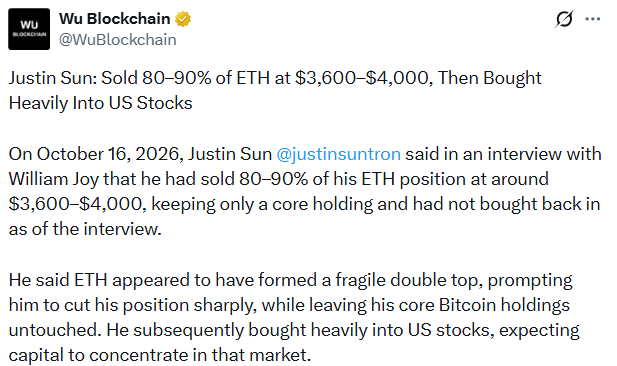
In a significant strategic shift that has garnered considerable attention within the cryptocurrency and investment communities, Justin Sun, the founder of TRON and a prominent figure in the digital asset space, has announced his decision to divest a substantial portion of his Ethereum holdings. Sun revealed in a recent interview with Wu Blockchain that he has sold between 80% and 90% of his personal Ethereum (ETH) assets. These funds are now being reallocated to a carefully selected portfolio of U.S.-listed cryptocurrency-related stocks, a move driven by his perception of emerging opportunities and potential outperformance in the American market. This strategic pivot marks a departure from his previous significant stake in the second-largest cryptocurrency by market capitalization and signals a contrarian view on Ethereum’s near-term trajectory compared to certain U.S. equities.
The catalyst for Sun’s decision appears to stem from his technical analysis of the Ethereum market, which he described as exhibiting a “double top pattern.” This chart formation is often interpreted by traders as a bearish indicator, suggesting a potential reversal of an upward trend and the onset of a sustained downtrend. According to Sun, this pattern has created a “fragile” technical setup for ETH, potentially hindering its ability to generate profits for investors. His assessment implies a belief that the current market structure for Ethereum presents a less favorable risk-reward profile compared to other investment avenues he has identified. While he has significantly reduced his ETH exposure, Sun confirmed that his Bitcoin (BTC) holdings remain unchanged, underscoring a distinction in his strategic outlook between the two leading cryptocurrencies.
Background and Chronology of Sun’s Investment Strategy
Justin Sun’s involvement in the cryptocurrency space dates back to the founding of TRON in 2017, a blockchain platform designed to decentralize the internet. Throughout his career, Sun has been known for his bold investment decisions and his ability to generate significant media attention. His substantial holdings in Ethereum, a platform that has become the backbone for a vast array of decentralized applications (dApps), non-fungible tokens (NFTs), and decentralized finance (DeFi) protocols, represented a significant part of his personal digital asset portfolio.
The decision to divest a large portion of his Ethereum holdings appears to be a recent development, likely influenced by evolving market dynamics and his ongoing analysis of global financial landscapes. The interview with Wu Blockchain, a well-known source for blockchain industry news and insights, provided the platform for Sun to articulate his reasoning. While the exact timing of his sales is not publicly detailed, the announcement suggests a deliberate and calculated move to rebalance his investment portfolio.

Sun’s explicit mention of the “double top pattern” in Ethereum indicates a technical trading approach. This pattern is characterized by two distinct peaks of a similar price level, separated by a trough. It is widely regarded as a signal of exhaustion in an uptrend, suggesting that buyers have lost momentum and that sellers may be taking control. The “fragility” he perceives in this pattern points to a belief that the support levels are weak and that a significant price decline could follow. This technical viewpoint, combined with his assessment of Ethereum’s performance as “sluggish,” has led him to seek alternative investment opportunities.
The choice to pivot towards U.S. crypto stocks is particularly noteworthy. This strategy suggests Sun’s confidence in the growth potential of companies that are either directly involved in the cryptocurrency industry or are significantly exposed to its ecosystem, but are listed on traditional stock exchanges. This could include companies involved in cryptocurrency mining, exchange operations, blockchain technology development, or companies that hold significant amounts of digital assets on their balance sheets. By investing in these publicly traded entities, Sun appears to be seeking a blend of exposure to the crypto market’s upside while potentially benefiting from the regulatory frameworks and investor confidence associated with established U.S. equities.
Supporting Data and Market Context
To understand the implications of Justin Sun’s move, it is essential to consider the broader market context for both Ethereum and U.S. crypto stocks. As of recent reporting periods, Ethereum has indeed experienced periods of volatility. While it has seen significant growth and adoption since its inception, its price performance is subject to the same market forces and sentiment shifts that affect all cryptocurrencies. The digital asset market is known for its rapid fluctuations, driven by regulatory news, macroeconomic factors, technological developments, and investor sentiment.
The concept of a “double top pattern” is a well-established technical analysis tool. If Ethereum were to exhibit such a pattern and subsequently enter a downtrend, it would align with Sun’s stated reasoning for his divestment. For instance, if Ethereum’s price had recently failed to surpass a previous high after a significant rally, and then began to decline, it would form the basis of this pattern. Traders often use such signals to de-risk their portfolios or to initiate short positions.
On the other hand, Sun’s interest in U.S. crypto stocks points to a potential belief that these companies are undervalued relative to their future prospects. Companies like Coinbase (COIN), MicroStrategy (MSTR), and various mining firms have experienced significant price swings that are correlated with the broader cryptocurrency market, but also influenced by their own corporate performance and strategic decisions. Sun’s mention of investing in World Liberty Financial (WLFI) as a specific example of a U.S.-based crypto-related stock further clarifies his investment thesis. His substantial investment of $30 million in WLFI tokens in November 2024, making him the largest investor in a platform backed by figures associated with the U.S. presidency, highlights his willingness to engage with established financial entities that are integrating with the digital asset space. This particular investment suggests a focus on companies that are not only exposed to crypto but are also strategically positioned within the traditional financial and political landscape of the United States.
Analysis of Implications
Justin Sun’s decision carries several implications for the cryptocurrency market and beyond. Firstly, it highlights the growing maturity of the digital asset investment landscape, where sophisticated investors like Sun are diversifying their strategies beyond direct cryptocurrency holdings into related equities. This diversification can lead to increased institutional interest in the crypto sector through traditional investment vehicles.
Secondly, Sun’s rationale based on technical analysis and perceived market sluggishness could influence other investors. While individual investment decisions are personal, high-profile moves by influential figures can sometimes trigger follow-on actions from other market participants who may share similar concerns or analyses. However, it is crucial to note that the cryptocurrency market is highly dynamic, and technical patterns alone do not guarantee future price movements.
Thirdly, Sun’s focus on U.S. crypto stocks suggests a growing confidence in the regulatory clarity and growth potential within the United States for companies operating in the digital asset space. As regulatory frameworks evolve, investors may find it more attractive to invest in U.S.-listed companies that navigate these regulations, potentially offering a more stable and predictable investment environment compared to direct exposure to the inherently volatile cryptocurrency markets. This trend could further bridge the gap between traditional finance and the burgeoning digital asset economy.
Furthermore, Sun’s specific mention of World Liberty Financial (WLFI) and his significant investment in it indicates a potential strategy of capitalizing on companies that are actively building bridges between traditional finance and the decentralized world. His backing of WLFI, especially given its association with prominent political figures, might suggest a belief in its ability to leverage regulatory developments and secure strategic partnerships. The investment of $30 million underscores his conviction in the platform’s future.
Official Responses and Broader Market Reactions

As of the reporting of this news, there have been no official responses from major Ethereum foundations or development teams directly addressing Justin Sun’s divestment. However, the broader cryptocurrency community often reacts to significant moves by prominent figures. Discussions on social media platforms and cryptocurrency forums are likely to be analyzing Sun’s decision, debating the validity of his technical analysis, and speculating on the future performance of Ethereum versus U.S. crypto stocks.
The crypto market, by its nature, is often influenced by sentiment and news flow. While Sun’s move is a personal investment decision, the narrative it generates could contribute to market discussions about Ethereum’s future and the attractiveness of alternative crypto-related investments. It is also possible that other investors, particularly institutional ones, are closely monitoring such strategic shifts as they formulate their own asset allocation strategies within the digital asset ecosystem.
Looking ahead, the performance of both Ethereum and the selected U.S. crypto stocks that Sun has invested in will be closely watched. If Ethereum were to experience a significant downturn, it would validate Sun’s bearish outlook, at least in the short to medium term. Conversely, if Ethereum were to rebound strongly, or if the U.S. crypto stocks underperform relative to ETH, it would present a different narrative. The success of Sun’s strategy will ultimately be measured by the returns generated from his reallocated portfolio.
The decision by Justin Sun to significantly reduce his Ethereum holdings and redirect capital into U.S. crypto stocks represents a strategic maneuver driven by his assessment of market opportunities and potential risks. His reliance on technical analysis, specifically the identification of a “double top pattern” in Ethereum, coupled with his conviction in the growth potential of certain U.S.-listed cryptocurrency-related equities, paints a picture of a seasoned investor adapting to perceived shifts in the global financial landscape. This move not only reflects his personal investment philosophy but also contributes to the ongoing evolution of investment strategies within the dynamic and rapidly expanding digital asset sector, highlighting a potential trend towards diversification into more traditional, yet crypto-exposed, investment vehicles. The long-term implications of this pivot will undoubtedly be a subject of continued observation and analysis by market participants worldwide.