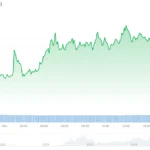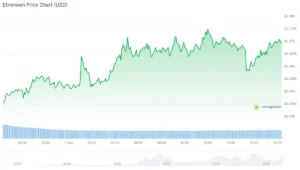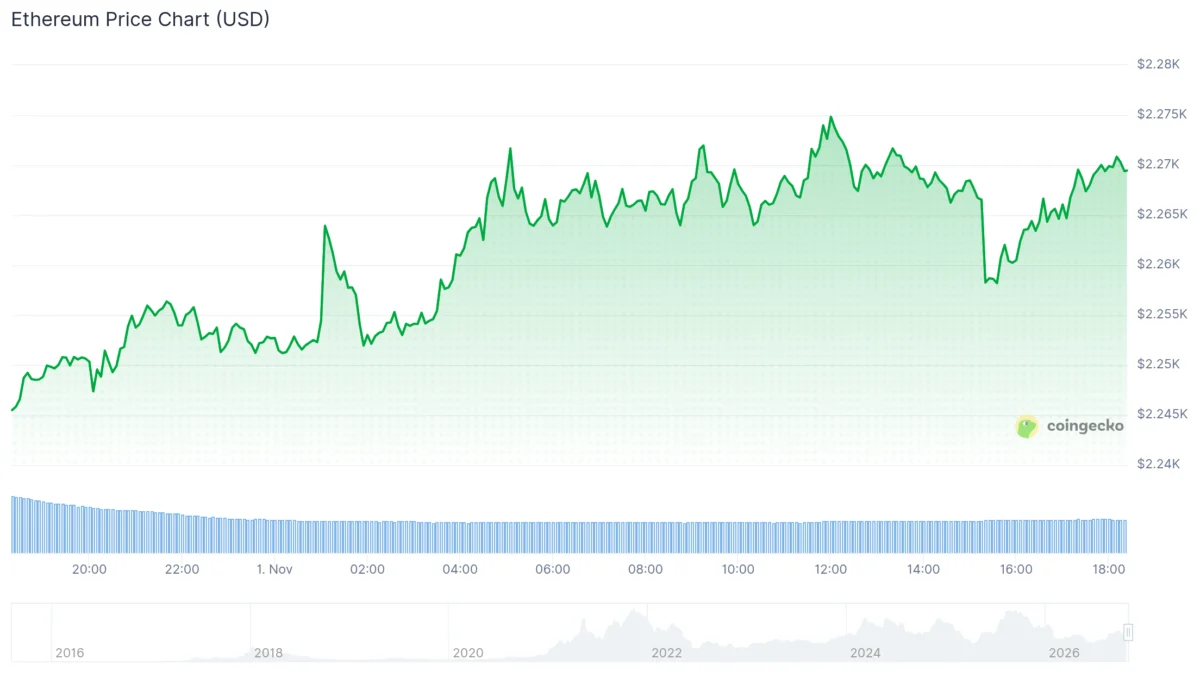
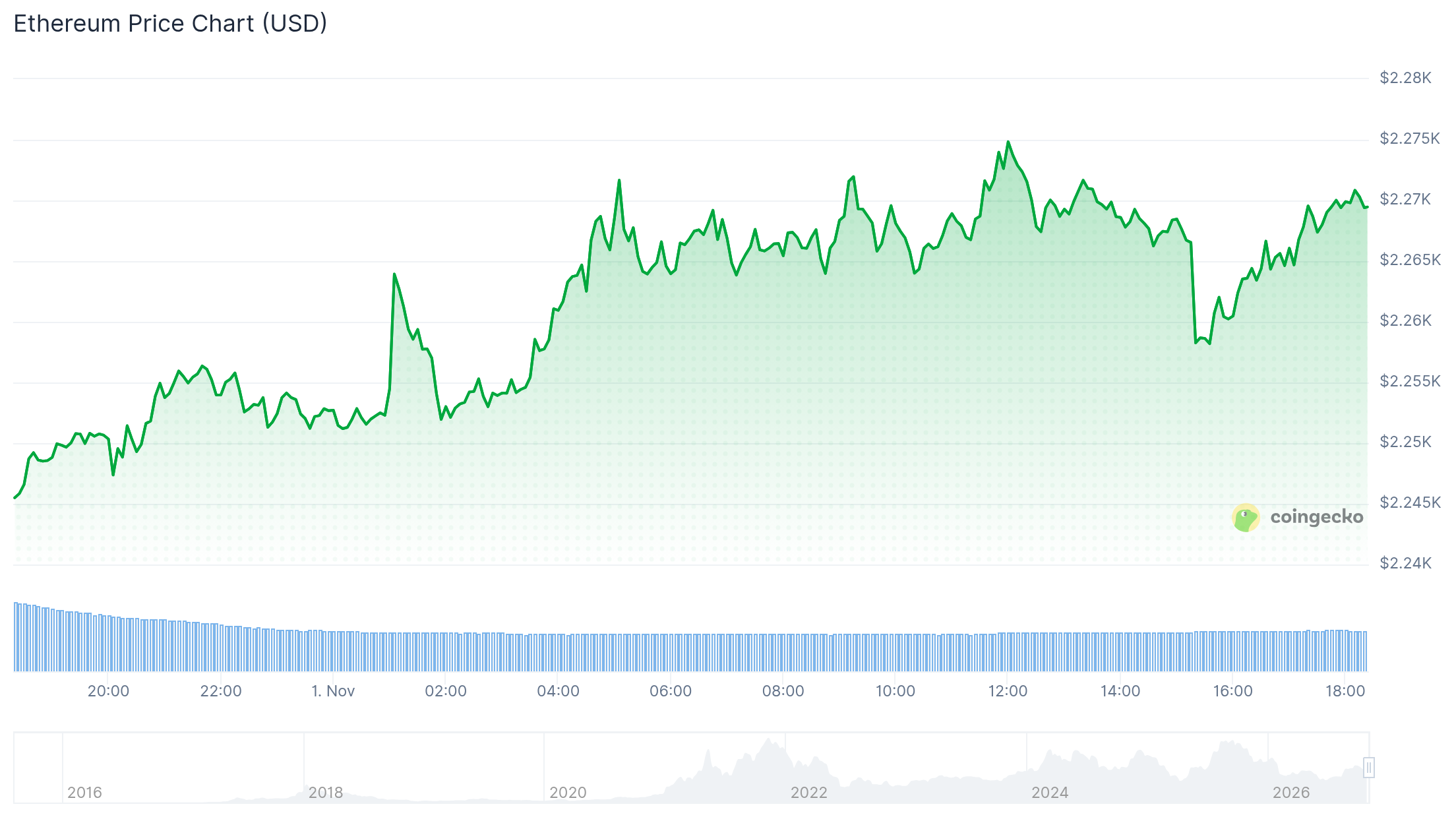
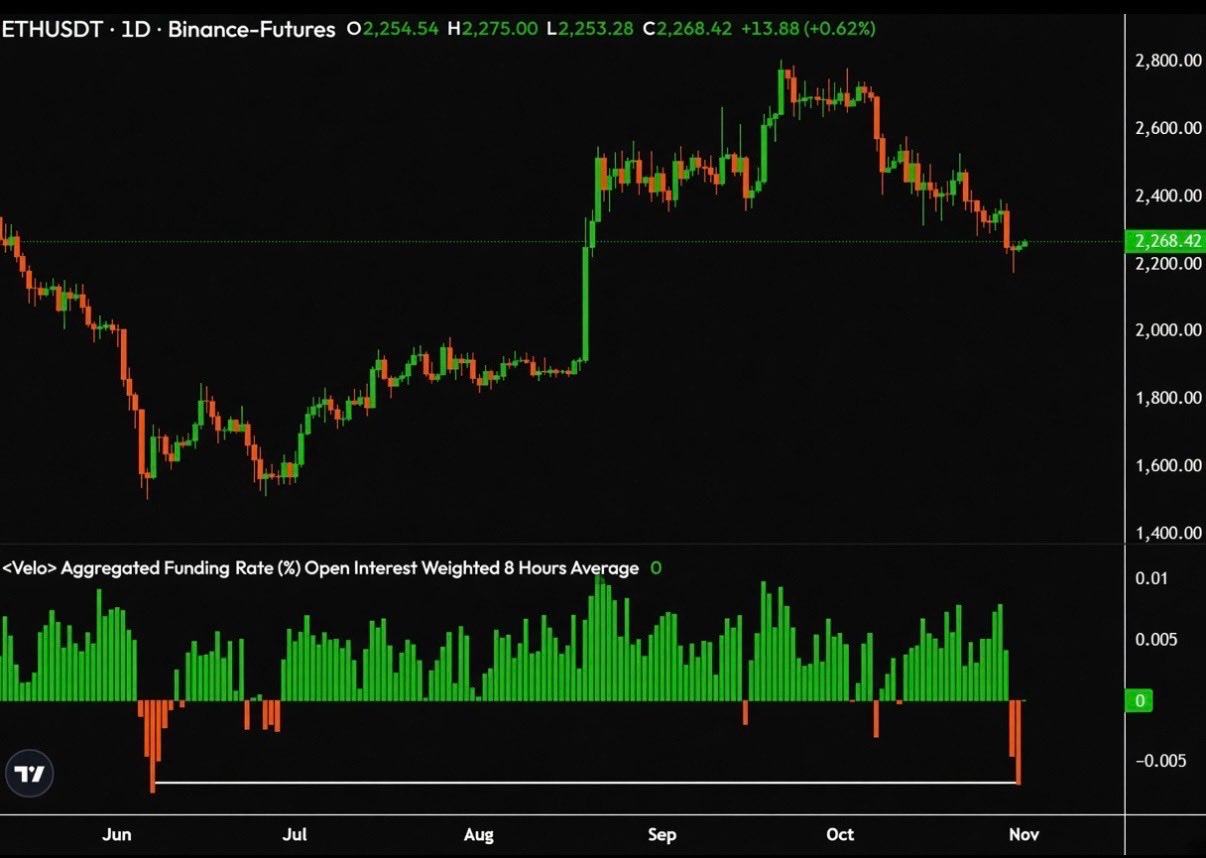
Ethereum’s price demonstrated a modest recovery on November 1, trading near $2,268, marking an increase of approximately 1.19% over a 24-hour period. This upward movement allowed the digital asset to regain the $2,250 threshold, a notable development influenced by a confluence of geopolitical discussions surrounding the Strait of Hormuz and the continued trend of withdrawals from U.S. spot Ethereum exchange-traded funds (ETFs). Concurrently, Bitcoin was observed trading around $77,812, while XRP maintained a position near $1.25, indicating broader activity across the cryptocurrency market.
The rebound in Ethereum’s value emerged against a backdrop of significant international diplomacy. Iranian Foreign Minister Abbas Araghchi articulated a proposal that could see the critical Strait of Hormuz waterway reopened within two days, provided a set of specific conditions are accepted by Washington. This geopolitical development carries substantial implications for global energy markets and, by extension, investor appetite for risk assets, including cryptocurrencies. However, the market’s tentative optimism was tempered by the persistent institutional trend of net outflows from Ethereum-based investment products, signaling a cautious stance among some large-scale investors.
Geopolitical Undercurrents: The Strait of Hormuz Proposal
The Strait of Hormuz, a narrow maritime chokepoint between the Persian Gulf and the Gulf of Oman, holds immense strategic importance as the world’s most vital oil transit waterway. Approximately one-fifth of the world’s total petroleum consumption, and roughly one-third of all seaborne crude oil, passes through this strait. Any disruption or perceived threat to navigation in this area can trigger significant volatility in global oil prices and broader financial markets. Historically, tensions in the region have led to spikes in crude oil futures and a general flight to safety among investors, often to the detriment of riskier assets like equities and cryptocurrencies.
Iranian Foreign Minister Abbas Araghchi confirmed ongoing discussions with Qatari mediators regarding a streamlined process for reopening the Strait. Tehran’s proposal outlines a compressed implementation period, reducing the anticipated timeline from seven days to a mere two, contingent upon the acceptance of its specific demands. These conditions are extensive and underscore Iran’s strategic objectives in the region and its long-standing grievances with Western powers.
Key among Iran’s demands is comprehensive sanctions relief, which would entail lifting economic restrictions imposed primarily by the United States. These sanctions have severely impacted Iran’s oil exports, access to international banking, and overall economic stability. A second condition calls for a reduction in the presence of U.S. military forces in the region, a long-standing point of contention for Tehran, which views the U.S. military footprint as a destabilizing factor. Furthermore, Iran seeks the restoration of oil waivers, which would allow certain countries to purchase Iranian oil without facing U.S. penalties, thereby boosting its export revenues. Access to frozen Iranian funds held in foreign banks, a significant sum accumulated from past oil sales and other assets, also forms a crucial part of the proposal.

Beyond economic and military concessions, the Iranian demands extend to regional security. Reports indicate Iran is seeking agreement on specific shipping routes with Oman, its neighbor across the Strait, to ensure predictable and secure maritime passage. Critically, Iran also called for an end to regional hostilities, with a particular emphasis on halting Israeli attacks on Lebanon. This condition highlights the interconnectedness of regional conflicts and Iran’s desire for broader de-escalation.
The proposed timetable for reopening the Strait would only commence upon the formal acceptance of these terms. Araghchi emphasized that consultations were ongoing, and a final outcome had not yet been reached. A successful resolution to these negotiations could significantly alleviate concerns over disrupted global shipping and energy supplies. Such an outcome would likely foster increased investor confidence, potentially encouraging a renewed appetite for riskier assets, including cryptocurrencies like Ethereum, as a more stable geopolitical environment reduces systemic risks. Conversely, a failure in negotiations or a protracted stalemate could prolong market uncertainty, exerting downward pressure on risk-on assets.
Institutional Flows: Ethereum ETFs Endure Persistent Outflows
While geopolitical developments offered a glimmer of optimism, the institutional investment landscape for Ethereum presented a more cautious picture. U.S. spot Ethereum ETFs recorded substantial net withdrawals on October 30, totaling $155.7 million, according to data from Farside Investors. This marked the fifth consecutive trading session of net outflows, signaling a sustained trend of institutional investors reducing their exposure to Ethereum through these regulated investment vehicles.
The outflows were concentrated among several prominent funds. BlackRock’s ETHA, a significant player in the spot Ethereum ETF market, accounted for a substantial portion of the daily total, experiencing $76.6 million in withdrawals. Grayscale’s ETH fund, another major vehicle, saw $34.1 million exit, while its separate ETHE fund recorded an additional $21.5 million in redemptions. Collectively, BlackRock’s ETHA and Grayscale’s ETH fund alone contributed $110.7 million to the daily net outflow, representing approximately 71% of the total for that day. This concentration underscores that the selling pressure originated largely from a few key institutional products.
Over a broader period encompassing seven trading sessions, the cumulative net outflows from U.S. spot Ethereum ETFs reached an alarming $537.6 million. This period included a brief anomaly with a small net inflow on October 23, which was swiftly followed by five consecutive days of negative flows. The data clearly indicates that the recent, albeit modest, price rebound in Ethereum had not translated into a sustained return of demand from ETF investors. This trend suggests that while individual traders might be reacting to short-term news, institutional sentiment remains predominantly bearish or cautious regarding Ethereum’s immediate prospects.
For the overall Ethereum price outlook, repeated redemptions from ETFs represent a significant challenge. These funds were anticipated to be an important source of sustained investment demand, channeling traditional capital into the cryptocurrency market. Their continued underperformance in attracting inflows places a persistent downward pressure on the asset. A reversal towards consistent net inflows would be a much clearer indicator that fund investors are actively rebuilding their exposure to Ethereum, which could provide a stronger foundation for a sustained price recovery. The current pattern, however, suggests that institutional conviction for Ethereum remains weak, potentially due to broader market uncertainties, profit-taking, or a re-evaluation of risk-reward dynamics.
Ethereum’s Price Action and Technical Outlook
Despite the institutional headwinds, Ethereum’s price managed to hold critical support levels during its recent recovery. The focus for traders remains firmly on the $2,250 mark, a psychological and technical level that, if maintained, could provide a base for further upside. Should this level fail, the next significant support zone is identified at $2,220. A breach below $2,220 would expose Ethereum to further downside, with potential targets at $2,100 and $2,050, reflecting a loss of recent gains and increased selling pressure.
On the upside, ETH price analysis identifies several resistance zones that buyers would need to overcome to establish a stronger bullish trend. The immediate resistance levels are pegged at $2,400 and $2,450. A successful breakthrough and sustained trading above these levels could open the path towards the more significant psychological barrier of $2,500.
For Ethereum to achieve a stronger advance and test these higher resistance levels, it must attract sufficient buying demand to absorb the persistent selling pressure that emerges near these price ceilings. A positive resolution to the Strait of Hormuz negotiations, leading to increased global stability and risk appetite, could provide the necessary catalyst for such an attempt. Conversely, stalled negotiations or a deterioration of geopolitical conditions could leave Ethereum’s nascent recovery vulnerable, potentially leading to a retest of lower support levels. The interplay between fundamental news, technical indicators, and overall market sentiment will dictate the trajectory of Ethereum in the coming days.
Broader Market Context: Bitcoin, XRP, and Macro Factors
The performance of other major cryptocurrencies provides additional context to Ethereum’s movements. Bitcoin, often seen as the bellwether for the entire crypto market, was trading around $77,812. Such a high valuation, if accurate, would signify an extremely bullish environment, potentially driven by factors distinct from those directly impacting Ethereum, or perhaps indicating a broader market rally. XRP, a prominent altcoin, held near $1.25, suggesting a degree of stability in its own trading range. The correlation between these assets often means that significant movements in Bitcoin can either lift or drag down the rest of the market, including Ethereum.
Beyond the immediate crypto ecosystem and geopolitical events, broader macroeconomic factors continue to exert influence. The upcoming U.S. midterm elections on November 3 add another layer of uncertainty for traders. Election outcomes can significantly impact policy expectations, particularly concerning cryptocurrency regulation, fiscal spending, and monetary policy, all of which can induce volatility across global financial markets. Depending on the results, a shift in political power could lead to new regulatory frameworks for digital assets, potentially affecting institutional adoption or retail participation. Price reactions in the cryptocurrency market are thus likely to depend not only on the outcome of the Strait of Hormuz negotiations but also on the perceived implications of the midterm election results for the broader economic and regulatory landscape.
The Road Ahead: Navigating Uncertainty
Ethereum’s recent price recovery underscores the complex interplay of forces shaping the cryptocurrency market. While a significant geopolitical event like the potential reopening of the Strait of Hormuz can inject optimism by easing global economic anxieties, the persistent outflows from institutional investment products highlight a more cautious, if not outright bearish, sentiment among larger investors. This divergence creates a dynamic environment where short-term speculative gains can be quickly eroded by underlying institutional skepticism.
The coming days will be critical. A definitive agreement on the Strait of Hormuz, particularly one that meets Iran’s conditions and leads to genuine de-escalation, could provide a strong tailwind for risk assets. However, the political complexities involved, especially regarding sanctions relief and military presence, make a swift and easy resolution far from guaranteed. Simultaneously, the performance of U.S. spot Ethereum ETFs will serve as a crucial barometer of institutional conviction. A reversal of the outflow trend into consistent inflows would signal renewed confidence, essential for a sustained rally. Finally, the results of the U.S. midterm elections will undoubtedly introduce new variables, shaping regulatory discourse and overall market sentiment.
In this intricate global landscape, Ethereum’s path forward remains contingent on a delicate balance of geopolitical stability, institutional investment patterns, and evolving macroeconomic and regulatory environments. Investors will closely monitor these developments, understanding that significant shifts in any of these areas could profoundly impact the digital asset’s trajectory.