The Middle East and North Africa (MENA) region navigated a period of intense geopolitical volatility and economic recalibration between July 2025 and June 2026, with the cryptocurrency sector serving as both a mirror and a refuge for these broader regional stresses. Despite a global bear market that saw the total cryptocurrency market capitalization slashed by half, the MENA crypto economy remained remarkably resilient, slipping only 1.4% to a total value of $443.3 billion. This stability, however, masked significant internal shifts: while 16 of the 24 measurable markets in the region experienced growth, the overall total was flattened by the diverging trajectories of the region’s two largest players, Türkiye and the United Arab Emirates (UAE), which together account for 56% of the regional economy.

The reporting period was defined by a "regional cloud of uncertainty" triggered primarily by the Iran conflict, which began on February 28, 2026. This conflict created cross-border economic pressures that affected every market in the study. Simultaneously, local factors—ranging from a severe internet crackdown in Iran to a major regulatory licensing transition in Türkiye—redefined how retail and institutional players engaged with digital assets. As global institutional capital sought durable, regulated hubs, the UAE emerged as the primary beneficiary, while Turkish users increasingly bypassed traditional exchanges in favor of peer-to-peer (P2P) and tokenized gold alternatives.
A Chronology of Conflict and Regulation
The 2025–2026 period was marked by several pivotal events that fundamentally altered the flow of digital assets across the MENA region. In September 2025, the U.S. Office of Foreign Assets Control (OFAC) intensified its focus on Iranian "shadow banking" networks, which influenced the regional compliance landscape. By January 2026, the Turkish government announced the Precious Metal Tracking System (KMTS), a framework designed to curb the informal economy by banning cash transactions for physical gold. This move immediately redirected Turkish savings demand toward tokenized gold on the blockchain.

On February 28, 2026, the outbreak of the Iran conflict introduced a new layer of complexity. The Iranian government responded to internal protests and the onset of war with two major internet blackouts: a 20-day shutdown in January and a subsequent 88-day shutdown starting in late February. During these periods, cryptocurrency activity within Iran plummeted but did not cease, as resilient users sought alternative connection methods. Meanwhile, the UAE faced direct drone and missile threats, which prompted a shift in investment behavior as residents looked toward "safe haven" assets. By July 2026, the regional landscape had been permanently altered, with Türkiye enforcing a strict new licensing regime and the UAE solidifying its position as a global institutional hub.
Türkiye: The Shift from Exchange-Dominated to Institutional Infrastructure
Türkiye remained the largest crypto economy in the MENA region during the reporting period, accounting for $144.5 billion in value received—approximately one-third of the regional total. While the market saw a modest year-over-year contraction, analysts view this as a structural transition rather than a retreat. The decline in exchange-based volume was largely offset by a deepening of institutional engagement from banks and a surge in wallet-to-wallet activity.

A major driver of this change was the enforcement of a new regulatory regime requiring all Crypto Asset Service Providers (CASPs) to hold licenses from the Capital Markets Board of Türkiye (SPK). Burcu Küçükünal, CEO of the Turkish exchange Stablex, noted that the law "raised the operational bar for the whole industry," effectively integrating crypto into the traditional financial system. Salim Karaman, CEO of BtcTurk, added that the focus has shifted from "assessing potential" to developing regulated services for treasuries and family offices.
Despite this institutionalization, Türkiye’s grassroots crypto economy remains the most vibrant in the region. The country’s P2P economy grew fivefold to $3.56 billion, nearly triple the combined P2P activity of the rest of the MENA region. This growth was almost entirely concentrated in stablecoins, which serve as a dollar-denominated hedge against the persistent inflation of the Turkish lira. Because the Central Bank of the Republic of Türkiye prohibits using crypto for direct payments, this $3.56 billion represents a massive "underground" savings and transfer mechanism rather than a retail payment system.

The Rise of Tokenized Gold in the Turkish Market
One of the most significant trends of 2026 was Türkiye’s emergence as a world leader in tokenized gold adoption. Traditionally, Turkish households have hoarded physical gold—estimated at 5,000 tons—to protect wealth. However, the KMTS cash ban on physical gold redirected this demand on-chain. Tokenized gold trading, which was virtually non-existent in 2024, surged to nearly $1 billion by June 2026.
Data from exchange order books revealed that the Turkish lira was the second most popular currency globally for purchasing tokenized gold, trailing only the U.S. dollar. In February 2026, following the KMTS announcement, gold trading hit $183.9 million, representing 2.5% of the entire lira-denominated trading book. Fatih Günaydın, General Manager at İş Digital Asset Technologies, observed that the market is rapidly evolving from a volume-based structure into a "mature ecosystem focused on institutional products."

The UAE: Solidifying a Global Institutional Hub
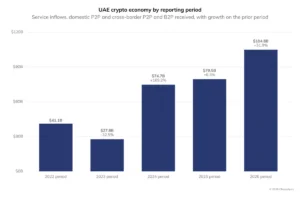
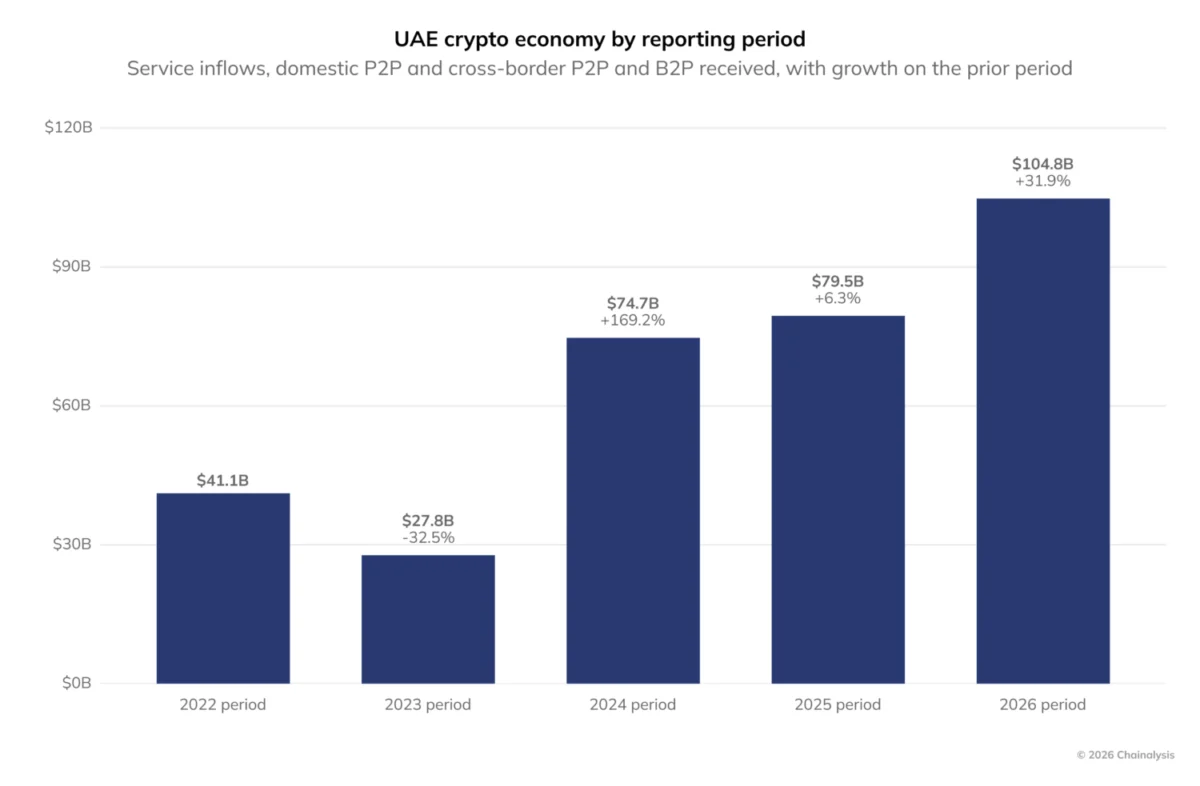
While Türkiye underwent a transition, the UAE experienced an explosive 32% growth, reaching a crypto economy of $104.8 billion. This growth is a direct result of the Emirates’ long-term strategy to diversify its oil-dependent economy through proactive regulation. Henri Arslanian, co-founder of Nine Blocks Capital Management, noted that while the Iran conflict impacted UAE tourism, the crypto industry remained resilient. "Outside of the U.S., the UAE has become the main hub for crypto firms’ global operations," Arslanian stated.
The UAE’s growth was driven by its services sector, which saw a 29% increase in inflows. Notably, institutional platforms—including custodians and market makers—grew by 75%, reaching $11.7 billion. This institutionalization is reflected in the types of inquiries received by local exchanges. Laurent Girouille of Rain Trading Limited reported that clients are no longer asking about retail access, but rather about "regulated counterparties, asset custody, and settlement reconciliation."

Furthermore, the UAE has become a global center for B2B stablecoin transactions. Cross-border business payments spiked nearly 400%, fueled by stablecoin transfers exceeding $1 million. Industry experts at Fuze Finance suggested that stablecoins are now viewed as "financial infrastructure" for corporate treasury and cross-border settlement, rather than speculative assets.
Iran: Digital Resilience Under Blackouts
Iran presents a dual-faced crypto economy: one utilized by the regime to evade sanctions and fund the IRGC, and another used by everyday citizens to hedge against inflation. Our analysis focused on the latter, revealing the profound impact of government-imposed internet blackouts. During the 88-day shutdown following the start of the war, Iranian bitcoin transactions dropped by 80%.

However, the data also highlighted the resilience of the Iranian population. Despite the blackout, bitcoin activity gradually climbed back to 75% of the baseline before the restrictions were even lifted, suggesting that users found ways to bypass the blockade via Starlink or other means. Once the blackouts were lifted in May 2026, activity surged to nearly double the baseline, indicating that the restrictions had merely "bottled up" a massive latent demand for digital assets.
Israel: A Mature Market in a State of Equilibrium
Israel’s crypto economy, valued at $37.9 billion, remained largely static during the reporting period, growing by only 0.7%. Unlike the UAE or Türkiye, Israel showed no significant reaction to the 2026 Iran war. Analysts suggest this is because the Israeli market had already undergone its major adjustment following the events of October 7, 2023.

Israel remains a retail-driven market, with 98.4% of transfers into services being under $10,000. Stablecoins have become the dominant asset class, representing 57% of service inflows. Ilan Sterk, CEO of Horizon, explained that Israelis primarily use stablecoins as a "bridge" to access global trading opportunities not available on domestic platforms. Interestingly, Israel’s domestic stablecoin velocity—the rate at which tokens change hands within the country—remains very low (1.46 vs. a global average of 9.31), indicating that Israeli users are primarily "holding" rather than "transacting."
Broader Impact and Future Implications
The events of the July 2025 to June 2026 period underscore a fundamental shift in the MENA crypto landscape. Geopolitical conflict and regulatory pressure did not stifle adoption; instead, they accelerated the maturation of the market. The UAE’s rise as an institutional powerhouse provides a blueprint for other jurisdictions, while Türkiye’s shift toward tokenized assets and P2P rails demonstrates how digital assets can adapt to traditional financial restrictions.

As the region enters 2027, the primary question remains whether these shifts are permanent. On current trajectories, the UAE is poised to surpass Türkiye as the region’s largest crypto economy by next year. The move toward tokenized gold and the institutionalization of stablecoins suggest that cryptocurrency is no longer a "parallel system" in the Middle East but is becoming the very infrastructure upon which the region’s future financial stability may depend. In a region defined by uncertainty, the transparency and durability of on-chain economics have provided a rare constant.