Ethereum, the second-largest cryptocurrency by market capitalization, is currently navigating a critical price zone, exhibiting indecisiveness and potential exhaustion as it consolidates below the $2,700 mark. This prolonged period of stagnation has prompted scrutiny from market watchers, with prominent analysts weighing in on the potential trajectories for the digital asset. The prevailing sentiment suggests that Ethereum is at a make-or-break level, with its immediate future hinging on its ability to overcome key resistance points or succumb to bearish pressures.
Analyzing the Current Price Action and Technical Indicators
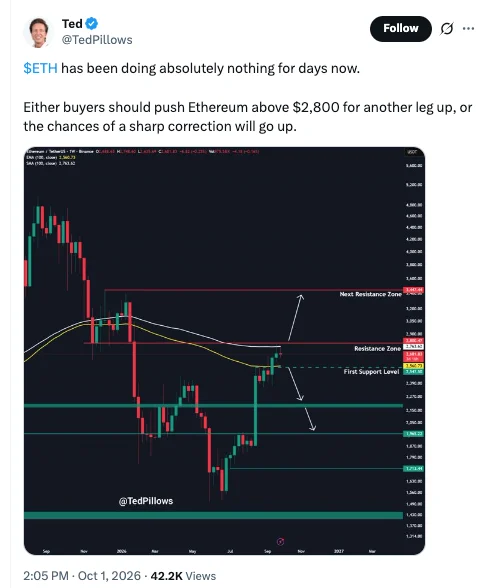
For the past week, Ethereum has been trapped in a narrow trading range, a scenario that often precedes significant price movements. At the time of writing, ETH is trading around $2,620, a figure that places it precariously between two important technical indicators: the 100-day Simple Moving Average (SMA) and the exponential moving average (EMA). The 100-day SMA, a widely followed metric for medium-term trends, is positioned around $2,780, acting as a significant overhead resistance. Conversely, the EMA, which gives more weight to recent price data, sits around $2,560, providing a near-term support level. This proximity between ETH’s current price and these two moving averages creates a volatile equilibrium, offering ample motivation for a decisive move in either direction.
Crypto analyst Ted Pillows, in a recent social media post, highlighted the $2,800 level as a pivotal point for Ethereum’s price action. According to Pillows, a sustained break above this resistance is crucial for bullish momentum to continue. Such a breakout would signal renewed buying interest and could pave the way for higher price targets. However, a failure to breach this level, particularly with a decisive move, could trigger a sharp price correction, a scenario that the current upward forces are keen to avoid. The implications of failing to hold this level are significant, as it could signal a broader shift in market sentiment towards a more bearish outlook.
Potential Downside Targets and the Specter of a Bear Market

Should Ethereum’s price succumb to bearish pressure and break below the $2,700 threshold, several key support levels come into play. Analysts have identified $2,547 as the immediate next level to watch. A breach of this support could open the door to more substantial declines, with subsequent targets at $1,965 and potentially as low as $1,713. These levels represent significant historical price floors, and a fall to these points would indicate a considerable downturn in Ethereum’s market valuation.
The persistent discussion around a potential bear market for Ethereum is not without precedent. While the original article’s premise cited Peter Schiff’s declaration of Ethereum being in a bear market after falling under $4,000, it’s important to note that Schiff is a well-known Bitcoin maximalist and a vocal critic of altcoins, including Ethereum. His pronouncements often reflect a deeply held belief in Bitcoin’s superiority and a skepticism towards any cryptocurrency that deviates from his preferred narrative. However, the current price action, while not definitively confirming a bear market by traditional definitions (often considered a sustained drop of 20% or more from recent highs), does reflect a period of significant underperformance and a loss of upward momentum that concerns many investors.
The October Enigma: Historical Trends vs. Current Realities
The month of October has historically been viewed with a degree of optimism within the cryptocurrency community, often referred to as "Uptober." Data suggests that in 13 out of the last 10 years, October has seen net bullish activity. This historical trend provides a psychological comfort for bulls, suggesting a potential for positive price action. However, the cryptocurrency market is not immune to unexpected events, and last October serves as a stark reminder of this volatility. In the preceding year, the market experienced one of the largest derivatives liquidations in history, exceeding $15 billion, which was widely interpreted as a premature end to the 2024-2025 bull market cycle. This event underscores the importance of not relying solely on historical patterns and remaining cognizant of the inherent risks.
This year, October has not commenced with the robust bullish surge that some might have anticipated. The initial week, often considered crucial for setting the tone for the month, has seen major cryptocurrencies trading sideways or experiencing modest declines. This lack of immediate upward momentum is a cause for concern for those hoping for a strong "Uptober." While there is still ample time for bulls to reassert their influence and drive prices higher, the current sideways consolidation, occurring just below multi-month highs, paints a picture of caution rather than outright optimism.
Ethereum’s Dominance and the Broader Altcoin Market

The performance of Ethereum holds significant weight not only for its own investors but also for the broader altcoin market. As the foundational layer for a vast ecosystem of decentralized applications (dApps), DeFi protocols, and NFTs, Ethereum’s market dominance and health are intrinsically linked to the success of numerous other digital assets. A sustained downturn in ETH’s price can have a ripple effect, dampening investor sentiment and leading to broader sell-offs across the altcoin landscape.
Currently, the altcoin market’s overall situation appears vulnerable, if not weak, largely contingent on Ethereum’s positioning. The network’s ongoing development, including upgrades like the transition to Proof-of-Stake (The Merge) and subsequent network enhancements, aims to bolster its scalability, security, and efficiency. These improvements are designed to attract more developers and users, thereby strengthening Ethereum’s ecosystem and, by extension, its market standing. However, these long-term developments must contend with short-term market pressures and investor sentiment.
Broader Implications and Future Outlook
The current price consolidation of Ethereum below critical resistance levels underscores the broader macroeconomic factors and market sentiment that influence cryptocurrency prices. Inflationary pressures, interest rate policies by central banks, and geopolitical events all play a role in shaping investor appetite for risk assets, including digital currencies. The cryptocurrency market, while evolving, remains susceptible to these external forces.
For Ethereum to regain strong bullish momentum, several factors would likely need to align. These include a sustained breakout above the $2,800 resistance level, positive developments within the Ethereum ecosystem (such as increased adoption of its Layer 2 scaling solutions or successful implementation of further network upgrades), and a general improvement in global economic sentiment. Conversely, a failure to overcome current resistance, coupled with negative macroeconomic news or a loss of confidence in the broader crypto market, could lead to the bearish scenarios outlined by analysts.
The coming weeks will be critical for Ethereum. Investors and analysts will be closely monitoring the price action around the $2,700 and $2,800 levels. The ability of bulls to defend key support zones and mount a convincing challenge against resistance will determine whether Ethereum can embark on another upward trajectory or if it will face a period of significant correction. The ongoing debate between "Uptober" and "Downtober" remains active, with Ethereum’s price action poised to be a significant indicator of which narrative will prevail. The market’s attention remains firmly fixed on BTC and ETH, as these bellwethers often dictate the direction for the rest of the cryptocurrency market. The resilience of Ethereum’s market dominance and its central role in the burgeoning decentralized finance space mean that its performance will continue to be a key determinant of the broader altcoin market’s health and trajectory.