The United States Department of the Treasury’s Office of Foreign Assets Control (OFAC) announced a sweeping set of sanctions on October 28, 2026, targeting a sophisticated international network of 10 individuals and one entity. These actors are accused of facilitating North Korean government-run information technology (IT) worker schemes, which serve as a critical financial lifeline for the Democratic People’s Republic of Korea (DPRK) and its prohibited weapons of mass destruction (WMD) and ballistic missile programs. This latest regulatory action underscores the growing complexity of Pyongyang’s efforts to bypass international sanctions through a combination of cyber deception, blockchain technology, and geopolitical cooperation with Russian intermediaries.
According to federal authorities, these IT worker networks generate hundreds of millions of dollars in annual revenue for the North Korean regime. By infiltrating the global job market under the guise of legitimate remote freelancers, these state-sponsored agents secure high-paying positions in various sectors, including software development, blockchain engineering, and graphic design. The income generated is then laundered through a series of complex cryptocurrency transactions before being converted into fiat currency and funneled back to Pyongyang.
The Mechanics of Deception: AI and Laptop Farms
The October 2026 OFAC designation highlights a significant evolution in the tactics employed by the DPRK. Historically, North Korean IT workers relied on forged physical documents and basic virtual private networks (VPNs) to hide their true location. However, recent investigations reveal a shift toward more advanced technological manipulation.
The use of generative artificial intelligence (AI) has become a cornerstone of the DPRK’s recruitment strategy. Operatives now use AI tools to fabricate highly specialized resumes tailored to specific corporate job postings. These tools allow less-skilled workers to draft convincing cover letters and pass initial screening processes. In more brazen instances, the regime has deployed deepfake video and audio technology during live interviews to conceal the identities of North Korean nationals, often assuming the personas of real individuals whose identities have been stolen.

To maintain the illusion of a domestic presence, the network utilizes "laptop farms" located within the United States and other Western nations. These farms are managed by domestic facilitators who host hardware connected to local residential internet lines. North Korean workers log into these machines remotely, ensuring that their IP addresses appear consistent with the location of a local hire. This infrastructure effectively bypasses the geographic security protocols used by many major corporations to prevent unauthorized foreign access to sensitive internal systems.
The Russian Nexus: Crypto-to-Cash Pipelines
A primary focus of the new sanctions is the role of Russian nationals in laundering the proceeds of these IT schemes. As North Korea faces increasing isolation from the traditional global financial system, it has turned to Russian intermediaries to bridge the gap between digital assets and usable cash.
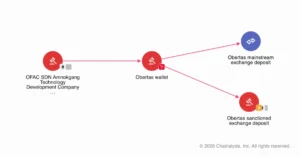
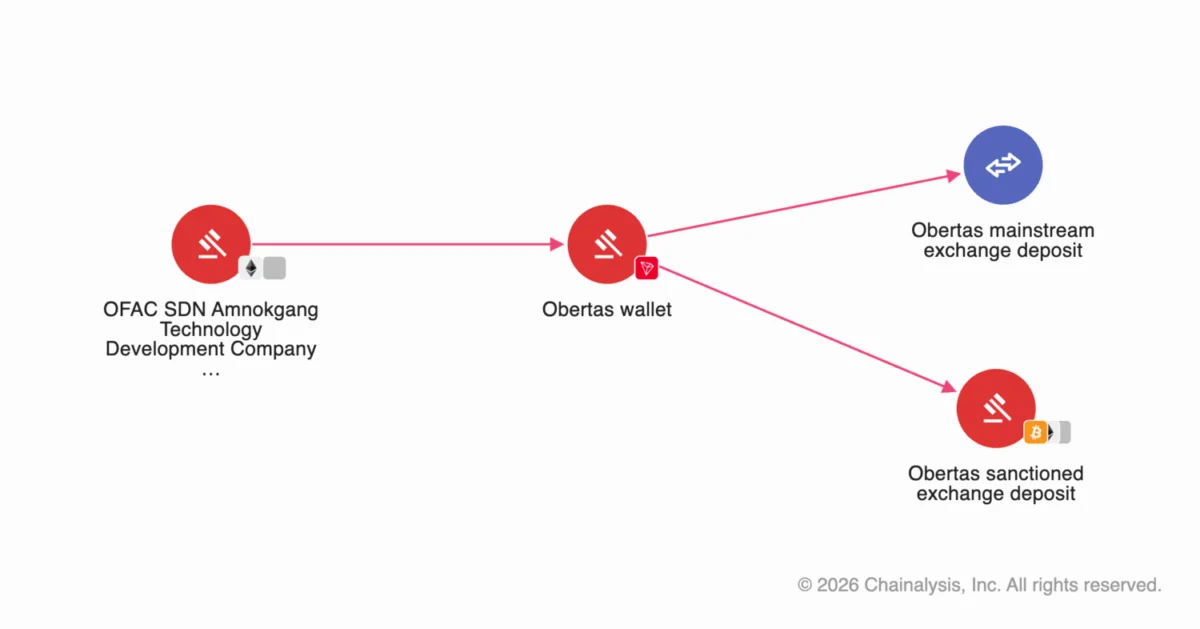
Among those designated is Vitold Viktorovich Obertas, a Russian national who allegedly served as a primary intermediary for illicit DPRK financial transactions. According to OFAC, Obertas has been involved in converting nearly $2 million worth of cryptocurrency into fiat currency for North Korean officials since early 2025. Blockchain analysis reveals that Obertas’s relationship with these networks dates back to 2023, involving transactions with Amnokgang Technology Development Company, a previously sanctioned entity responsible for managing DPRK IT worker delegations.
Another Russian national, Ilya Aleksandrovich Boykov, was sanctioned for providing logistical and financial support to Alis, a front company for North Korean workers. Boykov’s role involved monitoring cryptocurrency wallets and facilitating the transfer of funds to Garantex, a Russian-based cryptocurrency exchange that was previously sanctioned by the U.S. for its role in laundering ransomware proceeds and illicit finance. By utilizing exchanges like Garantex, the network can convert stablecoins and other digital assets into cash with minimal regulatory oversight.
Key Entities and Individuals Targeted
The sanctions list includes several high-ranking DPRK nationals who managed these overseas operations from Russian territory. Kim Ki Hyok and Kim Hyo Dong were identified as key managers reporting to the Chinyong Information Technology Cooperation Company. Chinyong, which was designated by OFAC in 2023, functions as an umbrella organization for various IT delegations.

Kim Ki Hyok reportedly led a delegation associated with Alis and was responsible for transferring nearly $500,000 in cryptocurrency. Kim Hyo Dong managed a separate Chinyong-subordinate delegation, providing logistical assistance and engaging in direct sanctions evasion.
The OFAC action also designated the First Financial and Technical Development Center (FFTDC), a DPRK-controlled entity operating out of Russia. The FFTDC is accused of deploying six specific IT workers—Kim Kyong Ju, Ri Thae Chol, So Hyon Jin, Han Yu Song, Kim Sung Gwan, and Hyon Se Il—who collectively generated more than $750,000 in revenue since 2025. These workers utilized sophisticated money laundering techniques and complex cryptocurrency transfers to obscure the origin of their earnings.
Chronology of Enforcement and Regulatory Response
The October 2026 action is part of a multi-year, coordinated effort by the U.S. government to dismantle North Korea’s digital revenue streams. The timeline of these efforts demonstrates the escalating nature of the threat:
- May 2022: The FBI, State Department, and Treasury Department issued a comprehensive joint advisory detailing the tactics used by DPRK IT workers, including the use of stolen identities and proxy infrastructure.
- May 2023: OFAC sanctioned the Chinyong Information Technology Cooperation Company and several associated facilitators, marking a major strike against the regime’s IT management structure.
- 2024–2025: The Department of Justice (DOJ) unsealed several indictments against U.S.-based facilitators who operated laptop farms in states like Tennessee and Arizona, highlighting the domestic reach of the conspiracy.
- March 2026: Additional sanctions were leveled against Amnokgang Technology Development Company for its role in deploying IT workers to Russia and China.
- October 2026: The current action targets the "last mile" of the financial pipeline—the Russian intermediaries and specific managers who convert digital earnings into the fiat currency required for state-level procurement.
Broader Implications for Global Security and Corporate Governance
The persistent success of North Korean IT worker schemes poses a dual threat: it provides a steady stream of revenue for a rogue state’s nuclear program and creates significant security vulnerabilities for the businesses that unwittingly hire these agents.
Beyond the financial aspect, North Korean IT workers often gain privileged access to corporate networks. While their primary goal is typically income generation, there is a constant risk that they may use their access to deploy malware, steal intellectual property, or conduct industrial espionage. The U.S. government has warned that these workers often keep "backdoors" into the systems they help build, which can be exploited by state-sponsored hacking groups like the Lazarus Group.

For the private sector, the October 2026 sanctions serve as a reminder of the need for rigorous "Know Your Employee" (KYE) protocols. Security experts suggest that companies should be wary of candidates who refuse to appear on camera, utilize VoIP phone numbers, or have inconsistencies in their background check documentation. Furthermore, the use of blockchain analytics has become an essential tool for compliance departments to screen for transactions associated with sanctioned addresses.
Analysis of Economic Impact and Future Outlook
The United Nations Panel of Experts estimates that North Korean IT workers generate between $250 million and $600 million annually. By targeting the intermediaries in Russia, the U.S. Treasury is attempting to increase the "friction" of these transactions. When facilitators like Obertas and Boykov are removed from the system, the regime must find new, often more expensive or less reliable, ways to move its money.
However, the challenge remains significant. The decentralized nature of cryptocurrency and the willingness of certain jurisdictions to ignore international norms provide a persistent "gray zone" for the DPRK to operate. As AI technology continues to improve, the ability of these workers to blend into the global workforce will only increase.
A spokesperson for the Treasury Department stated that the U.S. remains committed to using all available authorities to disrupt the DPRK’s ability to generate revenue through illicit means. "Today’s action targets the financial facilitators who enable North Korea’s exploitation of the global technology sector. We will continue to follow the money and hold accountable those who help Pyongyang fund its dangerous and destabilizing weapons programs."
As the digital landscape evolves, the intersection of cybersecurity, financial regulation, and geopolitics will remain the primary battleground in the effort to contain North Korea’s nuclear ambitions. The October 28, 2026, sanctions represent a significant step in that ongoing campaign, signaling to both facilitators and the corporations they target that the risks of engagement are higher than ever.