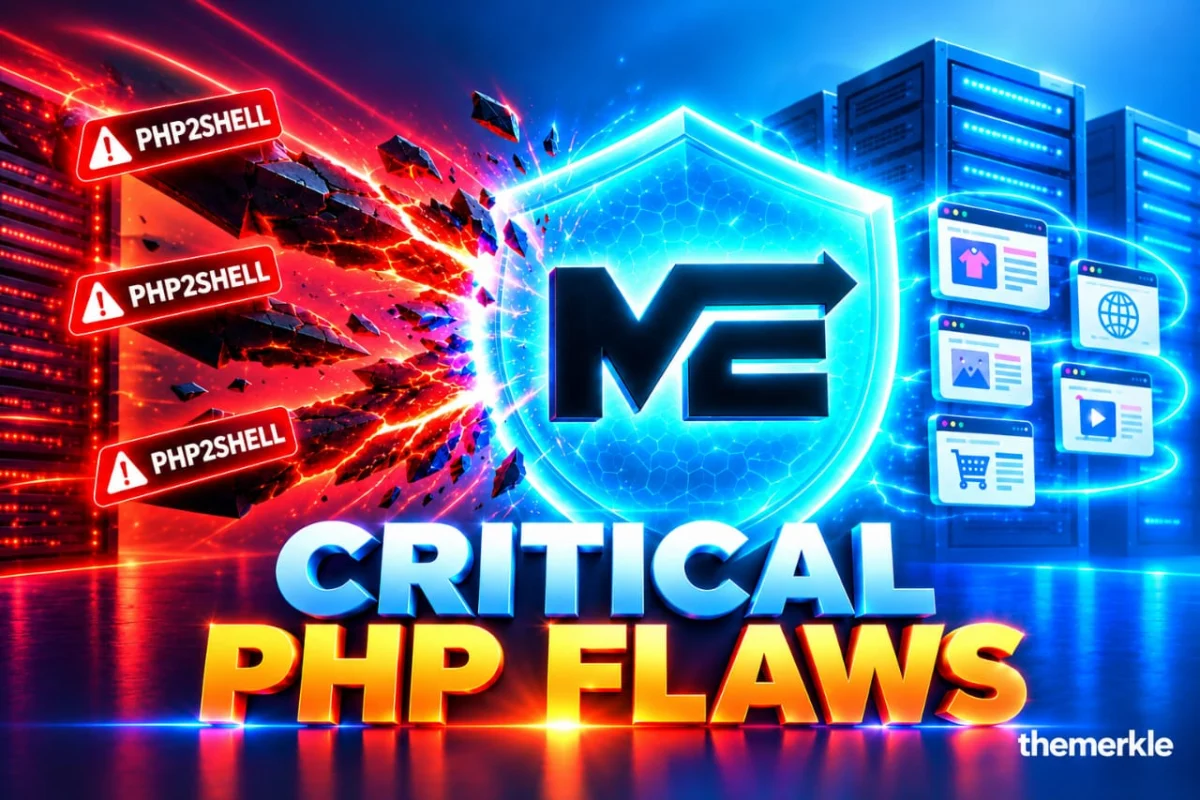
The digital world is currently grappling with an urgent security crisis following the emergency release of patches for two critical vulnerabilities in the PHP language runtime. Tracked as CVE-2026-109618 and CVE-2026-109619, and collectively nicknamed "PHP2Shell," these flaws enable unauthenticated remote code execution (RCE), allowing attackers to seize control of web servers without needing any prior authentication. The cybersecurity community is treating this as a profoundly significant event, with researchers from Wiz describing the findings as among the most severe ever discovered in PHP. Independent security expert Kevin Beaumont has warned of an impending "wave of incidents," categorizing PHP2Shell as one of the most critical vulnerabilities to emerge in years, underscoring the immediate and pervasive threat to web infrastructure globally.
The severity of these vulnerabilities stems from their ability to let an attacker execute arbitrary code on a web server without logging in. Given that PHP powers approximately 69.7% of websites whose server-side language is known, according to W3Techs, virtually every PHP installation serving web requests is potentially affected. This includes a vast array of popular platforms such as WordPress, Drupal, Magento, Joomla, and Laravel, as well as countless custom applications. Cybersecurity agencies have reacted swiftly and decisively. The UK’s National Cyber Security Centre (NCSC) has issued an unequivocal directive for organizations to update their systems immediately, further advising that any system incapable of receiving immediate patches should be taken offline to prevent potential compromise.
The Discovery and Premature Disclosure of "PHP2Shell"
The vulnerabilities, rated critical with a CVSS v4.0 score of 9.2, were jointly disclosed by Wiz Research and the PHP security team. This high score signifies that the flaws are easily exploitable, require low attack complexity, and have a devastating impact on confidentiality, integrity, and availability. Wiz Research’s findings pointed to deep-seated issues within the core PHP runtime that could expose applications to unauthenticated remote code execution and memory disclosure. The critical nature of these flaws was inadvertently amplified by a premature leak. On October 20, a now-deleted post on Hacker News revealed the CVE identifiers before the official patches were made available to the public. The PHP team, recognizing the potential for immediate exploitation once details became public, had previously stated they reserved the right to accelerate their release schedule under such circumstances, highlighting the delicate balance between responsible disclosure and mitigating real-world threats. This incident underscores the inherent challenges in managing high-stakes vulnerability disclosures, where even a slight misstep in timing can significantly escalate risk.
Understanding the Mechanics of "PHP2Shell"
The technical underpinnings of PHP2Shell are complex but fundamentally dangerous. The NCSC’s explanation highlights that an attacker can trigger an out-of-memory condition, leading to memory corruption. Under specific, exploitable conditions, this corruption can be leveraged to achieve unauthenticated remote code execution.
The first vulnerability, CVE-2026-109618, involves a flaw in PHP’s out-of-memory handling mechanisms. When PHP encounters an out-of-memory situation, its internal request data might only be partially initialized. An attacker can exploit this incomplete state to manipulate memory structures, creating a pathway for arbitrary code execution. The partial initialization leaves critical internal data in an inconsistent state, which can then be manipulated by subsequent operations or attacker-controlled input.
The second vulnerability, CVE-2026-109619, allows internal state data associated with a request to persist or "survive" even after its allocated memory has been freed. This is a classic "use-after-free" vulnerability. When memory is freed, it is marked as available for reuse. If an attacker can then trigger a new allocation in that same memory region and control its contents, they can effectively manipulate data that PHP still believes is part of an active request’s internal state. This control over freed memory, combined with the out-of-memory handling flaw, provides a robust vector for achieving full system compromise. Together, these flaws bypass standard security measures, allowing an attacker to inject and execute malicious commands directly on the server, effectively taking it over.
The Unprecedented Scope and Impact of the Threat
The widespread adoption of PHP across the internet means the impact of PHP2Shell is almost unparalleled. From small blogs to large enterprise applications, the vast majority of web services rely on PHP. The data from W3Techs, indicating PHP’s use on nearly 70% of websites with known server-side languages, paints a stark picture of the potential attack surface.
All PHP versions from 5.4 through 8.5.11 are confirmed to be vulnerable. This extensive range covers many legacy systems that might not have been updated in years, alongside more modern deployments. The fixes have been released in PHP 8.5.12, 8.4.27, 8.3.36, and 8.2.35. The NCSC has explicitly cautioned organizations against limiting their search to only outdated PHP versions, emphasizing the need to identify all PHP installations and prioritize internet-facing systems due to their direct exposure to external threats.
The implications for widely used PHP-based content management systems (CMS) and frameworks are particularly severe. Platforms like WordPress, which alone powers over 40% of all websites, Drupal, Magento (for e-commerce), Joomla, and frameworks like Laravel and Symfony, are all exposed if they run on a vulnerable PHP version. This means that patching efforts are not just for individual server administrators but also for the vast ecosystem of developers and users reliant on these platforms. A successful RCE attack could lead to data theft, website defacement, installation of ransomware, creation of botnet nodes, and even a pivot to compromise other systems within an organization’s network. The scale of potential disruption, data breaches, and financial losses could be immense, potentially rivaling the impact of past major RCE vulnerabilities such as Log4Shell or EternalBlue.
A Chronology of Critical Events
The unfolding of the PHP2Shell crisis followed a rapid and somewhat chaotic timeline, characteristic of severe, widespread vulnerabilities:
- Pre-October 20, 2026: Wiz Research privately discovers the vulnerabilities and engages in responsible disclosure with the PHP security team. This phase involves detailed technical analysis, proof-of-concept development, and coordination for a patch release.
- October 20, 2026: The CVE identifiers (CVE-2026-109618 and CVE-2026-109619) are prematurely disclosed in a now-deleted post on Hacker News. This leak triggers immediate concern within the security community, as attackers could potentially reverse-engineer the flaws before official patches are available.
- October 21, 2026 (Emergency Release Day):
- The PHP security team, responding to the leak and the critical severity, issues emergency patches. New versions PHP 8.5.12, 8.4.27, 8.3.36, and 8.2.35 are released to address PHP2Shell.
- Official security advisories are published on PHP.net, detailing the vulnerabilities and urging immediate updates.
- Government cybersecurity agencies, including the NCSC (UK) and CERT-EU, issue their own critical warnings and guidance for organizations.
- Wiz Research publicly releases its detailed findings, providing technical insights into the nature of the vulnerabilities.
- Kevin Beaumont, a prominent independent security researcher, amplifies the warning, calling it "one of the biggest vulnerabilities in years" and predicting a "wave of incidents."
- Cloud providers like Google Cloud publish advisories and outline their response strategies, highlighting the collective industry effort to mitigate the threat.
- Ongoing: Reports surface of potential exploitation attempts, including a video demonstrating the exploit. While no evidence of widespread, at-scale attacks has been confirmed yet, these reports underscore the urgency for patching and vigilance. The cybersecurity community remains on high alert, monitoring for active exploitation in the wild.
Official Directives and Cybersecurity Agencies’ Stance
The rapid response from leading cybersecurity authorities underscores the gravity of the PHP2Shell vulnerabilities. The UK’s National Cyber Security Centre (NCSC) has been particularly emphatic in its guidance, stressing that organizations must update immediately. Beyond simply applying patches, the NCSC has advised that any system that cannot be fixed right away should be taken offline to prevent potential compromise. This drastic measure highlights the immediate and severe risk of unauthenticated remote code execution. Furthermore, the NCSC has urged organizations to conduct comprehensive audits to identify all PHP installations, not just those running older versions, with a clear priority on internet-facing systems that are most exposed to external attacks. Crucially, for any system suspected of having been exposed prior to patching, the NCSC recommends a thorough forensic investigation for signs of compromise, including the presence of backdoors or other malicious implants.
Similarly, CERT-EU (Computer Emergency Response Team for the EU institutions, bodies, and agencies) has issued its own advisory, recommending that where immediate patching is not feasible, organizations should consider isolating internet-facing applications from public networks. This isolation creates a buffer, preventing direct access to vulnerable systems and buying time for proper remediation. Both agencies emphasize that the window of opportunity for attackers to exploit these flaws is likely to be very narrow, making swift action paramount. The collective voice of these authoritative bodies sends a clear message: the threat is real, the impact could be devastating, and immediate, decisive action is required to protect digital assets.
The End-of-Life Conundrum and Legacy Systems
One of the most significant challenges presented by the PHP2Shell vulnerabilities is the predicament of end-of-life (EOL) PHP versions. The official PHP project does not backport security fixes to PHP 8.1 or earlier versions, as these have officially reached their end of life. This policy is standard practice for software projects, encouraging users to migrate to actively maintained versions for continued security support. However, in the context of a critical, widespread vulnerability, this policy creates an immediate crisis for countless organizations still running older PHP versions.
For these entities, simply applying a patch is not an option. Their only long-term solution is a full migration to a supported version, specifically PHP 8.2 or newer. Such migrations can be complex, time-consuming, and costly, often requiring significant code refactoring, dependency updates, and extensive testing, especially for large or intricate applications.
Recognizing the severity of PHP2Shell, the PHP team did make a concession: they released "minimal source backports" for PHP 7.4, 8.0, and 8.1. While this provides a temporary lifeline, it comes with significant caveats. These backports are primarily intended for users who build PHP from source, rather than those who rely on pre-compiled packages from operating system repositories or hosting providers. Implementing these source backports requires a high level of technical expertise and is not a substitute for a full upgrade. It merely offers a stop-gap measure for organizations with the technical capacity to custom-compile their PHP installations, buying them some time to plan and execute a proper migration. This situation highlights the inherent risks associated with running EOL software, making these critical vulnerabilities particularly dangerous for a large segment of the internet.
Broader Implications for the Digital Ecosystem
The PHP2Shell vulnerabilities cast a long shadow over the broader digital ecosystem, serving as a stark reminder of the interconnectedness and fragility of modern web infrastructure. The potential for mass exploitation of these flaws carries significant implications across several dimensions:
- Economic Impact: The immediate costs associated with patching—developer time, server downtime, and potential service interruptions—are substantial. Beyond that, the economic fallout from potential data breaches, ransomware attacks, or other forms of compromise could be catastrophic, leading to regulatory fines, legal liabilities, reputational damage, and loss of customer trust. For smaller businesses, a successful attack could even threaten their very existence.
- Supply Chain Risk: Web applications often form critical links in digital supply chains. A compromised PHP server could be leveraged to launch further attacks against its users, connected services, or even inject malicious code into content served to visitors, creating a cascading effect of security incidents. This amplifies the risk beyond individual organizations to their entire network of partners and customers.
- Cybersecurity Posture: This event underscores the absolute necessity for robust patch management, comprehensive asset inventory, and well-rehearsed incident response plans. Organizations that lack a clear understanding of their PHP deployments or have neglected timely updates will face the most significant challenges. It also highlights the continuous pressure on open-source projects, which form the bedrock of the internet, to maintain stringent security standards for their widely adopted components.
- User Trust: Widespread breaches stemming from PHP2Shell could erode user trust in online services, potentially leading to a reluctance to engage in e-commerce, online banking, or sharing personal information, thereby impacting the digital economy as a whole.
Immediate Action: A Comprehensive Checklist for Organizations
Given the critical nature and widespread impact of PHP2Shell, organizations must act decisively and immediately. Here’s a comprehensive checklist of recommended actions:
- Comprehensive Inventory: Begin by identifying all systems running PHP, prioritizing internet-facing applications and servers. This includes web servers, API endpoints, and any backend services that utilize PHP.
- Immediate Patching: Apply the official security updates to all vulnerable PHP installations without delay. This means upgrading to PHP 8.5.12, 8.4.27, 8.3.36, or 8.2.35. For major PHP-based platforms (WordPress, Drupal, etc.), monitor their official security advisories for specific update instructions, as they may release their own patched versions that bundle the PHP runtime updates.
- Address End-of-Life Versions: For systems running EOL PHP versions (8.1 and older) where official patches are unavailable, prioritize immediate migration to a supported version (PHP 8.2 or newer). If immediate migration is impossible, and the organization possesses the necessary technical expertise, consider implementing the minimal source backports for 7.4, 8.0, or 8.1 as a temporary stop-gap, but recognize this is not a long-term solution.
- Isolation and Offline Measures: As advised by NCSC and CERT-EU, if a system cannot be patched immediately, consider taking it offline or isolating it from public networks. This might involve firewall rules, network segmentation, or temporarily disabling the service.
- Forensic Investigation for Compromise: If any system was exposed to the internet before patching, conduct a thorough forensic examination for signs of compromise. Look for unusual file modifications, new user accounts, unexpected network connections, backdoors, or suspicious processes. Incident response plans should be activated.
- Web Application Firewall (WAF) and Intrusion Prevention System (IPS) Review: While patching is the primary defense, review and update WAF and IPS rules to detect and block potential exploitation attempts. These can provide an additional layer of defense, though they should not be considered a substitute for applying the patches.
- Enhanced Monitoring: Increase logging and monitoring on all PHP-powered servers for suspicious activity, unusual resource consumption, or unauthorized access attempts.
- Communication: Inform relevant stakeholders, including IT teams, management, and potentially customers, about the vulnerability and the steps being taken to mitigate it.
The Enduring Challenge of Web Infrastructure Security
The PHP2Shell vulnerabilities serve as a potent reminder of the inherent complexities and continuous challenges in maintaining secure web infrastructure. Even the most fundamental components, like a widely used programming language, can harbor critical flaws with global ramifications. The experience of platforms like TheMerkle.com, which moved from a WordPress (PHP-based) CMS to a custom React-based system, underscores how architectural and infrastructure decisions can significantly influence an organization’s exposure to such systemic risks. While not every organization can undertake a complete overhaul, the principle remains: proactive security, timely updates, and a clear understanding of one’s technology stack are non-negotiable in the current threat landscape. The ongoing race between vulnerability discovery, patch development, and exploitation attempts is a constant battle, requiring vigilance, investment, and collaborative efforts from developers, security researchers, and organizations worldwide. The digital future depends on it.