The global cryptocurrency landscape was reshaped on October 29, 2026, as the industry witnessed what investigators have categorized as the largest digital asset theft in history. Binance, the world’s most prominent cryptocurrency exchange by volume, became the target of a sophisticated multi-chain exploitation resulting in the unauthorized transfer of approximately $6.4 billion. According to a detailed forensic analysis by Chainalysis, the breach has been attributed to TraderTraitor, a notorious cybercrime syndicate with established ties to the Democratic People’s Republic of Korea (DPRK). This event surpasses all previous financial crimes within the blockchain sector, eclipsing the 2022 Ronin Network hack and the Poly Network exploit in both scale and technical complexity.
The incident has sent shockwaves through international financial regulatory bodies, highlighting the persistent vulnerability of centralized exchanges and the evolving capabilities of state-sponsored threat actors. The sheer magnitude of the theft—roughly $6.4 billion—represents a significant portion of the total value locked in various decentralized finance (DeFi) protocols and centralized hot wallets. While a coordinated international response led by law enforcement, stablecoin issuers, and blockchain analytics firms has successfully frozen $2.8 billion of the stolen assets, the remaining $3.6 billion continues to move through a labyrinth of automated laundering scripts, posing a monumental challenge for global recovery efforts.
Detailed Chronology of the Exploitation
The breach began in the late afternoon of October 29, 2026, characterized by a rapid and highly coordinated series of outflows across multiple blockchain networks, including Ethereum, BNB Chain, and Bitcoin.

At 4:20 p.m. Eastern Time (ET), investigators noted the first signs of anomalous activity. Funds began exiting Binance’s hot wallets—operational wallets kept online to facilitate immediate user withdrawals. The methodology on the Ethereum network was particularly sophisticated. The attacker utilized an operational wallet that had been previously funded through Tornado Cash, a decentralized privacy protocol that obscures the origin of funds. Using this wallet, the perpetrator submitted valid, signed authorizations that allowed them to execute attacker-deployed code within the context of Binance’s hot wallet infrastructure. This suggests that the attackers may have gained access to private keys or exploited a vulnerability in the wallet’s authorization logic.
Once the malicious code was active, the attacker initiated a "sweep" of the assets into addresses under their direct control. Simultaneously, on other blockchains, the transfers appeared to mimic ordinary signed transactions, suggesting a multi-pronged compromise of the exchange’s withdrawal systems. By 4:40 p.m. ET, the total value of unauthorized transfers across all affected blockchains had reached the $6.4 billion mark.
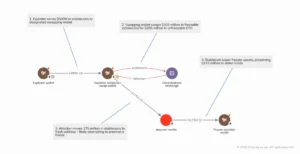
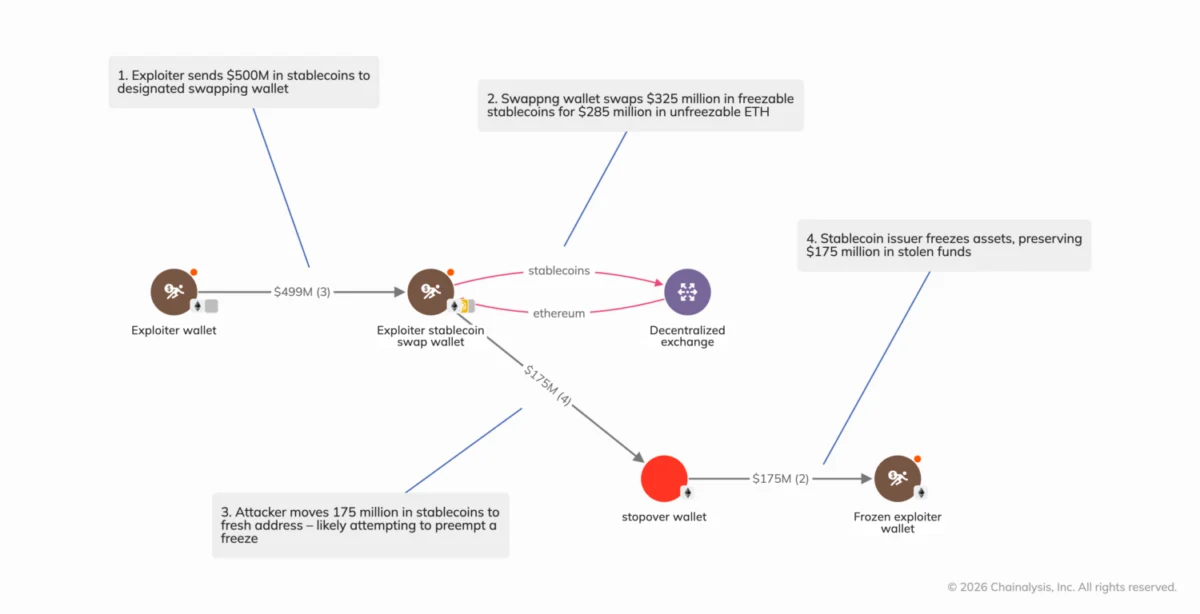
The subsequent hour was defined by a high-stakes "race against the clock." The attackers were acutely aware that while assets like Bitcoin (BTC) and Ether (ETH) are permissionless and cannot be frozen by any central authority, stablecoins such as Tether (USDT) and USD Coin (USDC) are issued by centralized entities that possess the technical capability to blacklist addresses and freeze funds. Between 4:40 p.m. and 5:00 p.m. ET, the exploiter attempted to convert as much of the freezable stablecoin holdings as possible into non-freezable assets.
In a twenty-minute window, the attacker moved $500 million in stablecoins into a specialized swap wallet. This wallet successfully converted $325 million of these assets into $285 million worth of ETH. Ten minutes later, an additional $175 million in stablecoins was funneled into "stopover" wallets designed to act as buffers against immediate blacklisting. However, the industry’s defensive response was swifter than anticipated. By 5:14 p.m. ET, less than an hour after the initial breach, the first successful freezes were implemented by stablecoin issuers in coordination with law enforcement.

Technical Methodology and Investigative Findings
The technical execution of the Binance hack reveals a level of preparation and resources typical of state-sponsored entities. The use of "TraderTraitor" as the primary suspect is based on on-chain signatures and laundering behaviors that mirror previous DPRK-linked operations. The specific use of an Ethereum operational wallet to run custom code indicates that the attackers did not merely steal keys but understood the internal smart contract architecture used by Binance for its hot wallet management.
Chainalysis and other forensic firms have pointed to the "commingling" of funds as the most definitive piece of evidence linking the DPRK to the event. In the hours following the Binance breach, investigators observed stolen funds being mixed with assets derived from an exploit of the Bitget exchange that occurred just one month prior. That previous attack had already been definitively attributed to North Korean actors. The direct on-chain link between the two separate incidents provided the necessary intelligence to confirm TraderTraitor’s involvement.
Furthermore, the laundering patterns observed in the wake of the hack suggest the use of highly advanced automation. In a departure from traditional manual "peeling" methods—where small amounts are gradually moved to different wallets—the Binance attackers utilized scripts to circulate funds among thousands of addresses in a very short timeframe. This programmatic approach is designed to overwhelm manual tracing efforts and create a "noise" floor that makes it difficult for investigators to identify the final destination of the assets.
One specific pattern identified involves the use of the TRON (TRX) network. Investigators noted thousands of addresses following a rigid sequence: each address would receive exactly 1 TRX (presumably for gas fees), followed by a larger influx of stolen funds, which were then immediately forwarded to a new set of addresses. This repetitive, machine-like behavior confirms that the DPRK has integrated sophisticated software engineering into its cyber-heist operations.

Industry and Regulatory Response
The response to the Binance hack has been unprecedented in its level of public-private cooperation. Upon the detection of the breach, a coalition consisting of Binance’s security team, Chainalysis, major stablecoin issuers (Tether, Circle, and Paxos), and international law enforcement agencies initiated a global containment strategy.
As of November 3, 2026, approximately $2.8 billion has been successfully frozen. This recovery represents nearly 44% of the total stolen amount, a significant achievement given the speed of modern crypto transactions. However, the remaining $3.6 billion, largely held in Bitcoin and Ethereum, remains outside the reach of centralized intervention. These assets are expected to be slowly filtered through various mixers, cross-chain bridges, and "over-the-counter" (OTC) brokers who operate in jurisdictions with lax Anti-Money Laundering (AML) enforcement.
Official statements from regulatory bodies have been swift. Spokespersons from the U.S. Treasury’s Office of Foreign Assets Control (OFAC) and the Financial Action Task Force (FATF) have reiterated that the North Korean regime uses these stolen funds to bypass international sanctions and fund its ballistic missile and nuclear programs. This hack is no longer viewed merely as a corporate security failure but as a significant threat to global national security.
Binance has pledged to cooperate fully with investigators and has hinted at the potential use of its Secure Asset Fund for Users (SAFU) to mitigate losses for affected customers. However, the $6.4 billion figure far exceeds the reported balances of most exchange insurance funds, leading to questions about the long-term solvency and insurance requirements for major crypto platforms.

Broader Impact and Implications for the Crypto Ecosystem
The 2026 Binance hack serves as a watershed moment for the cryptocurrency industry. It highlights several critical areas that require immediate attention from developers, exchanges, and regulators:
- The Vulnerability of Centralized Liquidity: Large exchanges act as "honey pots" for state-sponsored hackers. The concentration of billions of dollars in hot wallets creates a single point of failure that can have systemic consequences for the entire market.
- The Evolution of Cyber-Warfare: The DPRK’s shift toward automated laundering and smart contract exploitation demonstrates that cyber-theft is a core pillar of their economic strategy. The "TraderTraitor" group has shown that it can adapt to industry defenses in real-time.
- The Necessity of Real-Time Forensics: The success of the $2.8 billion freeze was only possible because of real-time monitoring and immediate communication between forensic firms and asset issuers. This incident will likely lead to mandates for exchanges to integrate more robust, real-time reporting tools.
- Regulatory Escalation: In the wake of this event, it is highly probable that global regulators will push for stricter controls on "unhosted" wallets and privacy-preserving protocols like Tornado Cash. There may also be renewed pressure on decentralized protocols to implement "circuit breakers" or "emergency pause" functions, despite the philosophical opposition from the DeFi community.
As the investigation continues, the focus shifts to the $3.6 billion still in circulation. Blockchain analysts are monitoring "hop" addresses and bridge protocols for any signs of movement toward centralized exit ramps. The crypto industry remains in a state of high alert, as the Binance hack proves that even the largest and most well-resourced platforms are not immune to the sophisticated reach of state-sponsored cybercrime. The coming months will determine whether the industry can evolve its security paradigms fast enough to prevent a repeat of this historic financial catastrophe.