North America maintained its status as the primary engine of the global cryptocurrency market during the 12-month reporting period ending July 1, 2026, driven by a sophisticated investor base, evolving regulatory frameworks, and the rapid integration of digital assets into traditional financial systems. Despite a challenging macroeconomic environment characterized by a lingering bear market, the region processed a staggering $3.02 trillion in on-chain value. While this represented a modest 1.9% contraction from the previous year, the sheer scale of the North American crypto economy—led by the United States and Canada—underscores its role as the world’s leading exporter of crypto-economic influence and infrastructure.

The slight regional decline was primarily attributed to a 2.2% slowdown in the United States market, which settled at $2.78 trillion. However, analysts view this not as a sign of waning interest, but as a period of market maturation. After nearly doubling in size during the 2025 period, the U.S. market has transitioned into a phase where speculative fervor is being replaced by institutional utility. The proliferation of spot Bitcoin and Ethereum exchange-traded funds (ETFs), the acceleration of asset tokenization, and the widespread adoption of stablecoins have provided a floor for the industry, allowing it to retain the massive gains achieved in previous years.
Chronology of Market Evolution: From Speculation to Infrastructure
The trajectory of the North American crypto market from 2024 to 2026 reveals a clear shift from retail-driven price action to institutional-grade infrastructure building. In early 2024, the approval of spot Bitcoin ETFs in the U.S. served as the primary catalyst for institutional entry. By mid-2025, the legislative landscape shifted with the passage of the GENIUS Act, which formalized the status of digital dollars and provided a clearer roadmap for stablecoin issuers.

Entering the 2026 reporting period, the focus moved toward the "Agentic Economy"—a term describing autonomous AI software capable of conducting on-chain transactions. This period saw the launch and rapid scaling of the x402 protocol, a payment rail specifically designed for AI agents. By June 2026, the market had diversified into three distinct pillars: AI-driven commerce, the tokenization of real-world assets (RWA), and a robust cross-border remittance network centered in Canada.
The Rise of Agentic Commerce and the x402 Protocol
One of the most significant developments in the 2026 period was the emergence of the United States as the global leader in the AI on-chain economy. As AI development continues to center in American tech hubs, the need for machine-to-machine payment systems has become critical. The x402 protocol, incubated by Coinbase, has emerged as the standard for this new economic frontier.

Unlike traditional payment rails, which are optimized for human-scale transactions and carry high fees, x402 enables micropayments that are economically infeasible on credit card networks. Data from the 2026 period shows that over 138 million x402 transactions occurred on Base, the leading blockchain for agentic commerce. A detailed analysis of these transactions reveals that 87% of payments fell between a hundredth of a cent and ten cents.
“AI agents are becoming economic actors where every agent is effectively a new ‘user’ of the blockchain,” noted Hoolie Tejwani, Head of Coinbase Ventures. This shift is particularly visible in the "stickiness" of AI wallets. In the third quarter of 2025, only 70.6% of wallets received a second funding within 30 days. By the second quarter of 2026, that figure rose to 89.3%, indicating that users are increasingly viewing these agents as permanent tools requiring recurring budgets rather than experimental novelties.

Geopolitical Competition in AI and Blockchain Security
The 2026 data highlights a fascinating geopolitical divide in how on-chain AI is utilized. The United States dominates the "inference" and "building" categories, with American wallets accounting for 88.1% of all geolocated AI model inference transactions. This suggests that the U.S. is the primary hub for agents that "think" and process information on-chain.
In contrast, Chinese-attributed wallets have carved out a niche in blockchain security and smart contract auditing. Approximately 90% of transactions flowing into security and code analysis services, such as AgentLISA, originated from Chinese-linked wallets. This disparity may be a result of "AI nationalism," where different regions prefer locally developed models and tools. While the U.S. market relies on metered, high-performance models like ChatGPT and Claude, the Chinese market has leaned into open-weight models like DeepSeek and Qwen, which are often free to use but require specialized security auditing.

The Strategic Balance: Importing Gold and Exporting Dollars
A unique economic phenomenon has emerged in the U.S. crypto landscape: the country is effectively importing "digital gold" (Bitcoin) while exporting "digital dollars" (stablecoins). Since the launch of Bitcoin ETFs, the U.S. share of global Bitcoin activity has risen consistently. In 2026, the U.S. became a net importer of Bitcoin for the first time since 2022. While retail investors (transfers under $10,000) remain net outbound, institutional transfers over $10 million accounted for a net inflow of 53,200 coins.
Simultaneously, the U.S. has solidified its role as the world’s stablecoin mint. Approximately 99.1% of stablecoin order book volume is pegged to the U.S. dollar. These digital dollars allow global users to access the stability of the greenback without requiring an American bank account. Circle, the issuer of USDC, reported a 19% year-over-year increase in circulation, reaching $73.3 billion. This trend bolsters U.S. economic strength, as every stablecoin issued represents a claim on reserves held largely in short-dated U.S. Treasury debt.

The Tokenization of Real-World Assets (RWA)
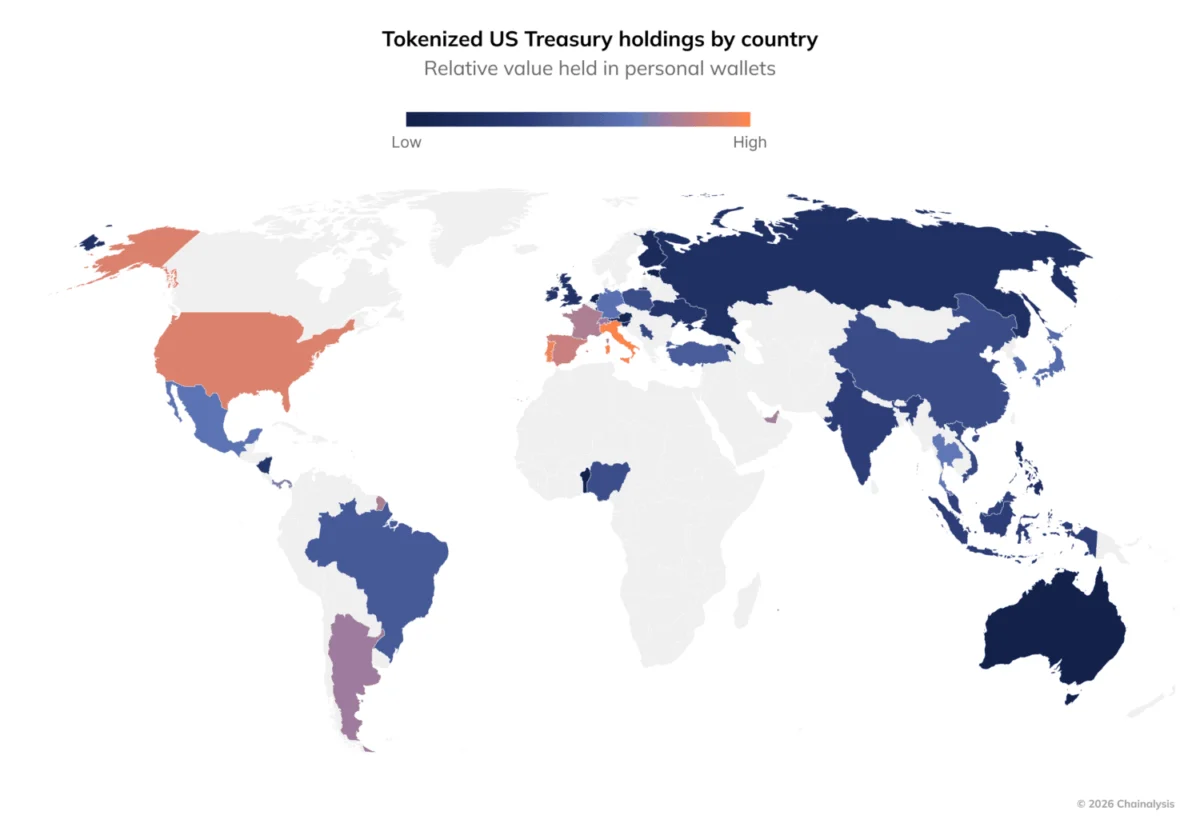
The tokenization sector experienced explosive growth in 2026, with the total market value of tokenized RWAs reaching $36.07 billion—a 135% increase period-over-period. U.S. Treasury bonds remained the dominant asset class, accounting for $15.42 billion, or 42.8% of all tokenized value.
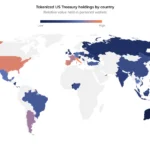
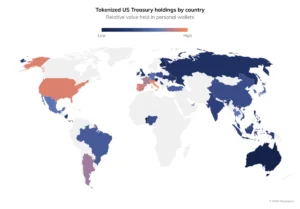
While the infrastructure is largely American, the holder base is global. Interestingly, the U.S. ranks only fourth in geolocated tokenized Treasury holdings. Italy leads with 29.9% of the value, followed by Portugal (18.8%) and Singapore (18.2%). This suggests that tokenization is successfully democratizing access to U.S. government debt, allowing retail investors in Europe and Asia to hold "digital T-bills" that were previously accessible only to large institutional players with U.S. brokerage relationships.

Other sectors of tokenization are also beginning to scale. Corporate credit saw a staggering 3,156% growth, while private equity tokenization rose by 1,340%. According to Tom Murphy, Head of Communications for Securitize, the end state of this trend is not a separate crypto financial system, but a unified one. "It is increasingly one financial system using better technology," Murphy stated, pointing to the speed, programmability, and global interoperability that blockchain provides.
Canada’s Leadership in P2P and Remittance Markets
While the U.S. focused on institutional rails, Canada emerged as a global leader in the peer-to-peer (P2P) crypto economy. Canada’s crypto economy grew by 2.3% to $247.7 billion, driven largely by its diverse immigrant population. Approximately 23% of Canada’s population is foreign-born, the highest share in the G7, making the country a natural hub for cross-border remittances.

Traditional remittance channels from Canada to countries like India, the Philippines, and China often carry fees exceeding 7%. In contrast, stablecoin transfers settle for less than a cent. During the 2026 period, stablecoin and Bitcoin transfers from Canada to these three countries totaled $2.36 billion, a 141% increase year-over-year.
Morva Rohani, Executive Director of the Canadian Web3 Council, noted that while this growth is positive for residents, it creates a policy challenge. "Buying U.S. dollar stablecoins creates demand for U.S. government debt at the expense of potential demand for Canadian government debt," she explained. This has prompted the Canadian government to fast-track the Canadian Stablecoin Act to encourage the development of CAD-backed alternatives.

Broader Implications and the Path Ahead
The data from 2026 suggests that the North American crypto industry has moved beyond the "experimentation phase." The mechanical regularity of AI agent spending, the institutional accumulation of Bitcoin, and the global demand for tokenized U.S. Treasuries point to a deeply entrenched ecosystem.
However, this American-centric infrastructure is facing increasing competition. The European Union’s MiCA framework, Singapore’s stablecoin licensing, and Brazil’s "Drex" digital real pilot are all attempts to build sovereign alternatives to the dollar-denominated crypto economy. For North America to maintain its lead, the next 12 months will require clear regulatory guidance on agentic payments and tokenization to ensure that the builders of the rails remain as influential as the capital that flows over them.

As the industry converges with traditional finance, the distinction between "crypto" and "finance" is blurring. The 2026 reporting period may well be remembered as the year when blockchain stopped being a speculative asset class and started being the essential plumbing of the global economy.