While debates continue regarding Ethereum’s (ETH) recent market performance, Jeo Chalom, CEO of SharpLink, is urging institutional investors to recognize Ethereum’s fundamental strengths and embrace its capabilities for on-chain participation. In a recent interview, Chalom articulated a compelling case for why established financial entities should prioritize Ethereum as a leading investment destination within the burgeoning on-chain economy.
The digital asset landscape has witnessed significant shifts, with many observers scrutinizing Ethereum’s price action against benchmarks like Bitcoin (BTC). Despite periods of relative stagnation, Chalom and SharpLink maintain a decidedly optimistic outlook, grounded in Ethereum’s foundational infrastructure and its growing utility. This perspective is particularly noteworthy given SharpLink’s substantial commitment to the Ethereum ecosystem. As a Nasdaq-listed company, SharpLink is dedicated to managing an Ethereum treasury and providing sophisticated investors with access to on-chain opportunities. Currently, the firm ranks as the second-largest corporate holder of Ether globally, boasting a treasury of 888,938 ETH, valued at approximately $1.88 billion. This position places them behind BitMine, the market leader with an impressive 6,060,506 ETH, valued at $12.82 billion.
The strategic decision by large firms to engage with public blockchains is far from arbitrary. It involves a meticulous evaluation of critical factors such as regulatory compliance, secure custody solutions, robust security protocols, and adequate liquidity. These are not merely operational considerations but essential prerequisites for managing significant capital and conducting thorough due diligence. Chalom’s advocacy for Ethereum stems from its demonstrable leadership in key areas that address these institutional requirements.
The Growing Institutional Embrace of Public Blockchains
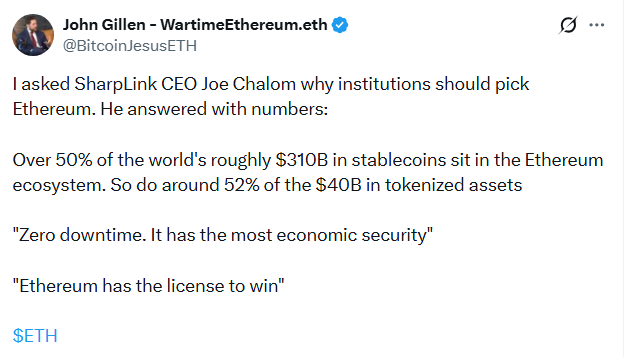
The trend of institutional capital flowing into public blockchains is gaining momentum, a phenomenon Chalom is actively observing and addressing. His recommendation for institutions to consider Ethereum is rooted in its established dominance in critical on-chain activities. "If institutions intend to operate onchain where most of the money and liquidity already sit, Ethereum is the top ecosystem," Chalom stated, emphasizing the network’s unparalleled position.
This assertion is supported by compelling data. Ethereum hosts the largest share of the global stablecoin market, with an estimated 54.1% of the world’s $163 billion in stablecoins built on its network. Stablecoins, pegged to fiat currencies, are a cornerstone of digital asset trading and a vital tool for institutional players seeking to manage volatility and facilitate transactions. Ethereum’s preeminence in this sector underscores its role as a foundational layer for much of the digital economy.
Furthermore, Ethereum is also a dominant force in asset tokenization, accounting for 41% of all tokenized assets. Asset tokenization, the process of converting real-world assets like real estate, art, or commodities into digital tokens on a blockchain, represents a significant frontier for financial innovation. Ethereum’s leading position here signifies its capacity to unlock new avenues for liquidity and investment across diverse asset classes.
Ethereum: The Sovereign On-Chain Economy
The statistics presented by Chalom paint a clear picture: Ethereum is not merely another blockchain but the foundational infrastructure of the sovereign on-chain economy. Its leading role in hosting stablecoins and tokenized assets positions it as the primary venue for institutional engagement in the digital asset space. This growing influence is attracting a diverse range of institutional players, including asset managers, hedge funds, and traditional Wall Street firms, all keen to capitalize on the opportunities presented by the on-chain revolution.
The implications of this trend are profound. As more institutions allocate capital and develop operational frameworks on Ethereum, its network effects are likely to intensify. This could lead to further innovation, increased liquidity, and a more efficient global financial system. The robust ecosystem, coupled with ongoing development and upgrades, suggests that Ethereum is well-positioned to remain at the forefront of this transformative shift.
A Deep Dive into Ethereum’s Fundamental Strengths
While market observers may focus on short-term price fluctuations, Chalom’s analysis directs attention to Ethereum’s intrinsic value and its evolving capabilities. The network’s journey, often characterized by significant technological advancements, has been less about linear progression and more about fundamental evolution. Key milestones have shaped its trajectory:
- The Genesis and Early Development (2013-2015): Conceptualized by Vitalik Buterin and a founding team, Ethereum was envisioned as a decentralized platform for smart contracts, extending the capabilities of Bitcoin’s blockchain. The whitepaper was published in late 2013, and the Ethereum Foundation was established in 2014. The network officially launched on July 30, 2015.
- The Rise of Decentralized Applications (DApps) and ICO Boom (2016-2018): Following its launch, Ethereum quickly became the de facto platform for decentralized applications (DApps). This era saw the explosion of the Initial Coin Offering (ICO) market, with numerous projects raising capital by issuing tokens on the Ethereum blockchain. This period highlighted Ethereum’s utility as a programmable blockchain but also exposed challenges related to scalability and transaction fees.
- The DeFi Revolution and Scalability Efforts (2019-2021): The Decentralized Finance (DeFi) movement gained significant traction on Ethereum, offering alternative financial services like lending, borrowing, and trading without traditional intermediaries. This surge in activity exacerbated existing scalability issues, leading to persistently high gas fees. In response, developers intensified efforts to address these challenges, culminating in the planning and execution of major upgrades.
- The Merge and the Transition to Proof-of-Stake (September 2022): The most significant evolution in Ethereum’s history was "The Merge," a landmark event where the network transitioned from a Proof-of-Work (PoW) consensus mechanism to Proof-of-Stake (PoS). This transition dramatically reduced Ethereum’s energy consumption by an estimated 99.95%, addressing environmental concerns and paving the way for future scalability upgrades. The PoS model also introduced staking, allowing ETH holders to earn rewards by validating transactions.
- The Shanghai and Capella Upgrades (April 2023): Following The Merge, the Shanghai and Capella upgrades (collectively known as "Shapella") enabled staked ETH to be withdrawn from the network. This was a critical step in maturing the PoS system, providing greater flexibility and confidence for stakers and further enhancing Ethereum’s institutional appeal.
- Ongoing Scalability Solutions (EIP-4844 and Layer 2s): The roadmap for Ethereum continues with a focus on enhancing scalability. Ethereum Improvement Proposal (EIP) 4844, also known as "proto-danksharding," is designed to significantly reduce transaction fees on Layer 2 scaling solutions by introducing a new transaction type for "blobs" of data. Layer 2 solutions like Optimism, Arbitrum, and Polygon are already playing a crucial role in processing transactions off the main Ethereum chain, thereby increasing throughput and lowering costs for users.
This evolutionary path demonstrates Ethereum’s commitment to innovation and its ability to adapt to the demands of a rapidly growing ecosystem. Each major upgrade has addressed critical issues and unlocked new functionalities, progressively enhancing its suitability for institutional adoption.
Addressing Market Perceptions and Future Outlook
Chalom’s comments come at a time when public discourse sometimes focuses on Ethereum’s comparative performance against Bitcoin. While it is true that ETH has experienced periods of underperformance against BTC, such comparisons often overlook the distinct roles and developmental stages of each asset. Bitcoin remains primarily a store of value, while Ethereum is evolving into a programmable platform powering a vast decentralized economy.
The underlying infrastructure and utility of Ethereum are what draw institutional interest. The network’s ability to facilitate complex transactions, host a diverse range of DApps, and serve as the backbone for DeFi and tokenization initiatives offers a unique value proposition. As institutions become more sophisticated in their understanding of digital assets, they are increasingly recognizing that Ethereum’s long-term potential lies in its utility and ecosystem growth, rather than solely in its speculative price movements.
The implications of institutions choosing Ethereum for on-chain participation are multifaceted. Firstly, it signifies a maturation of the institutional approach to digital assets, moving beyond simple investment in cryptocurrencies to actively utilizing blockchain infrastructure. Secondly, increased institutional involvement can bring greater liquidity, stability, and regulatory clarity to the Ethereum ecosystem. This, in turn, can foster further innovation and adoption by a broader range of participants.
SharpLink’s proactive approach in building a significant Ethereum treasury, coupled with Chalom’s vocal advocacy, suggests a strategic bet on Ethereum’s enduring relevance and growth potential. As the digital asset landscape continues to evolve, Ethereum’s fundamental strengths—its robust developer community, its ongoing technological advancements, and its established position as the leading smart contract platform—are likely to underpin its appeal to institutional investors seeking to navigate and capitalize on the opportunities of the on-chain economy. The network’s evolution, while not always linear, is demonstrably fundamental, building a resilient and expansive foundation for the future of finance.