The global race for supremacy in artificial intelligence has entered a clandestine phase as a sophisticated shadow economy emerges to bypass United States export controls. While the U.S. government has implemented stringent barriers to prevent Chinese entities from accessing "frontier" AI models—the most powerful systems currently in existence—new research indicates that these restrictions are being systematically undermined. A detailed investigation by the Chainalysis Global Intelligence Team has uncovered a thriving network of proxy services that allow banned users and companies in China to access restricted tools like Anthropic’s Claude and OpenAI’s ChatGPT, often utilizing cryptocurrency as a primary financial rail to remain off the grid.
These proxy services operate as intermediary waystations, routing queries into American AI models while effectively masking the geographic origin of the requests. This allows Chinese developers not only to use these tools for general productivity but, more critically, to engage in "model distillation." Through this process, Chinese laboratories can extract the logic and capabilities of advanced American models to train their own competing systems at a fraction of the original research and development cost. This practice has prompted warnings from the National Security Agency (NSA) and major AI labs, signaling a shift in the nature of technological warfare where digital borders are increasingly porous.
The Architecture of the Proxy Economy
The market for unauthorized AI access has evolved from an informal collection of workarounds into a highly structured, commercialized ecosystem. This shadow economy features a segmented supply chain, dedicated financial infrastructure, and sophisticated marketing strategies. At the heart of this system are the proxy providers, which purchase access to U.S. frontier models through various illicit means—including "account farming" and the use of stolen or fraudulent credentials—and then resell that access to users in restricted jurisdictions.
According to a survey of 100 such proxy services, the infrastructure for payment is diverse but increasingly reliant on decentralized finance. While many services still accept traditional fiat currency through China-based processors like WeChat Pay and Alipay, approximately 40% of the surveyed providers now accept cryptocurrency. Stablecoins, such as USDT (Tether) and USDC, are the preferred medium of exchange due to their price stability and the ease with which they can bypass state-mandated capital controls.
The use of cryptocurrency is not merely a convenience but a strategic choice. For proxy operators, crypto payments obfuscate the financial trail, making it significantly harder for U.S. regulators and AI companies to identify and shut down the funding mechanisms of these services. For the end-users—often sensitive entities within the Chinese tech sector—crypto provides a layer of anonymity that traditional banking cannot offer, shielding them from both domestic oversight and international sanctions enforcement.
Chronology of the AI Export Conflict
To understand the current state of the shadow market, one must look at the timeline of escalating tensions and regulatory shifts between 2022 and 2026.

- Late 2022 – Early 2023: The U.S. Department of Commerce begins implementing broad export controls on high-end semiconductors (GPUs) essential for training AI. Simultaneously, major AI labs like OpenAI and Anthropic implement geoblocking to restrict access from mainland China.
- Mid-2023: Informal "VPN-sharing" communities begin to surface on Chinese social media platforms, providing basic access to ChatGPT.
- Early 2024: The U.S. government expands restrictions to include cloud computing services, aiming to prevent Chinese firms from training models on American servers. In response, the first professionalized "API proxy" services emerge, offering stable, high-speed access to GPT-4 and Claude 3.
- 2025: Anthropic and other labs detect a surge in "distillation attacks," where thousands of automated accounts are used to scrape model logic. Major U.S. intelligence agencies issue warnings regarding the national security implications of these "leaked" capabilities.
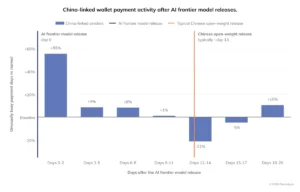
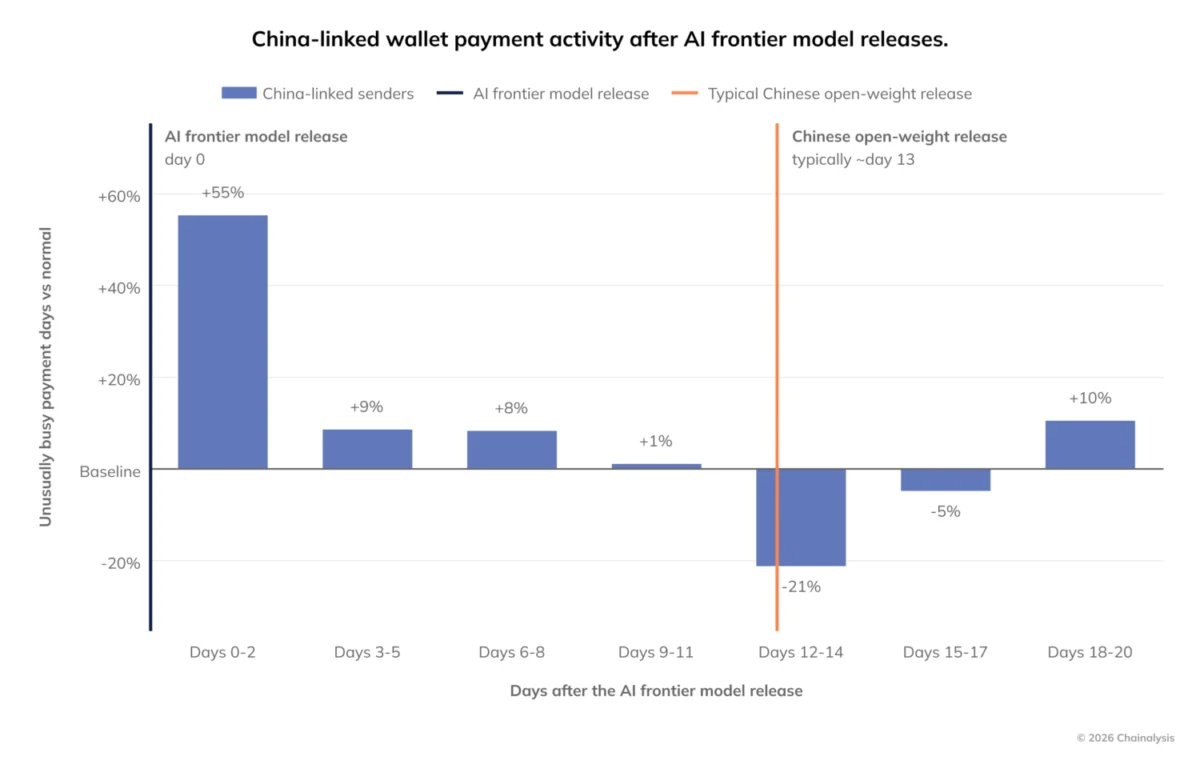
- 2026: Chainalysis identifies a mature proxy economy. Data shows that payment activity in these networks spikes within 72 hours of any major U.S. AI model release, indicating a coordinated effort by Chinese labs to ingest new technology as soon as it becomes available.
Model Distillation: The Strategic Threat
The primary concern for U.S. authorities is not the individual student in Beijing using ChatGPT to write an essay, but rather the systematic extraction of intelligence known as model distillation. In a distillation attack, a smaller, less capable model (the "student") is trained using the outputs of a larger, more advanced model (the "teacher").
By querying an American frontier model millions of times through proxy services, Chinese AI labs can capture the nuanced reasoning patterns and knowledge bases of systems like Claude. This allows them to "shortcut" the expensive and time-consuming process of trial-and-error inherent in AI training. Anthropic recently identified three prominent Chinese AI laboratories—DeepSeek, Moonshot, and MiniMax—as having allegedly used 24,000 fraudulent accounts via proxy services to extract capabilities from their models.
The danger of this practice is twofold. First, it erodes the competitive advantage held by the U.S. AI industry, which spends billions of dollars on research that is effectively being harvested for free. Second, and more concerning to the NSA, is the lack of safety guardrails. Frontier models undergo rigorous "red-teaming" to ensure they do not assist in creating biological weapons, launching cyberattacks, or generating extremist propaganda. Distilled models, however, often retain the "intelligence" of the original system without the embedded safety filters, potentially placing dangerous capabilities in the hands of actors who do not share U.S. safety standards.
Data Analysis: Correlating Wallet Activity with Model Launches
Chainalysis’s investigation utilized blockchain forensics to track the flow of funds from suspected Chinese wallets to the payment processors used by proxy services. The findings reveal a clear pattern of behavior that aligns with the release cycles of U.S. tech companies.
When a new frontier model is released, there is a measurable increase in cryptocurrency transfers to proxy-linked addresses. This spike is significantly higher among wallets identified as having links to the Chinese mainland compared to the global average of users. This data suggests that Chinese developers are not just casual users but are strategically prepared to "top up" their accounts the moment new capabilities hit the market.
Furthermore, the research found that the geographic distribution of these wallets is concentrated in "regional proxy corridors." While the end-users are in China, the wallets often route through Japan, Hong Kong, Singapore, and South Korea. This layering is designed to exploit the relatively more permissive regulatory environments in these neighboring hubs, creating a buffer between the Chinese user and the U.S.-based AI provider.
Financial Intermediaries and Custodial Services
The complexity of the proxy economy is further deepened by the use of third-party custodial payment processors. Most proxy services do not maintain their own crypto wallets for direct peer-to-peer transactions. Instead, they utilize custodial services that act as a "clearinghouse" for digital assets.

These intermediaries provide several advantages for the shadow market:
- Regulatory Arbitrage: By using a processor based in a jurisdiction with lax crypto regulations, proxy services can avoid the stringent Know Your Customer (KYC) requirements that might otherwise expose their operators.
- Risk Mitigation: Relying on a third party reduces the service provider’s exposure to the volatile legal landscape of cryptocurrency in China, where the government has historically wavered between strict bans and tacit acceptance of certain blockchain activities.
- Layering: This structure creates a "blind spot" for regulated crypto exchanges. When funds eventually move from a proxy processor to a major exchange to be cashed out into fiat, the exchange sees only a transaction from a payment processor, not the original link to an unauthorized AI service.
Official Responses and Enforcement Challenges
The U.S. government and the AI industry have begun to respond to these threats, though the "cat-and-mouse" nature of the digital economy makes enforcement difficult. The NSA has issued multiple warnings, emphasizing that the distillation of frontier models by China-based companies poses risks to critical infrastructure and military technology domains.
In its own defense, Anthropic has pioneered new methods for detecting distillation attacks, such as identifying patterns of queries that suggest an automated system is trying to "map" the model’s internal logic. However, as the proxy services become more sophisticated, they are adopting techniques to make their traffic look more human, such as varying query intervals and using diverse IP addresses.
Industry experts suggest that the current strategy of "blocking and tackling" individual accounts is insufficient. Instead, a more holistic approach involving "financial intelligence" is required. By mapping the blockchain connections between proxy services and their financial facilitators, authorities can target the economic bottlenecks of the shadow market rather than just the technical ones.
Broader Implications for Global AI Governance
The existence of a robust shadow market for AI access highlights the limitations of national export controls in a globalized, digital world. As AI becomes the "general-purpose technology" of the 21st century—akin to electricity or the internet—the pressure to bypass restrictions will only grow.
For the United States, the challenge is to maintain a balance between national security and the open exchange of ideas that fuels innovation. If restrictions are too porous, the security risks are manifest; if they are too rigid, they may inadvertently drive the development of entirely independent, unregulated AI ecosystems in the East that are completely beyond the reach of international safety norms.
The role of blockchain intelligence in this landscape cannot be overstated. As the "financial glue" of the proxy economy, cryptocurrency provides the very trail that investigators need to follow. By leveraging the transparency of the blockchain, regulators have a unique opportunity to gain visibility into an otherwise opaque market, potentially turning the shadow economy’s favorite tool against it. The outcome of this struggle will likely determine the balance of power in the AI era for decades to come.