


The global financial landscape is undergoing a structural transformation as tokenized real-world assets (RWAs) migrate from experimental pilot programs to the foundational infrastructure of modern finance. According to data from a forthcoming industry report titled The New Rails: How Digital Assets Are Reshaping the Foundations of Finance, the total value of RWAs managed on-chain is rapidly approaching $30 billion in assets under management (AUM). This surge represents more than just a capital influx; it signals a fundamental shift in how traditional financial instruments, including bonds, equities, and commodities, are issued, managed, and settled. By utilizing blockchain technology as a "superior rail," financial institutions are achieving 24/7 market access, near-instant settlement, and a significant reduction in intermediary costs that have historically plagued legacy systems.
The Regulatory Catalyst: From Uncertainty to Frameworks
The acceleration of the RWA sector is inextricably linked to a series of pivotal regulatory milestones that reached a crescendo in mid-2025. Chief among these was the passage of the GENIUS Act in July 2025. This legislation provided the necessary federal framework to standardize settlement infrastructure for payment stablecoins, which serve as the primary liquidity vehicle for on-chain asset trading.
The GENIUS Act did not exist in a vacuum. It was the result of a broader "regulatory awakening" that included updated mandates from the Office of the Comptroller of the Currency (OCC) regarding the custody and reporting of digital assets. These updates clarified the legal obligations for institutions, allowing them to integrate blockchain-based assets into their balance sheets without the fear of sudden enforcement actions or compliance ambiguity. Furthermore, the introduction of standards like ERC-3643 has provided a technical blueprint for programmable compliance, ensuring that tokenized securities automatically adhere to jurisdictional regulations regarding investor whitelisting and transfer restrictions.

A Chronology of the Tokenization Evolution
The path to the current $30 billion market was paved by a series of strategic entries by some of the world’s largest asset managers. In the early stages, between 2022 and late 2024, the market remained relatively flat as institutions grappled with technical hurdles and a lack of legal clarity.
- Early 2024: Institutional interest began to solidify around U.S. Treasury debt. Assets such as BlackRock’s BUIDL fund and Circle’s USYC emerged as liquid, yield-bearing instruments that bridged the gap between traditional cash management and on-chain liquidity.
- July 2025: The passage of the GENIUS Act established the federal framework for stablecoins, providing the "on-ramp" for massive institutional capital.
- Late 2025: A "regulatory awakening" across global markets led to emerging mandates for on-chain capital markets, particularly in Europe and parts of Asia, prompting a surge in specialty finance and asset-backed credit tokenization.
- Q1 2026: Market data confirmed that institutional capital was outpacing retail participation for the first time, with tokenized gold and other commodities beginning to mirror the trading patterns of their traditional counterparts.
The Race to $1 Billion: Comparative Growth Metrics
One of the most revealing indicators of the shift toward institutional dominance is the "velocity of valuation"—the time it takes for a specific RWA category to reach $1 billion in on-chain issuance. The data indicates that categories catering to institutional needs are scaling at an unprecedented rate compared to retail-focused sectors.
Institutional-grade asset-backed credit reached the $1 billion milestone in just 6.1 months from its first on-chain issuance. Specialty finance followed at 21.5 months. In contrast, retail-leaning sectors such as commodities took 36.2 months to reach the same valuation, while tokenized stocks have yet to cross the $1 billion threshold. This disparity suggests that when regulatory and technical infrastructure reaches "institutional grade," large-scale financial entities move with significantly more capital and speed than the retail market.
While the total AUM is climbing, it is important to distinguish between liquid and illiquid assets. The primary data source, rwa.xyz, notes that while U.S. Treasuries represent the largest single asset class by volume, the market also includes highly illiquid assets like real estate. Because these physical assets lack continuous secondary market trading, their valuations are often based on periodic appraisals rather than real-time market discovery. However, the liquid segments—Treasuries and commodities—are providing the high-frequency data necessary to prove the efficiency of blockchain rails.

Wallet Behavior: RWAs as the Institutional Onboarding Mechanism
An analysis of nearly 400,000 distinct RWA holding addresses reveals a structural shift in how users enter the digital asset ecosystem. Historically, the assumption was that users would enter through "crypto-native" assets like Bitcoin or Ethereum before eventually exploring more complex instruments like RWAs. The 2025-2026 data suggests the opposite is true for institutions.
The spike in Ethereum wallets receiving an RWA token within the first six months of their creation indicates that RWAs are now the primary "top-of-funnel" for new institutional participants. Many of these wallets are "purpose-built" or "explicitly whitelisted." For instance, nearly all addresses holding specialty finance or asset-backed credit tokens received their first RWA transfer within one week of the wallet’s creation. This suggests these are not retail investors experimenting with new technology, but rather institutional desks setting up dedicated infrastructure for specific asset classes.
Conversely, retail-leaning categories like tokenized stocks and commodities show a higher percentage of "legacy wallets"—addresses that have been active on-chain for months or years prior to their first RWA transaction. This bifurcation highlights two distinct market movements: the "crypto-native" retail user diversifying into traditional assets, and the "TradFi" institution entering the blockchain space specifically to access tokenized instruments.
Market Convergence: The Case of Tokenized Gold
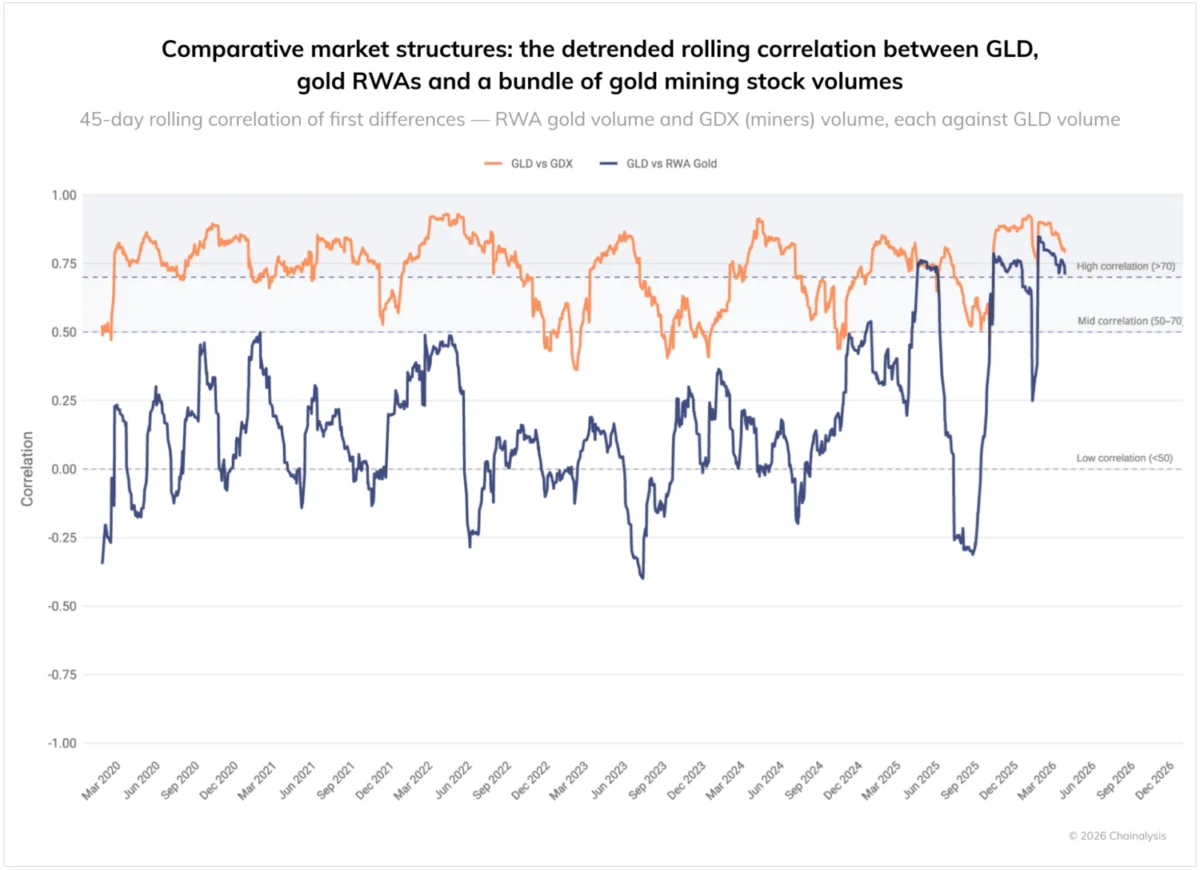
A critical test for the maturity of the RWA space is whether on-chain assets behave like their traditional equivalents. If a tokenized asset is to be used in sophisticated hedging or risk management strategies, its trade volume and price movements must correlate with the underlying market.

Historically, tokenized gold volumes showed almost no correlation with legacy gold markets (such as the GLD ETF). For years, tokenized gold was driven by "idiosyncratic volatility" and the internal liquidity cycles of the crypto market. However, a significant breakout occurred in the second quarter of 2025. Since that period, the trade volume correlation between tokenized gold and traditional gold has spiked above the 0.70 threshold, moving in tandem with traditional mining stocks (GDX).
This convergence is a landmark development for institutional trading desks. It indicates that the on-chain gold market has reached sufficient depth and liquidity to respond to macro signals—such as inflation data, geopolitical risk, and interest rate changes—rather than just crypto-specific sentiment. As these assets continue to mature, risk models developed for traditional finance will become increasingly applicable to their on-chain counterparts.
Official Responses and Strategic Implications
The rapid growth of RWAs has prompted reactions from both regulatory bodies and major financial institutions. The OCC’s clarified stance on digital asset custody has been described by industry leaders as a "green light" for Tier-1 banks to begin moving substantial portions of their settlement operations on-chain.
"The integration of traditional financial instruments directly into blockchain infrastructure is no longer a matter of ‘if,’ but ‘how,’" noted one senior analyst involved in the report. "The data shows that the efficiencies of 24/7 markets and T+0 settlement are too significant for the industry to ignore, especially as the regulatory guardrails are now firmly in place."

The Depository Trust & Clearing Corporation (DTCC) has also begun exploring ways to bridge tokenized assets with existing custody systems, further legitimizing the space. For market participants, the strategic imperative has shifted. The focus is now on executing integration strategies that capture the first-mover advantage in a market that is fundamentally rebuilding the "plumbing" of global finance.
Broader Impact: The Future of Global Finance
The implications of the RWA surge extend far beyond the $30 billion AUM figure. By moving assets onto public or permissioned ledgers, the financial system gains a level of transparency previously thought impossible. Real-time monitoring of asset flows and counterparty exposure perfectly aligns with the risk management requirements of a post-2008 financial world.
Furthermore, the "programmability" of these assets allows for automated corporate actions—such as dividend distributions, interest payments, and voting—to be handled via smart contracts, removing the need for manual reconciliation and reducing the likelihood of human error. As institutional capital continues to outpace retail participation, the RWA ecosystem is set to become the primary distribution channel for financial products.
In conclusion, the rise of tokenized real-world assets represents a departure from previous crypto adoption cycles. Driven by the GENIUS Act and a new era of regulatory clarity, the market is maturing into an institutional-grade environment. With correlation to traditional markets increasing and purpose-built infrastructure becoming the norm, the "New Rails" are effectively being laid, promising a more efficient, transparent, and accessible global financial system. Those who adapt to this on-chain reality will likely define the next century of finance, while those who remain tethered to legacy systems face the risk of increasing obsolescence in an era of near-instant, 24/7 global liquidity.














