


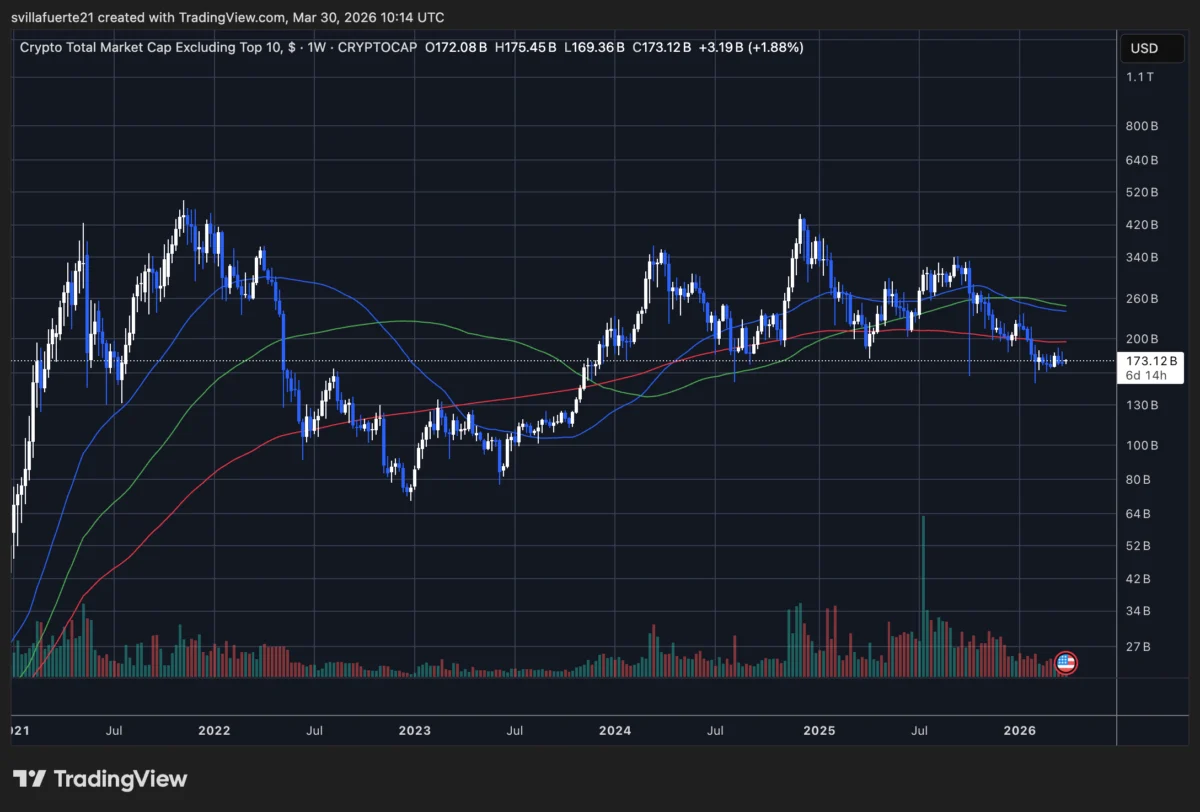
The long-anticipated "altseason," a period where alternative cryptocurrencies traditionally outperform Bitcoin and deliver exponential returns to investors, has failed to materialize in the current market cycle. Instead of the exuberant rallies witnessed in 2017 and 2021, the digital asset landscape is currently grappling with a structural decay that has pushed a staggering 40% of all altcoins to—or near—their all-time lows (ATL). This figure represents a critical threshold, surpassing the peak despair of the 2022 bear market and signaling a fundamental shift in how capital is distributed across the burgeoning crypto ecosystem.
Analysis from prominent market researcher Darkfost, utilizing data from CryptoQuant, reveals that the current environment for altcoins is not merely a temporary correction but a systemic "reckoning." The data indicates that the percentage of altcoins hovering near their all-time lows has surpassed the 38% mark recorded during the height of the previous bear cycle. This suggests that despite Bitcoin’s relative strength and the introduction of institutional instruments like Spot Bitcoin ETFs, the broader altcoin market is effectively resetting to zero, erasing years of speculative gains.
The Statistical Reality of a Fragmented Market
The current market cycle was widely expected to follow historical patterns where Bitcoin leads a rally, followed by Ethereum, and finally a "trickle-down" effect into mid-cap and small-cap altcoins. However, the data provided by Darkfost paints a different picture. The "Percentage Altcoin near ATL" metric is a vital barometer of market health, and its current reading above 40% suggests that nearly half of the tradable tokens in the space are in a state of terminal decline or extreme distress.
This phenomenon is happening even as Bitcoin maintains a significant portion of its value compared to previous cycles. The divergence highlights a growing "cannibalization" within the industry. In previous years, a rising tide lifted all boats; today, the tide is rising only for a select few assets, while the rest are being pulled under by the weight of their own oversupply.

The comparison to the previous bear market is particularly sobering. During the 2022 crash, which saw the collapse of the Terra-Luna ecosystem and the FTX exchange, the percentage of tokens hitting all-time lows peaked at approximately 38%. The fact that the market has exceeded this level in 2024/2025—a period that was supposed to be the "bull" phase of the four-year cycle—indicates that the structural integrity of the altcoin market has been compromised.
The Liquidity Crisis: 47 Million Parts of a Structural Problem
While macroeconomic factors are often blamed for market downturns, Darkfost’s analysis suggests that the primary culprit is an internal crisis of oversupply. The total number of cryptocurrencies in existence has ballooned to more than 47 million. This explosion in token creation has outpaced the growth of new capital entering the space, leading to what analysts call "liquidity dilution."
The breakdown of token issuance across major blockchains illustrates the scale of the issue:
- Solana: Over 22 million tokens created, largely driven by the ease of deployment through platforms like Pump.fun and the memecoin craze.
- Base: Over 18 million tokens, reflecting the rapid expansion of Layer-2 ecosystems.
- BNB Smart Chain: Approximately 4 million tokens.
The capital pool available to the crypto market is finite. When this capital is spread across 47 million different assets, the liquidity available for any single token becomes incredibly thin. This fragility means that even small sell orders can cause massive percentage drops in price. Furthermore, the constant stream of new token launches acts as a "vampire" on existing liquidity; investors frequently rotate funds out of older, established altcoins to chase the "next big thing" in the memecoin or AI sector, leaving the former to bleed out slowly.
Macroeconomic Headwinds and Geopolitical Pressures
The internal liquidity crisis is being exacerbated by a hostile external environment. Global geopolitical tensions, ranging from conflicts in the Middle East to trade frictions between major powers, have fostered a "risk-off" sentiment among global investors. In such a climate, the traditional 60/40 portfolio (60% stocks, 40% bonds) has seen some of its worst performance in decades, leading investors to flee speculative assets.

Altcoins occupy the most volatile tier of the risk-asset hierarchy. They are typically the first to be sold off during periods of uncertainty and the last to receive fresh capital when confidence returns. Unlike Bitcoin, which is increasingly viewed as "digital gold" or a legitimate institutional asset, most altcoins lack a clear value proposition or institutional backing. As a result, they absorb the impact of market fear disproportionately.
Darkfost notes that the current volatility is falling most heavily on these vulnerable assets. Many tokens that were launched during the 2021 bull run have never recovered their previous valuations, and a significant portion of the tokens launched in 2023 and 2024 are already trading below their private-sale or initial-offering prices.
Technical Breakdown: The Unwinding of the Bull Run
The technical health of the altcoin market is best measured by the "OTHERS" chart, which tracks the total market capitalization of all cryptocurrencies excluding the top 10 assets. This index provides a "pure" look at the performance of the broader altcoin sector without the skewing effect of Bitcoin, Ethereum, or major stablecoins.
The data reveals a devastating trend:
- Peak to Trough: The index peaked near $480 billion in late 2024. Since then, it has collapsed by 64%, currently sitting around $173 billion.
- Moving Average Collapse: The price has broken below the 50-week, 100-week, and 200-week moving averages. This is a rare and highly bearish signal.
- The Death Cross: A "death cross" has occurred on the weekly timeframe, where the 50-week moving average has crossed below the 100-week moving average. This typically signals long-term downward momentum.
- Support Flipping to Resistance: The 200-week moving average, historically a "line in the sand" for market support near $190 billion, has been lost. The market is now testing this level from below, treating it as a ceiling rather than a floor.
The current level of $173 billion is not a guaranteed bottom. Analysts point to the 2022 bear market low of $80 billion as the next major logical support level if the current defense fails. The fact that the entire 2023-2024 bull run has been unwound in the altcoin sector suggests that the "altseason" narrative may have been a historical anomaly rather than a repeatable cycle.

A Shift in Investor Psychology and Market Dynamics
The failure of altcoins to rally has led to a profound shift in investor psychology. In previous cycles, retail investors were driven by "unit bias"—the idea that buying a cheap token for a fraction of a cent offered more upside than buying a fraction of a Bitcoin. However, the sheer volume of "rug pulls," failed projects, and predatory tokenomics (where venture capital firms dump tokens on retail investors) has soured the market’s appetite for small-cap assets.
Furthermore, the rise of Bitcoin ETFs has institutionalized the top end of the market while leaving the bottom end to fend for itself. Institutional capital is not flowing into obscure altcoins; it is staying within the regulated confines of Bitcoin and, to a lesser extent, Ethereum. This has created a "barbell" market where the largest assets grow while the middle and bottom segments of the market atrophy.
Implications and the Path Forward
The "reckoning" described by Darkfost suggests that the crypto market is entering a phase of maturation through attrition. In a market of 47 million tokens, the vast majority are destined for irrelevance. The current purge, while painful for investors, may be a necessary step in clearing out the "noise" and allowing capital to congregate around projects with actual utility, sustainable revenue models, and genuine adoption.
For investors, the implications are clear: the era of "blindly buying the dip" across the altcoin market is over. Success in the current environment requires a rigorous separation of the resilient from the irrelevant. The distinction between a "correction" and a "structural failure" is often only visible in hindsight, but with 40% of the market already at all-time lows, the data suggests that for many assets, there is no coming back.
The altcoin market is no longer a monolith. Moving forward, the industry is likely to see a permanent divergence where a handful of "blue-chip" altcoins survive and integrate into the broader financial system, while millions of others continue their slow descent toward zero liquidity and zero value. This is not just a market cycle; it is the evolution of an asset class finally coming to terms with the reality of supply and demand.














