


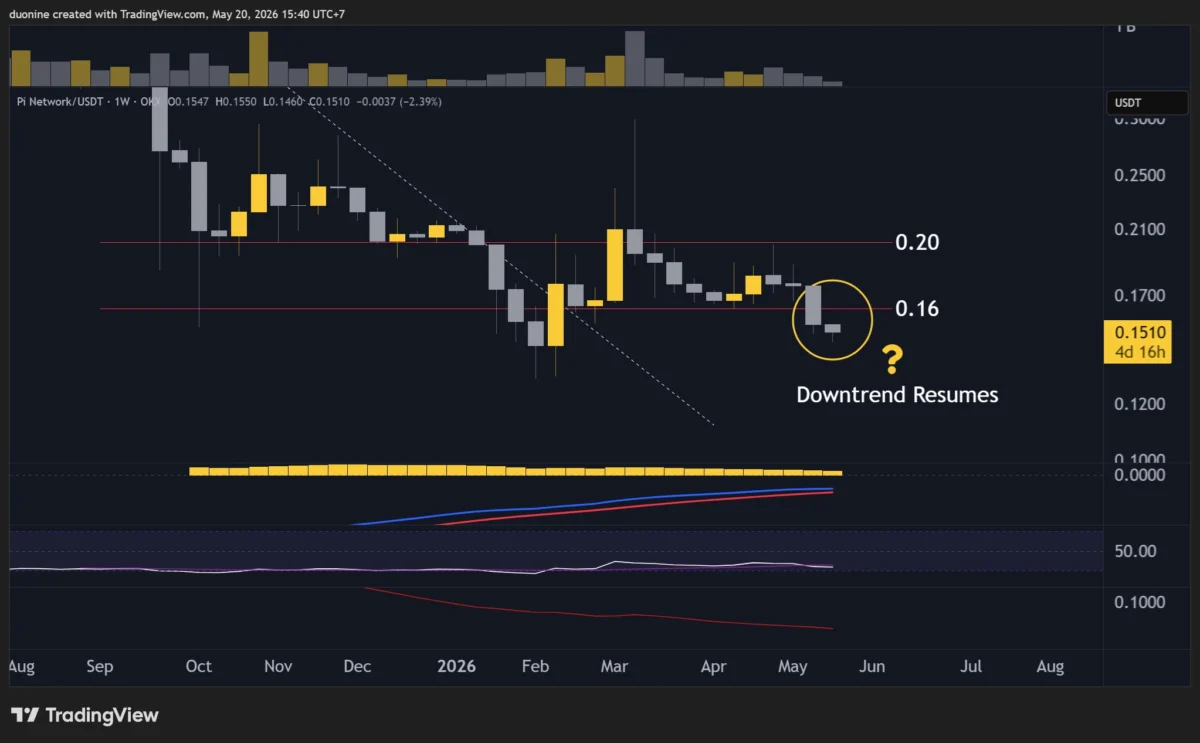
PI Network (PI) has witnessed a significant downturn, losing a crucial support level at $0.16 as selling pressure intensifies. This breach has shifted the immediate technical landscape, with the former support now acting as a resistance. The current price action suggests a potential resumption of the broader downtrend that began earlier in the year, with key levels to watch including $0.15 and $0.13 as critical support zones, and $0.16 and $0.20 as emerging resistance points.
Sellers Reassert Dominance, Breaking Key Support
In the latter part of the past week, a notable surge in selling activity has placed considerable strain on the PI Network’s price. The $0.16 support level, which had previously offered a floor, ultimately succumbed to this pressure. This breakdown is a significant technical development, transforming the $0.16 mark from a level of buyer interest into a barrier for any upward price movement.
This breach of a key support level is being interpreted by many market analysts as a signal that the macro downtrend, which had experienced a period of consolidation or sideways movement since February, may be resuming. For this bearish outlook to be confirmed, the price of PI Network would need to establish a new lower low below the $0.13 mark. This would indicate a continuation of the downward trend, with sellers demonstrating sustained control over the market.
The visual representation of this price action, as depicted in accompanying charts, highlights the aggressive nature of the recent sell-off. The rapid descent from higher levels, coupled with the failure to hold the $0.16 support, suggests a lack of robust buying interest at these price points. The shift in market sentiment from neutral or mildly bullish to decidedly bearish is evident in the volume profiles and the candle formations observed on the daily charts.
Bears Take Charge: A Test of Lower Support Levels
Following the breakdown of the $0.16 support, the bears have successfully driven the price down to the $0.15 level. At this juncture, there appears to be a nascent attempt by buyers to establish a foothold and initiate a recovery. However, preliminary observations indicate that the conviction behind these buying efforts is relatively weak, as evidenced by the low trading volume accompanying these attempts.
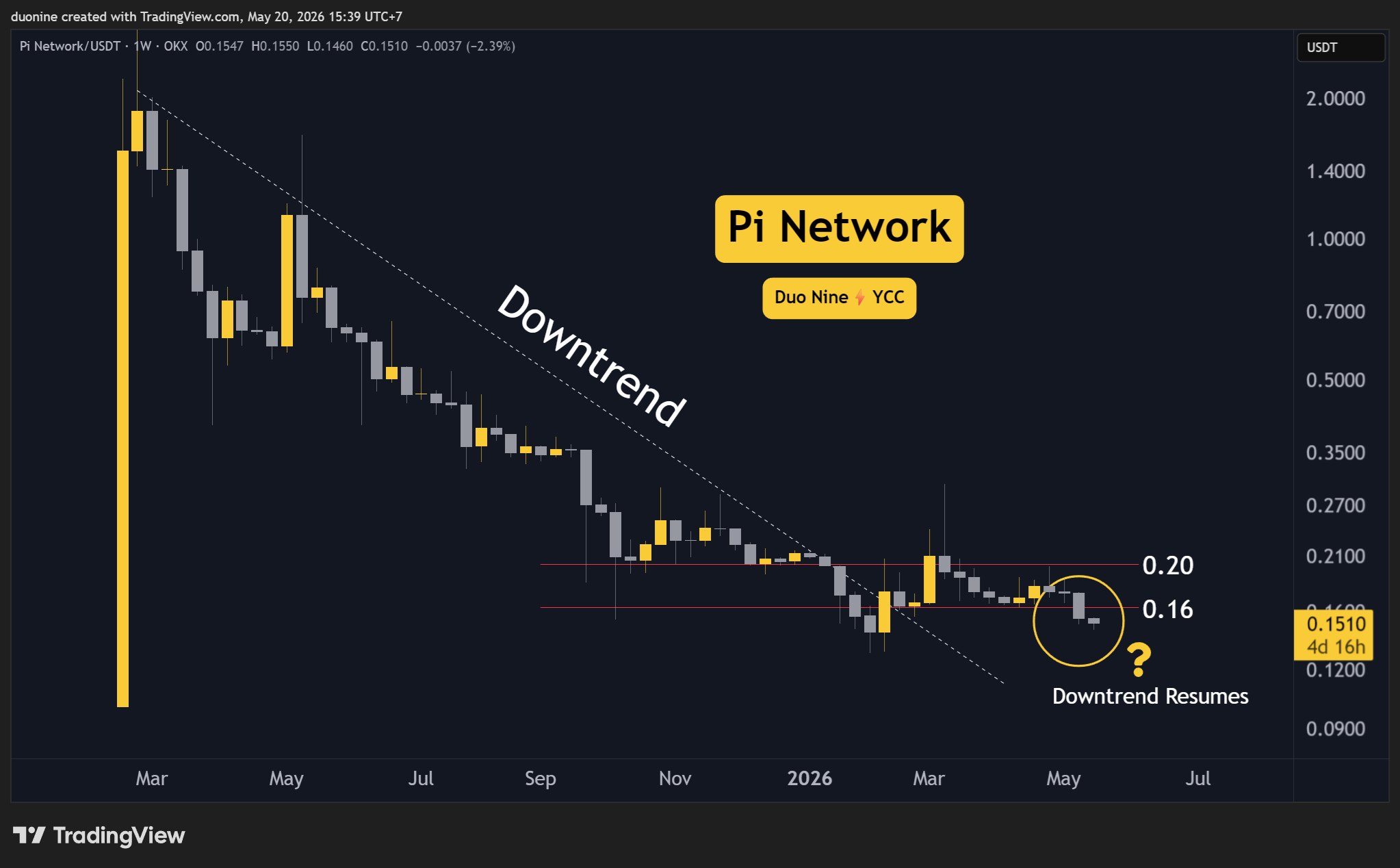
The current scenario presents a critical juncture for PI Network. If buyers are unable to muster sufficient strength and volume to engineer a sustained reversal from the $0.15 level, the cryptocurrency is highly likely to test its all-time low, which currently stands at $0.13. A re-test of this significant psychological and technical level would serve as a strong bearish signal, potentially emboldening sellers and encouraging them to exert further downward pressure, pushing the price even lower.
The implications of failing to hold the $0.13 support are considerable. Historically, breaking through such deeply established support levels can trigger cascading sell orders as stop-loss mechanisms are activated and market participants capitulate. This could lead to a rapid and substantial price decline, extending the current bearish trend and potentially setting new all-time lows for PI Network.
The Role of the Relative Strength Index (RSI) and Potential for a Bounce
On the daily chart, the Relative Strength Index (RSI), a popular momentum oscillator used by traders to gauge the speed and change of price movements, has fallen below the 30 threshold. This places the RSI firmly within the "oversold" territory. The oversold condition suggests that PI Network has experienced a significant amount of selling pressure and may be due for a temporary price correction or bounce.
This technical indicator often signals that an asset is being traded too heavily to the downside and could be poised for a short-term recovery. Traders often look to the oversold RSI as an opportunity to enter long positions, anticipating a rebound. It is possible that some buyers are entering the market at current levels precisely because of this oversold condition, hoping to capitalize on a potential upward movement.
However, it is crucial to temper expectations regarding the potential bounce. While an oversold RSI can indicate a potential for a rebound, it does not guarantee a sustained recovery or a reversal of the broader trend. Sellers may indeed require a brief respite from their aggressive selling, which could provide an opening for buyers to push prices back up. Nevertheless, any such bounce may prove to be short-lived. The underlying bearish sentiment and the significant overhead resistance, particularly at the previously broken $0.16 level, could cap any upward momentum. Therefore, the probability of PI Network testing the critical $0.13 support level remains a significant consideration, even in the event of a short-term bounce.
Contextualizing the Price Action: A Broader Market Perspective
The recent price action of PI Network cannot be viewed in isolation. The broader cryptocurrency market has experienced significant volatility in recent months, with various factors influencing asset prices. Global economic conditions, such as inflation rates, interest rate hikes by central banks, and geopolitical uncertainties, continue to play a substantial role in investor sentiment towards risk assets like cryptocurrencies.
Furthermore, regulatory developments and news surrounding major cryptocurrency exchanges and projects can also trigger significant market movements. While the specific catalysts for PI Network’s recent decline are primarily technical, they occur within a market environment that is generally sensitive to negative news and shifting investor confidence.
PI Network, as a project focused on mobile-based cryptocurrency mining, operates within a unique segment of the blockchain ecosystem. Its development and adoption trajectory are distinct from many other cryptocurrencies that are tied to more established blockchain infrastructures or decentralized finance (DeFi) applications. The community’s ongoing efforts to develop the network and its ecosystem, including the recent introduction of new features and partnerships, are crucial factors that could influence future price performance. However, these fundamental developments often take time to translate into significant market impact, especially during periods of broader market deleveraging.
The price history of PI Network, like many emerging cryptocurrencies, has likely been characterized by periods of rapid growth followed by significant corrections. Understanding these historical patterns can provide valuable context for interpreting current price movements. The current breach of support at $0.16, following a period of sideways trading, could be interpreted as a cyclical correction within a longer-term growth narrative, or it could signal a more profound shift in market dynamics.
Key Support and Resistance Levels: Defining the Trading Range
To effectively navigate the current market conditions, it is essential to identify and monitor key technical levels.
Key Support Levels:
- $0.15: This is the immediate support level where buyers are currently attempting to make a stand. A failure to hold this level could lead to further declines.
- $0.13: This represents a critical long-term support level, including the all-time low. A sustained break below this price point would be a significant bearish development.
Key Resistance Levels:
- $0.16: This former support level has now flipped to become immediate resistance. A successful re-test and break above this level would be necessary for a bullish reversal.
- $0.20: This represents a more significant resistance level, acting as a target for any sustained upward movement. Breaking through $0.20 would indicate a stronger recovery.
These levels are dynamic and can be influenced by market sentiment, news events, and overall trading volume. Traders and investors will be closely watching these price points for signs of significant buying or selling pressure.
Future Outlook and Potential Scenarios
The immediate future for PI Network’s price action will likely be determined by the interplay between buyers and sellers at the current support levels.
Bearish Scenario: If selling pressure continues and PI Network fails to find sustained buying interest at $0.15, a decisive break below $0.13 is probable. This would confirm the resumption of the downtrend, potentially leading to further price discovery downwards. Factors that could contribute to this scenario include continued negative sentiment in the broader crypto market, lack of significant network adoption news, or an increase in sell orders from early investors.
Bullish Scenario: For a bullish reversal to occur, buyers would need to demonstrate significant strength and volume to reclaim the $0.16 resistance level. A sustained push above $0.20 would then be required to signal a genuine recovery. This scenario could be triggered by positive developments within the PI Network ecosystem, increased mainstream adoption, or a broader upturn in the cryptocurrency market. The oversold RSI could also contribute to a short-term bounce, which, if sustained, could lead to a re-test of higher resistance levels.
Consolidation Scenario: It is also possible that PI Network could enter a period of consolidation around the $0.15 to $0.16 range, particularly if buyers and sellers reach a temporary equilibrium. This would involve choppier price action with less directional momentum, awaiting a more significant catalyst to break out of the range.
Conclusion: Navigating Uncertainty
PI Network is currently facing a critical test of its support levels, with bears exerting considerable pressure. The breach of $0.16 has shifted the technical outlook, and the market is now closely watching to see if buyers can defend the $0.15 and $0.13 levels. While the oversold RSI suggests a potential for a short-term bounce, the broader bearish sentiment and the overhead resistance pose significant challenges. Investors and traders will need to closely monitor trading volumes, key price levels, and any unfolding news and developments surrounding the PI Network project to make informed decisions in this uncertain market environment. The question of where buyers will return remains a central focus for all participants in the PI Network market.














