California is entering a new era of financial oversight as the state prepares to implement the Digital Financial Assets Law (DFAL), a rigorous regulatory framework designed to bring transparency and consumer protection to the burgeoning cryptocurrency industry. Beginning July 1, 2026, any business that exchanges, transfers, stores, or administers digital assets for California residents must hold a valid license issued by the Department of Financial Protection and Innovation (DFPI). This date serves as a hard deadline for the industry; companies that fail to secure a license, file a complete application, or qualify for a specific exemption by the mid-2026 cutoff will be legally prohibited from operating within the borders of the world’s fifth-largest economy.
The DFAL, codified at California Financial Code § 3101, represents one of the most significant pieces of state-level crypto legislation in the United States since New York’s BitLicense was established in 2015. Signed into law by Governor Gavin Newsom on October 13, 2023, the act aims to create a stable environment for "digital financial asset business activity" while safeguarding the millions of California residents who participate in the digital economy. As the July 2026 deadline approaches, the industry faces a complex transition period characterized by high compliance standards, significant capital requirements, and a broader definition of state jurisdiction than many firms may expect.
The Regulatory Framework and Jurisdiction
At its core, the DFAL is a licensing and regulatory regime that empowers the DFPI to oversee the conduct of digital asset firms. The law defines a "digital financial asset" as a digital representation of value that is not legal tender but is used as a medium of exchange, a unit of account, or a store of value. Notably, the law excludes traditional assets such as gaming tokens with no real-world value, affinity program rewards, and digital representations of securities or commodities already regulated under existing frameworks.
The scope of the DFAL is notably broad, particularly regarding its definition of a "resident." Unlike traditional banking regulations that might rely on a simple mailing address, the DFAL considers a person a California resident if they are physically present in the state at the time of the transaction, have a domicile in the state, or are an entity organized or registered to do business in California. This means that a crypto exchange based in Europe or Asia must comply with California law if it serves a user who happens to be physically located in San Francisco or Los Angeles during a trade.
Furthermore, the DFAL does not operate in a vacuum. It is a standalone regime that exists alongside the state’s existing Money Transmission Act (MTA). Currently, businesses dealing with both fiat currency and digital assets must navigate two distinct licensing processes. While the DFPI has proposed regulations to address potential overlaps and streamline the dual-licensing burden, these remain in the proposal stage. For the time being, the "two-license" reality remains the default expectation for the industry.
Identifying In-Scope Business Activities
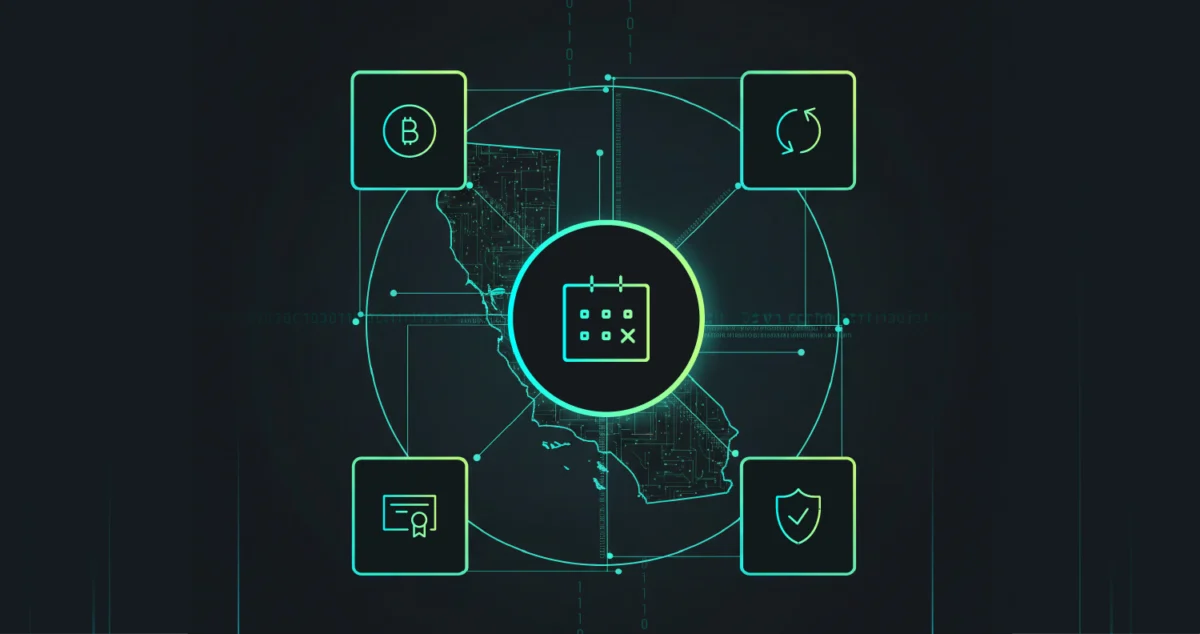
The DFAL targets four primary categories of digital financial asset activity: exchange, transfer, storage, and administration. Understanding these definitions is critical for firms determining their liability under the new law.
Exchange Services
The law defines "exchange" as the act of selling, trading, or converting digital assets into legal tender or other digital assets. This captures centralized exchanges (CEXs) and retail trading platforms. However, a point of significant debate among legal experts is the application of this rule to decentralized exchanges (DEXs). While the law focuses on "control" over assets, some interpretations suggest that platforms facilitating transactions via smart contracts or providing front-end interfaces for decentralized protocols may still fall under the DFPI’s magnifying glass.
Transfer and Storage
Transfer activities involve moving digital assets on behalf of a customer, whether between the customer’s own accounts or to a third party. The determining factor here is "control"—the power to unilaterally execute or prevent a transaction. This definition likely encompasses payment processors, custodial wallet providers, and certain "bridge" protocols. Similarly, "storage" involves maintaining control over a resident’s assets. If a firm has the authority to initiate or block transactions for a user, they are deemed to be providing storage and must be licensed.
Administration and Issuance
Administration covers the issuance of digital assets where the issuer retains redemption authority. This is particularly relevant for stablecoin issuers. While certain exemptions exist for registered investment companies and government entities, most private issuers of asset-backed tokens will find themselves within the scope of the DFAL.
Chronology of Implementation
The rollout of the DFAL follows a multi-year timeline designed to give the industry and the regulator time to adjust:
- October 13, 2023: Governor Newsom signs the Digital Financial Assets Law into effect.
- January 1, 2025: Regulations regarding digital asset kiosks (Bitcoin ATMs) take effect. These include a $1,000 daily transaction limit per customer and a fee cap of the greater of $5 or 15% of the transaction value.
- March 9, 2026: The DFPI begins accepting formal license applications via the Nationwide Multistate Licensing System (NMLS).
- July 1, 2026: The hard deadline for licensing. All in-scope businesses must have an active license or a submitted, complete application on file to continue operations.
The early implementation of kiosk regulations serves as a precursor to the broader law. The DFPI has already demonstrated its willingness to enforce these rules, recently pursuing actions against kiosk operators for exceeding transaction limits and failing to provide required consumer disclosures.
Application Requirements and Financial Standards
The licensing process is intended to be rigorous, ensuring that only well-capitalized and professionally managed firms operate in the state. The initial application fee is set at $7,500, though the DFPI reserves the right to charge for the actual costs of the review.
One of the most significant hurdles for startups will be the capital expectations. The DFPI has indicated an initial requirement of $100,000 in tangible net worth and a $500,000 surety bond. However, these figures are not fixed; the regulator will calibrate the final amounts based on the specific business model, transaction volume, and risk profile of the applicant.
Beyond financial metrics, applicants must provide:
- AML/CFT Programs: Evidence of an anti-money laundering and counter-terrorist financing program aligned with the federal Bank Secrecy Act (BSA).
- Cybersecurity Protocols: Documentation of an information security program, typically assessed against the NIST framework, covering identification, protection, detection, response, and recovery.
- Governance and Disclosures: Comprehensive business plans, flow-of-funds diagrams, and detailed consumer disclosures regarding fees, risks, and insurance (or lack thereof).
- Record Retention: A policy ensuring that all transaction, KYC, and complaint records are maintained for a minimum of five years.
Analysis of Implications and Market Impact
The implementation of the DFAL is expected to have a profound impact on the United States crypto market. As California is a hub for technological innovation, the state’s regulatory choices often set a "de facto" national standard.
For consumer advocates, the law is a victory. By requiring audited financial statements and strict disclosure rules, California is attempting to prevent the types of systemic failures seen in the 2022 collapses of several major crypto firms. The daily limits on Bitcoin ATMs are specifically designed to curb the use of these machines by scammers who frequently target vulnerable populations.
However, industry participants express concerns about the cost of compliance. The dual-licensing requirement (DFAL and MTA) and the high surety bond amounts could create a barrier to entry for smaller fintech startups, potentially consolidating the market in favor of established giants. There is also the risk of "regulatory fragmentation," where differing rules between California, New York, and the federal government create a patchwork of compliance that is difficult for firms to navigate.
Reactions from Stakeholders
While many major exchanges have expressed support for "clear rules of the road," the reaction from the broader tech community has been cautious. Industry groups have argued that the definition of "control" remains too vague, potentially capturing software developers who write code but do not handle user funds.
In a statement following the signing of the bill, Governor Newsom noted that while the law is a necessary step for consumer protection, he remains committed to ensuring California remains a leader in blockchain innovation. He instructed the DFPI to work closely with stakeholders to refine the regulations, particularly regarding the overlap with the Money Transmission Act.
As the July 2026 deadline looms, the focus now shifts to the DFPI’s rulemaking process. The industry will be watching closely to see how the regulator handles decentralized protocols and whether it provides any relief for firms burdened by multiple licensing requirements. For digital asset businesses, the message is clear: the era of unregulated crypto activity in California is coming to a definitive end, and the race to compliance has officially begun.