Bitcoin, the world’s leading cryptocurrency, has experienced a significant downturn, shedding 18% of its value and falling to approximately $32,000. This sharp decline has reverberated across the digital asset market, pushing the total cryptocurrency market capitalization below the crucial $1 trillion mark. The recent price action signals a potential shift in market sentiment, moving away from the optimistic trajectory observed in earlier periods and raising concerns among investors and analysts about the immediate future of digital assets.
The cryptocurrency market has been on a rollercoaster ride in recent times, with periods of rapid ascent followed by sharp corrections. The current dip in Bitcoin’s price, while substantial, is part of a broader pattern of volatility that characterizes the nascent digital asset class. Understanding the context behind this decline requires examining recent market trends, investor behavior, and the underlying economic factors influencing asset valuations.
Recent Market Performance and Key Levels
Bitcoin’s current trading position below the $80,000 support-turned-resistance level is a critical indicator for market observers. This psychological and technical barrier has acted as a significant point of contention for traders, with recent rejections above this level fueling bearish sentiment. The inability of Bitcoin to sustain gains above $80,000 has led to increased selling pressure, as traders who entered at higher prices seek to mitigate their losses.
Analysts are closely watching for a potential price squeeze, a phenomenon where a rapid and significant price movement, either up or down, forces a large number of traders to liquidate their positions. The current bearish momentum suggests that such a squeeze could push Bitcoin’s price even lower, with some projections indicating a potential drop below the $50,000 mark. This level has historically served as a significant psychological support, and a sustained breach could trigger further capitulation among investors.
Analyst Projections and Bearish Outlook
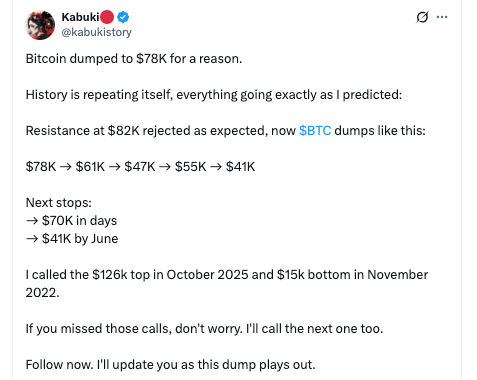
Popular cryptocurrency analyst Kabuki, known for his contrarian views and previous market calls, has articulated a particularly bleak outlook for Bitcoin. In a recent social media post, Kabuki outlined a potential downside scenario for the digital asset. His analysis suggests an initial drop to $61,000, followed by a further decline to $47,000. He then anticipates a brief recovery to $55,000 before Bitcoin potentially finds a bottom around $41,000.
Kabuki’s track record includes claims of accurately predicting the $126,000 peak during the 2024-2025 bull market and the $15,000 bottom in November 2022. With over 68,000 followers on the social media platform X (formerly Twitter), his pronouncements carry significant weight within certain segments of the crypto community. His latest projections, if realized, would represent a substantial correction from recent highs and would underscore a deepening bear market.
The Bears’ Resurgence and the $50k Threshold
The theory of a dump below $50,000 is being reiterated by a segment of market participants who have long held a bearish stance on Bitcoin. Despite strong inflows into Bitcoin Exchange-Traded Funds (ETFs) and continued institutional interest, these analysts maintain that any upward movements above the $80,000 resistance are temporary and represent a "bull trap." A bull trap is a situation where a declining asset experiences a short-lived rally, leading investors to believe the downtrend has reversed, only for the price to fall again, trapping those who bought during the rally.
These bearish analysts argue that the current market conditions are indicative of a prolonged bear market, rather than a temporary setback. Kabuki’s projection aligns with this perspective, framing the potential drop to $41,000 as a predictable outcome within the established crypto market cycles. He encourages fellow analysts to "bookmark" his analysis, suggesting a high degree of confidence in his predictive model.
Historical Context of Crypto Market Cycles
The cryptocurrency market is known for its cyclical nature, characterized by periods of intense speculation and rapid price appreciation (bull markets) followed by prolonged downturns and consolidation (bear markets). These cycles are often driven by a combination of technological adoption, macroeconomic factors, regulatory developments, and investor sentiment.
The current market cycle is particularly interesting given the unprecedented inflow of institutional capital through Bitcoin ETFs. These financial instruments have provided a more accessible avenue for traditional investors to gain exposure to Bitcoin, theoretically leading to greater price stability and adoption. However, the recent price action suggests that even these inflows may not be sufficient to counteract broader bearish pressures or a shift in investor risk appetite.
The concept of "halving events," which occur approximately every four years and reduce the rate at which new Bitcoins are created, has historically been a significant catalyst for bull markets. The most recent halving occurred in April 2024. While many anticipated a post-halving rally, the market has instead shown signs of topping out and beginning a correction. This deviation from historical patterns has added to the uncertainty and fueled bearish narratives.
Community Reactions and Divergent Opinions
The pronouncements from analysts like Kabuki have predictably elicited a wide range of responses from the cryptocurrency community on X. Some users have expressed agreement with his bearish outlook, sharing their own concerns about the market’s trajectory. These individuals often point to technical indicators and chart patterns that support a further decline.
Conversely, others have been quick to challenge Kabuki’s analysis, reminding him of previous predictions that did not materialize as expected. Critics argue that some analysts may be attempting to manipulate market sentiment or push prices lower to benefit their own trading positions. This skepticism highlights the inherent difficulty in predicting market movements and the prevalence of differing interpretations within the crypto space.
One user, @HardRelateKate, directly challenged Kabuki, suggesting that his predictions are often proven incorrect and that he might be "forcing the crypto to lower levels for his own gains." This sentiment reflects a common distrust of market commentators who are perceived as having ulterior motives. Another user, @NewCglobe_, quipped about the recurring nature of such predictions, implying that bearish forecasts are a constant feature of the crypto landscape, regardless of underlying market conditions.
Broader Market Implications and Potential Support Levels

While Kabuki and other analysts are forecasting a significant price dump for Bitcoin, it is important to consider the technical and psychological support levels that could mitigate such a decline. Despite the current bearish sentiment, there are several key price points that could act as buffers.
The $70,000, $60,000, and $50,000 levels are likely to attract significant buying interest if Bitcoin’s price approaches them. These psychological barriers have historically served as crucial support zones, and a substantial decline to these levels could trigger a resurgence of buying pressure from investors looking to acquire Bitcoin at a discount.
Currently, bulls may find solace in the $60,000 mark as a potential long-term support level. However, the prevailing market sentiment is fragile, and this could change rapidly. A significant deterioration in global macroeconomic conditions, particularly in light of ongoing geopolitical conflicts such as the one in the Middle East, could exacerbate the downturn and lead to a more severe sell-off across all risk assets, including cryptocurrencies.
The Role of Macroeconomic Factors
The cryptocurrency market, despite its decentralized nature, is not immune to the influence of global economic trends. Inflationary pressures, interest rate decisions by central banks, and geopolitical instability all play a crucial role in shaping investor sentiment and risk appetite.
In recent times, concerns about persistent inflation have led central banks to maintain higher interest rates, making riskier assets like cryptocurrencies less attractive compared to traditional safe-haven investments. Any escalation of global conflicts could further disrupt supply chains, increase energy prices, and create broader economic uncertainty, which typically leads to a flight to safety and away from speculative assets.
The ongoing conflict in the Middle East, for instance, has the potential to impact global energy markets and create broader economic instability. If such conditions worsen, it could trigger a significant deleveraging event across financial markets, with cryptocurrencies being particularly vulnerable due to their perceived speculative nature.

Future Outlook and Investor Considerations
The future trajectory of Bitcoin and the broader cryptocurrency market remains uncertain. While some analysts predict a significant downturn, others remain optimistic about the long-term prospects of digital assets, citing technological innovation and increasing adoption.
Investors are advised to approach the market with caution and to conduct thorough research before making any investment decisions. Diversification, risk management, and a long-term investment horizon are crucial strategies for navigating the inherent volatility of the cryptocurrency market.
The current price action highlights the importance of understanding market cycles, technical analysis, and the influence of macroeconomic factors. While predictions from prominent analysts can offer insights, they should be considered as part of a broader analytical framework rather than definitive forecasts. The cryptocurrency market is still relatively young and continues to evolve, making it a dynamic and often unpredictable landscape for investors. The resilience of Bitcoin and other digital assets will ultimately be tested by their ability to withstand both internal market pressures and external macroeconomic shocks.