



The cryptocurrency market is currently experiencing a significant influx of attention and speculation, fueled by a burgeoning rumor that Amazon founder Jeff Bezos may be preparing to make a substantial investment in Bitcoin. This speculation has gained considerable traction following reports that BlackRock’s iShares Bitcoin Trust (IBIT) has seen outflows totaling approximately $1 billion over the past week, a period marked by renewed selling pressure on the leading cryptocurrency. While the exact motivations behind these outflows and any potential involvement from high-profile investors like Bezos remain unconfirmed, the market is keenly observing these developments, seeking to understand the underlying dynamics and future implications for Bitcoin’s price trajectory.
BlackRock’s IBIT Witnesses Substantial Outflows Amidst Market Volatility
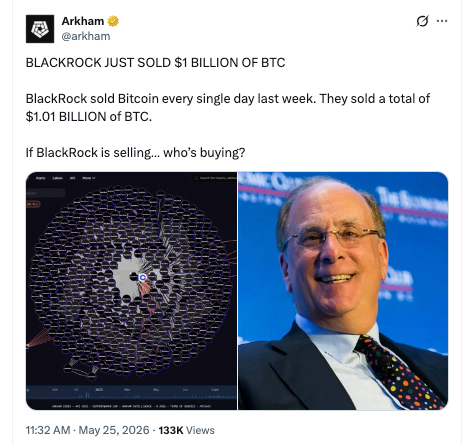
Data meticulously tracked by blockchain analytics firm Arkham has revealed that BlackRock’s iShares Bitcoin Trust (IBIT) has experienced a notable divestment of approximately $1 billion in Bitcoin over the last seven days. This significant outflow has coincided with a period of increased bearish sentiment, which has pushed Bitcoin’s price below the crucial $80,000 resistance level it had previously surpassed earlier in the month. The shift in market sentiment has led to a wave of capitulation among both institutional investors holding Bitcoin ETFs and retail traders, prompting them to liquidate their positions.
Arkham’s official statement on the matter, disseminated via their X (formerly Twitter) platform, highlighted the scale of these outflows. The firm, known for its comprehensive tracking of on-chain data and institutional movements, noted: "BlackRock offloaded approximately $1.01 billion in BTC overall during the last 7 days." These transactions are closely monitored by third-party observers, as they often provide insights into the shifting strategies of major financial institutions and the flow of capital within the burgeoning digital asset space. The consistent monitoring of BlackRock’s associated wallets by entities like Arkham has frequently been a source of news, as it reflects the dynamic nature of investor sentiment and the rotation of funds within these newly established Bitcoin ETFs.
Unpacking the Dynamics: If BlackRock Sells, Who Buys?
The substantial outflows from BlackRock’s IBIT have naturally ignited a crucial question within the crypto community: if such a prominent institutional player is divesting, who is absorbing these significant holdings? However, a closer examination of the situation reveals a more nuanced reality. BlackRock, as the issuer of the IBIT ETF, does not unilaterally decide whether to buy or sell the underlying Bitcoin. Instead, the responsibility lies entirely with the investors who hold shares in the ETF. When investors redeem their shares, BlackRock is compelled to sell the corresponding amount of Bitcoin to meet these redemption requests, thereby adjusting its portfolio to align with investor demand.
This process is a fundamental aspect of how exchange-traded funds operate. The outflows from IBIT, therefore, represent a collective decision by a multitude of investors to exit their positions, rather than a strategic selling decision by BlackRock itself. The question of who is buying is then redirected to the broader market participants. While specific large-scale buyers are not always immediately identifiable, historical trends and ongoing market activity suggest several potential candidates. These include prominent figures and entities within the crypto ecosystem, such as Michael Saylor’s MicroStrategy, which has consistently pursued aggressive Bitcoin accumulation strategies. Furthermore, other crypto treasury firms and even individuals associated with prominent business families, like Eric Trump (son of former U.S. President Donald Trump), have been noted as accumulating Bitcoin.

The current market environment, characterized by the ETF slump led by BlackRock’s outflows, also raises concerns about the behavior of retail investors. Many retail investors who entered the market at lower price points, potentially around the $60,000 mark, may be tempted to realize significant profits as Bitcoin approaches or exceeds the $80,000 level. The total unrealized profit on Bitcoin purchases has reportedly surpassed 60% when the cryptocurrency traded above this key resistance. This presents a strong incentive for these investors to book gains and await a potential market correction before re-entering, thereby contributing to the selling pressure.
A Deeper Dive into the Data and Potential Buyers
To provide a more comprehensive understanding of the market dynamics, it is important to contextualize the reported outflows. The $1 billion figure represents a significant sum, but it is crucial to consider it in relation to the total assets under management (AUM) of the IBIT ETF. While specific real-time AUM figures fluctuate, BlackRock’s Bitcoin ETF has, at various points, held tens of billions of dollars in Bitcoin. Therefore, while substantial, these outflows may represent a recalibration of investor portfolios rather than a wholesale abandonment of the asset class.
The entities identified as consistent buyers of Bitcoin offer a counterpoint to the selling pressure. Michael Saylor’s MicroStrategy has been a steadfast advocate for Bitcoin as a treasury reserve asset, regularly purchasing large quantities of the cryptocurrency. Their ongoing accumulation strategies have positioned them as a major player in the market, often acting as a significant bid during periods of price volatility. Their commitment to acquiring Bitcoin, irrespective of short-term market fluctuations, provides a stabilizing force and absorbs a portion of the selling pressure.
Furthermore, the involvement of other corporate treasuries and strategic investors, though sometimes less publicized than BlackRock or MicroStrategy, also plays a vital role. These entities often have long-term investment horizons and are less susceptible to the short-term emotional swings that can affect retail investors. The rumored interest from high-net-worth individuals, such as Jeff Bezos, even if unconfirmed, underscores a broader trend of increasing institutional and high-profile interest in Bitcoin as a potential store of value and investment asset.
The Whispers of Jeff Bezos and a Shift in Investment Philosophy
The speculation surrounding Jeff Bezos’s potential entry into the Bitcoin market has added a significant layer of intrigue to the current market narrative. While no concrete evidence has been presented to confirm these rumors, the mere suggestion has been enough to ignite the imaginations of crypto enthusiasts and market watchers. Bezos, a figure synonymous with innovation and monumental business success, has a history of embracing disruptive technologies. His offloading of billions of dollars in Amazon stock, a move that naturally leads investors to question his future investment strategies, has fueled this particular rumor.
Historically, individuals of Bezos’s stature have often been cautious in their public pronouncements regarding volatile asset classes like cryptocurrencies. However, the increasing acceptance of Bitcoin by traditional financial institutions, including the launch of spot Bitcoin ETFs by major players like BlackRock, has lent a degree of legitimacy to the asset class. If Bezos were to indeed invest in Bitcoin, it would represent a powerful endorsement, potentially signaling a broader shift in investment philosophy among ultra-high-net-worth individuals and further normalizing Bitcoin as a mainstream investment.
The implications of such a move are multifaceted. Firstly, it would undoubtedly inject a significant amount of capital into the market, potentially driving up prices. Secondly, it would serve as a powerful signal to other institutional investors and high-net-worth individuals who may still be on the fence about allocating a portion of their portfolios to Bitcoin. The narrative would shift from Bitcoin as a fringe digital asset to a recognized store of value and investment opportunity championed by one of the world’s most successful entrepreneurs.
The Future Outlook: Navigating Volatility and Accumulation
Despite the recent outflows from BlackRock’s IBIT, it is premature to interpret this as a definitive bearish signal for Bitcoin. As previously highlighted, these outflows are largely dictated by investor redemptions, a normal occurrence in the lifecycle of an ETF. The fact that these outflows represent a fraction of BlackRock’s total holdings and do not necessarily indicate a sustained selling pattern suggests that the market is still in a phase of price discovery and portfolio adjustment.
Macroeconomic factors, such as inflation concerns, interest rate policies, and geopolitical stability, continue to play a significant role in shaping investor sentiment towards risk assets, including Bitcoin. Profit-taking is also a natural consequence of any market rally, and it is expected that some investors will continue to liquidate positions to secure gains.
However, the ongoing accumulation strategies of entities like MicroStrategy, led by Michael Saylor, provide a crucial counter-narrative. Their consistent and aggressive approach to acquiring Bitcoin, often in significant tranches exceeding $1 billion, establishes a robust underlying demand for the cryptocurrency. This persistent buying pressure from committed institutional players helps to offset selling pressure from other market participants. In essence, MicroStrategy and similar entities have evolved into a more substantial force in the Bitcoin market than BlackRock itself, in terms of direct, ongoing accumulation.
The broader implications of these market movements are significant. The emergence of spot Bitcoin ETFs has democratized access to Bitcoin for a wider range of investors, leading to increased liquidity and institutional involvement. While this can lead to increased volatility in the short term, it also paves the way for greater adoption and price appreciation in the long run. The ongoing debate and speculation surrounding high-profile investors like Jeff Bezos underscore the growing mainstream recognition of Bitcoin’s potential.
In conclusion, the cryptocurrency market is currently at a pivotal juncture. The substantial outflows from BlackRock’s IBIT, while noteworthy, are occurring within a dynamic landscape of robust accumulation by entities like MicroStrategy and increasing speculative interest from high-profile individuals. The rumors surrounding Jeff Bezos, though unconfirmed, highlight the growing perception of Bitcoin as a legitimate investment asset. As the market navigates these complex dynamics, it will be crucial to observe the interplay between institutional flows, retail sentiment, and the evolving macroeconomic environment to fully grasp the future trajectory of Bitcoin. The narrative is one of continued evolution, with significant players making their moves and the broader market grappling with the implications of these shifts.














