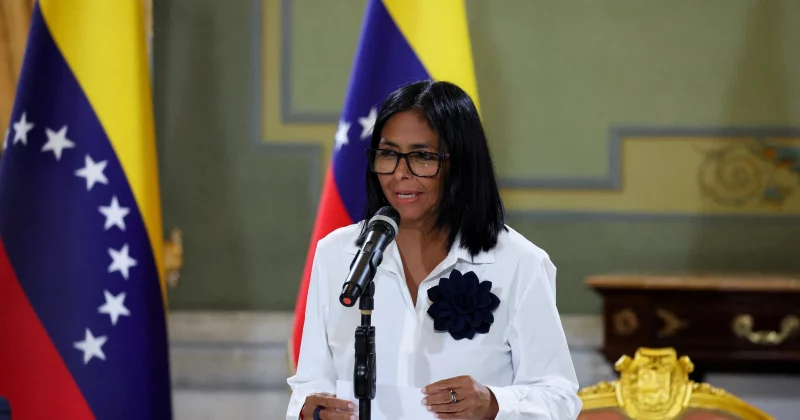
In a significant departure from years of aggressive legal pursuit, the Trump administration has directed federal prosecutors in Miami to terminate ongoing criminal investigations into Delcy Rodríguez, the acting President of Venezuela. This directive marks a fundamental recalibration of United States foreign policy toward the South American nation, signaling a transition from a strategy of total regime change to one of pragmatic stabilization in the wake of the previous leadership’s collapse. The decision has immediate and far-reaching implications for international diplomacy, sanctions enforcement, and the evolving role of digital assets within the Venezuelan economy.
The move to shield Rodríguez from prosecution comes at a pivotal moment in Venezuelan history. On January 3, 2026, a high-stakes U.S. military operation resulted in the capture of former President Nicolás Maduro. For over a decade, Maduro had been the primary target of American narco-terrorism enforcement, accused of leading the "Cartel of the Suns" and flooding the United States with cocaine. Following his extradition, Maduro and his wife, Cilia Flores, were arraigned in a New York federal court, where they pleaded not guilty to a litany of charges. With the figurehead of the previous administration in custody, the U.S. executive branch appears to be pivoting toward a "dual-track" approach: pursuing justice for past alleged crimes while seeking a functional relationship with the current governing body in Caracas.
The Miami Probe and the Strategic Stand-Down
The investigation into Delcy Rodríguez was spearheaded by federal prosecutors in the Southern District of Florida. This probe was initiated in March 2026, shortly after the power vacuum created by Maduro’s capture began to be filled by his former Vice President. Rodríguez, a seasoned diplomat and a long-term person of interest for the Drug Enforcement Administration (DEA), had been under scrutiny for her alleged role in facilitating the financial networks that sustained the Maduro administration during years of crippling sanctions.
However, the recent directive from Washington has ordered these prosecutors to "stand down." According to sources familiar with the administration’s thinking, the decision is not based on a lack of evidence or an exoneration of Rodríguez’s past actions. Instead, it is a calculated geopolitical maneuver. The administration’s primary objective in the post-Maduro era is to prevent Venezuela from descending into a failed state or a civil war, which would exacerbate the regional migration crisis and provide an opening for adversarial powers like Russia and China to increase their influence in the Western Hemisphere.
By halting the investigation into Rodríguez, the U.S. is effectively extending a diplomatic olive branch. This allows the acting president to govern without the immediate threat of a U.S. indictment hanging over her head, theoretically providing her the political space to implement economic reforms and engage in transition talks. This "punish the past, negotiate with the present" strategy aims to decapitate the old leadership while preserving the institutional skeleton of the country to ensure basic order.
A Chronology of Escalation and Transition
To understand the weight of this policy shift, one must look at the timeline of U.S.-Venezuela relations leading up to this moment:
- February 2018: Venezuela launches the Petro (PTR), the world’s first state-backed cryptocurrency, intended to bypass U.S. sanctions. The U.S. Treasury Department immediately warns investors that the Petro is a tool for sanctions evasion.
- March 2020: The U.S. Department of Justice indicts Nicolás Maduro and 14 other high-ranking officials on charges of narco-terrorism, corruption, and drug trafficking. A $15 million bounty is placed on Maduro’s head.
- 2021–2025: Economic conditions in Venezuela continue to deteriorate despite the use of digital assets. Hyperinflation renders the bolívar virtually worthless, leading to a massive adoption of the U.S. dollar and stablecoins like Tether (USDT) for daily transactions.
- January 3, 2026: In a coordinated military and intelligence operation, U.S. forces capture Nicolás Maduro. He is transported to New York to face trial.
- February 2026: Delcy Rodríguez assumes the role of acting President, promising a period of national reconstruction.
- March 2026: Federal prosecutors in Miami open a formal probe into Rodríguez and other members of the transitional cabinet.
- Late 2026: The Trump administration issues the directive to cease the investigation into Rodríguez, prioritizing regional stability and diplomatic engagement.
Digital Assets as a Geopolitical Tool
The Venezuelan crisis has served as a real-world laboratory for the intersection of sovereign finance and blockchain technology. The Petro (PTR) was the centerpiece of the Maduro administration’s strategy to maintain liquidity in the face of being cut off from the SWIFT international banking system. While the Petro failed to gain significant international traction—largely because it was deemed "radioactive" by global compliance officers—it set a precedent for state-sponsored crypto adoption.
In the absence of a stable national currency, the Venezuelan people and the government itself turned to Tether (USDT). As a dollar-pegged stablecoin, USDT provided a lifeline for a population suffering from triple-digit inflation. More importantly, the Venezuelan authorities began utilizing USDT for large-scale oil transactions. By moving value through decentralized or non-compliant channels, the regime was able to continue exporting crude oil to specific markets, despite heavy U.S. sanctions on the state-owned oil company, PDVSA.
The halt of the Rodríguez investigation has direct implications for the digital asset landscape. If this move signals a broader easing of sanctions, the "crypto escape hatch" may no longer be the only option for the Venezuelan state. A return to traditional financial rails would likely see a decrease in state-mandated crypto usage but could simultaneously lead to an explosion in legitimate, compliant crypto volume. Compliant exchanges operating in Latin America, which have historically steered clear of Venezuelan users to avoid OFAC (Office of Foreign Assets Control) penalties, may soon find themselves in a position to re-enter the market.
Economic Data and the Cost of Isolation
The economic data surrounding Venezuela highlights the urgency of the administration’s shift. Since 2014, the Venezuelan economy has contracted by more than 75%, one of the sharpest declines for a country not at war in modern history.
- Inflation: While hyperinflation peaked in 2018 at over 1,000,000%, it remained a persistent barrier to growth through 2025.
- Oil Production: Once a powerhouse producing over 3 million barrels per day, PDVSA’s output plummeted to under 700,000 barrels per day due to mismanagement and sanctions.
- Remittances: Digital assets currently facilitate an estimated $3 billion to $5 billion in annual remittances into Venezuela, as the diaspora uses crypto to bypass high fees and slow traditional banking routes.
For the Trump administration, the potential to restart the Venezuelan oil engine is a significant motivator. By stabilizing the Rodríguez government, the U.S. could eventually facilitate the return of Western oil majors like Chevron and Eni to full capacity, helping to lower global energy prices and reduce reliance on Middle Eastern or Russian supplies.
Official Responses and Political Repercussions
The directive to halt the Miami probe has not been without controversy. While the White House has framed the move as a necessary step for "regional security and the restoration of democracy," others within the government have expressed concern.
Sources within the DEA and the Department of Justice have reportedly voiced frustration, arguing that "political expediency should not override the rule of law." Critics argue that by giving Rodríguez a pass, the administration is signaling that high-level corruption and ties to narco-trafficking can be forgiven if the political timing is right.
In Congress, the reaction has been split along ideological lines rather than strictly partisan ones. Hardliners on Latin American policy, including several influential senators from Florida, have demanded transparency regarding the "deal" made with Rodríguez. They argue that any softening of the U.S. stance must be met with verifiable progress toward free and fair elections. Conversely, proponents of the move argue that the capture of Maduro was the "ultimate win" and that the U.S. must now focus on the "day after" to avoid a power vacuum that could be filled by even more radical elements.
Broader Impact and Future Implications
The "New York vs. Miami" dichotomy—where Maduro is prosecuted aggressively while Rodríguez is given a reprieve—establishes a new template for U.S. interventionism. It suggests a move toward "targeted accountability" rather than "blanket regime deconstruction."
For global investors and compliance officers, the landscape remains treacherous. The U.S. Treasury’s OFAC has not yet issued a formal de-listing of Venezuelan entities, meaning that the sanctions regime remains legally in force despite the prosecutorial stand-down. Financial institutions will likely remain cautious until there is a formal executive order or legislative change.
The real test of this policy will be the Maduro trial in New York. If the prosecution of the former president is successful and results in a conviction, it will satisfy the demand for justice regarding the "Cartel of the Suns." This would give the Trump administration the political cover it needs to continue negotiating with Rodríguez.
Ultimately, the goal is a "normalized" Venezuela that can re-enter the global economy. This would involve a complex unwinding of sanctions, a restructuring of billions of dollars in sovereign debt, and a transition of the country’s digital asset usage from a "shadow economy" necessity to a regulated financial sector component. As the administration navigates this delicate balance, the eyes of the world remain on Caracas, watching to see if this pivot will bring the long-awaited stability to a nation that has spent a decade in the dark.