


The Sui Network, a prominent Layer 1 blockchain, experienced a significant operational disruption on May 29, 2026, when a critical gas charging bug brought its mainnet to a halt for nearly six hours, freezing block production and prompting a sharp decline in the value of its native SUI token. The incident, which saw validator activity cease due to an error in the network’s transaction fee calculation system, marks the third major outage for Sui since 2024, raising pertinent questions about the network’s long-term stability and resilience, particularly during system updates.
Chronology of a Critical Disruption
The outage commenced with an abrupt halt in block finalization across Sui’s validator set. Data from SuiScan, the network’s block explorer, confirmed a complete cessation of checkpoint production, indicating that no new transactions or blocks were being added to the blockchain. This effectively rendered the network inoperable for users attempting to execute transactions or interact with decentralized applications (dApps) built on Sui.
Initial reports from the Sui development team pinpointed the root cause to a "gas charging bug" – a flaw within the core module responsible for calculating transaction fees. This bug reportedly broke established transaction processing rules, leading to a cascade failure among validators who were unable to process valid blocks. While the exact technical specifics of the bug were not immediately released, such errors often involve miscalculations of gas limits, gas prices, or resource consumption, preventing nodes from reaching consensus on block validity.
Swift action was taken by the Sui development team, who quickly identified the faulty update that had introduced the bug. Their response involved coordinating a "rollback-style fix" through a series of validator upgrades. This critical process required a substantial portion of the network’s decentralized validator nodes to implement the patched version of the protocol. Within hours, more than two-thirds of the total stake, representing the majority of the network’s computational power and security, had successfully upgraded. This critical threshold allowed the network to gradually restart block production after approximately six hours of complete standstill.
During the outage, users could still view their balances through RPC (Remote Procedure Call) endpoints, which remained online. However, the inability to execute transactions meant that any interaction with smart contracts, token transfers, or dApp functionalities was impossible. Following the restoration of services, Sui officially confirmed that no user funds were lost, and no chain splits – a scenario where the blockchain diverges into two incompatible histories – occurred during the disruption period, mitigating fears of more severe, irreversible damage.
Technical Deep Dive: The Gas Logic Bug
The "gas charging bug" is a particularly sensitive type of error in blockchain architecture. Gas fees are fundamental to the operation of any proof-of-stake or proof-of-work blockchain, serving two primary purposes: preventing spam attacks by making transactions costly, and compensating validators/miners for their computational work. A bug in this module can have profound implications, as demonstrated by Sui’s recent incident.
In Sui’s case, the bug reportedly disrupted the network’s ability to correctly process transaction rules within its fee calculation system. This could mean several things:
- Incorrect Fee Calculation: Transactions might have been submitted with gas fees that, according to the faulty logic, were either too low or excessively high, leading to rejection by validators.
- Resource Exhaustion Errors: The bug might have caused validators to miscalculate the computational resources required for certain transactions, leading to an inability to finalize blocks without triggering internal errors.
- Consensus Breakdown: If different validators interpreted the gas logic differently due to the bug, they would fail to agree on the validity of the same block, thereby halting the consensus mechanism essential for block production.
Sui Network is built on the Move programming language, renowned for its focus on safety and resource-oriented programming, and designed for high throughput and parallel transaction execution. This architecture aims to reduce congestion and improve scalability. However, the complexity of such systems also means that even minor errors in core components like the gas charging module can have widespread effects, impacting the entire network’s ability to achieve consensus and process transactions. The rapid identification and deployment of a fix underscore the technical capabilities of the development team, but the fact that such a bug bypassed testing safeguards points to potential vulnerabilities in the deployment pipeline or testing methodologies.
Market Reaction and SUI Token Volatility
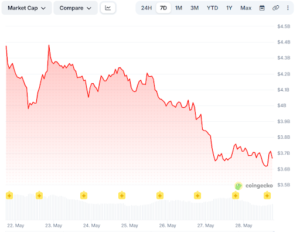
The immediate aftermath of the Sui Network Stall was acutely felt in the cryptocurrency markets, particularly by holders of the SUI token. As news of the outage spread, traders reacted swiftly, leading to significant price volatility. The SUI token experienced a notable drop, fluctuating between 6.6% and 8% during the peak of the outage. This sharp decline was exacerbated by thinning liquidity across major exchanges, a common occurrence during periods of market uncertainty and operational halts.
At its nadir, the market capitalization of SUI briefly lost approximately $3.7 billion before stabilizing as partial recovery efforts gained traction. This financial tremor was not entirely isolated, as the broader cryptocurrency market was also experiencing weakness, particularly Bitcoin, which increased selling pressure and deepened the short-term downside movement for SUI.
Prior to the incident, SUI had been trading around key support levels. Price action broke decisively below the $1.00 support zone, a psychological and technical benchmark that had previously provided stability during consolidation phases. Following the network’s restoration, market participants began to eye the $1.05–$1.10 region as a potential recovery band, contingent on renewed positive momentum and confidence in the network’s stability.
The disruption also rippled through derivatives markets, where funding rates for SUI futures and perpetual contracts fluctuated sharply. Such volatility underscores the heightened uncertainty among leveraged traders. Despite these setbacks, institutional interest in Sui, supported by its staking programs and ongoing ecosystem expansion initiatives, reportedly remained active. However, repeated network interruptions undoubtedly introduce a layer of operational risk that institutional investors carefully weigh in their investment decisions.
Broader Impact on Ecosystem and User Trust
Beyond the immediate technical and financial implications, the Sui Network Stall had a tangible impact on its burgeoning ecosystem of decentralized applications (dApps). Applications ranging from DeFi protocols to gaming platforms and NFT marketplaces were forced to pause operations. This cessation of services directly affected users who were unable to access their funds, execute trades, or participate in on-chain activities. For a network striving for widespread adoption, such disruptions can erode user trust and deter new users and developers from joining the ecosystem.
Developer confidence is also a crucial factor. While the speed of the fix was commendable, recurring outages can raise concerns about the robustness of the underlying infrastructure and the rigor of testing procedures before major updates. Developers building critical applications on Sui rely on predictable uptime and a stable environment. Repeated "validator coordination issues during system updates," as noted in earlier outages, suggest a systemic challenge that needs comprehensive addressing.
Sui has consistently positioned itself as a "high-throughput blockchain" capable of handling enterprise-level applications and massive user bases. This narrative is significantly challenged by recurring disruptions. In the highly competitive Layer 1 blockchain landscape, where networks like Solana, Aptos (also based on Move), and various Ethereum Layer 2 solutions vie for market share, reliability and uptime are paramount differentiators. Each outage, therefore, becomes a litmus test for the network’s engineering prowess and its ability to deliver on its promises.
Historical Context and Recurring Challenges
This latest incident is not an isolated event for the Sui Network. The platform has now recorded three major outages since its launch in 2023, with previous disruptions occurring in 2024 and January 2026. Each of these incidents has been linked, directly or indirectly, to upgrade processes or validator coordination failures. This pattern suggests a recurring operational risk associated with upgrade cycles, which are essential for blockchain evolution but must be managed with extreme caution.
Blockchain upgrades are inherently complex. They require all participating validators—which can number in the hundreds or thousands globally—to update their software in a coordinated manner. A single bug or misconfiguration, especially in a critical module like gas calculation, can rapidly propagate and lead to network-wide consensus failure. The promise of decentralization, while offering resilience against single points of failure, also introduces coordination challenges that centralized systems do not face to the same extent.
The industry as a whole has seen similar challenges. Solana, another high-throughput blockchain, famously experienced multiple significant outages in its early years, often related to network congestion and validator instability. These incidents underscored the difficulty of scaling blockchain technology without compromising reliability. Sui’s recurring issues place it in a similar spotlight, forcing market participants and stakeholders to question whether the current upgrade protocols are sufficiently robust to prevent future disruptions.
Official Response and Future Outlook
In response to the outage, the Sui development team has committed to conducting a full post-incident report. Such reports are standard practice in the tech industry, aiming to provide a detailed explanation of the incident’s root cause, how the faulty update bypassed testing safeguards, the steps taken for recovery, and, crucially, a plan to prevent similar occurrences in the future. This transparency will be vital for rebuilding trust and assuring the community of Sui’s commitment to network stability.
Recovery from such an event is a multi-faceted process. While block production has resumed, validators must fully synchronize under the patched version of the protocol, ensuring all nodes are operating with the correct and stable software. This synchronization process is critical for maintaining network integrity and preventing latent issues from resurfacing.
The long-term implications for Sui will hinge on its ability to address these recurring stability challenges comprehensively. Investors, developers, and users will be closely monitoring the network’s performance and the effectiveness of its future upgrade mechanisms. While the resilience shown in quickly identifying and resolving the bug is a positive sign, the repeated nature of these incidents demands a more fundamental re-evaluation of its operational protocols and testing environments.
In conclusion, the Sui Network’s recent six-hour mainnet outage due to a gas charging bug serves as a stark reminder of the inherent complexities and fragility within even the most advanced blockchain infrastructures. While the network demonstrated its capacity for rapid recovery and confirmed no loss of funds, the incident has undeniably highlighted persistent stability concerns. For Sui to solidify its position as a leading high-throughput blockchain, it must not only innovate but also unequivocally prove its reliability through robust engineering, rigorous testing, and an unwavering commitment to operational excellence. The forthcoming post-incident report and subsequent actions will be pivotal in shaping the network’s trajectory and restoring full confidence among its global community.














