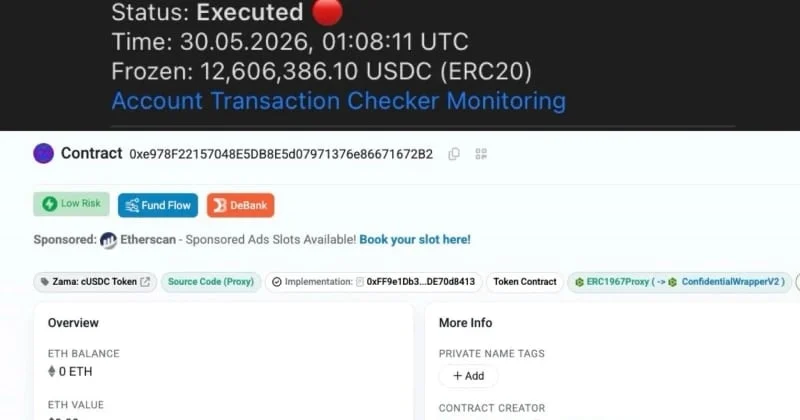
The digital asset industry was recently reminded of the inherent centralized control governing the world’s second-largest stablecoin. On May 30, Circle Internet Financial, the issuer of USD Coin (USDC), took the decisive action of freezing the cUSDC contract deployed by Zama, a prominent cryptography firm. The freeze effectively locked approximately 12.6 million USDC, valued at roughly $13 million, within the Ethereum-based contract. This move followed a public investigation by the renowned on-chain sleuth known as ZachXBT, who identified a direct connection between the contract’s address and the Overnight Finance project, which has recently been mired in allegations of a "rug pull" or exit scam.
Zama, a company that has gained significant traction for its pioneering work in Fully Homomorphic Encryption (FHE), acknowledged the freeze shortly after it occurred. The firm’s CEO, Rand Hindi, confirmed that the team is currently conducting a thorough investigation into the matter and intends to provide comprehensive updates as more information becomes available. The incident has sent ripples through the decentralized finance (DeFi) community, highlighting the complex intersection of privacy-preserving technology and the rigid compliance frameworks of centralized stablecoin issuers.
The Mechanics of cUSDC and the ERC-7984 Standard
To understand the gravity of this freeze, one must first examine the nature of Zama’s cUSDC. Unlike standard USDC, which operates on a transparent ledger where every balance and transaction is visible to anyone with an internet connection, cUSDC was built using the ERC-7984 standard. This framework was specifically designed to facilitate encrypted balances and transfers while maintaining "composability"—the ability for different protocols to interact with one another—on public blockchains like Ethereum.
The primary value proposition of cUSDC is its ability to offer "confidential" transactions. By leveraging Zama’s FHE technology, users could theoretically hold and move stablecoins without broadcasting their exact treasury movements or personal financial history to the global public. This functionality was marketed as a vital tool for institutional players who require privacy for strategic reasons—such as preventing competitors from tracking their liquidity or investment strategies—as well as for individual users seeking a higher degree of financial discretion.
However, the recent freeze by Circle has exposed a critical vulnerability in this model. While the data within the cUSDC contract may be encrypted using sophisticated cryptographic proofs, the asset itself remains a product of Circle. This creates a scenario where the cryptographic "wrapper" provides a layer of privacy against public scrutiny, but offers no protection against the administrative powers of the underlying asset’s issuer.
The Catalyst: ZachXBT and the Overnight Finance Connection
The impetus for Circle’s intervention was an investigation conducted by ZachXBT, an anonymous on-chain researcher who has become a de facto auditor for the crypto industry. ZachXBT’s findings linked the Zama cUSDC contract to funds associated with Overnight Finance, a project that issues the USD+ stablecoin. Overnight Finance has recently faced severe scrutiny and allegations of a "rug pull"—a type of scam where developers abandon a project and run away with investors’ funds.
According to the on-chain data, a significant portion of the capital residing in the cUSDC contract was traced back to wallets involved in the suspicious movements surrounding Overnight Finance. In the realm of centralized stablecoins, such a link is often sufficient for issuers to take preemptive action to prevent the laundering of illicit funds. Circle, which operates under the regulatory jurisdiction of the United States, maintains a strict compliance department that monitors the movement of USDC to ensure it does not facilitate criminal activity or violate sanctions.
The speed with which Circle acted underscores the "watchdog" role that private companies now play in the blockchain ecosystem. By freezing the contract, Circle has effectively sidelined $13 million in liquidity, preventing it from being moved or cashed out through traditional fiat gateways until the investigation is resolved.
The Technical Reality of Fully Homomorphic Encryption
Zama’s reputation is built on its mastery of Fully Homomorphic Encryption (FHE). In simple terms, FHE is a form of encryption that allows mathematical computations to be performed on ciphertext (encrypted data) without the need to decrypt it first. The result of the computation remains encrypted, and when decrypted by the owner of the private key, it yields the same result as if the operation had been performed on the original plaintext data.
This technology is often described as the "holy grail" of cryptography because it allows for the outsourcing of data processing to third parties (like cloud providers or public blockchains) without those parties ever seeing the underlying sensitive information. Zama has successfully applied this to create confidential versions of both USDC and USDT (Tether).
However, the legal and architectural reality of USDC is not homomorphic. USDC is a centralized IOU issued by Circle Internet Financial, LLC. Every USDC in circulation is backed by reserves held in US treasuries and cash at regulated financial institutions. To maintain its licenses and operate within the global financial system, Circle includes a "blacklist" function in its smart contracts. This function allows the company to prevent specific Ethereum addresses from sending or receiving USDC. When Circle blacklists a contract address—as it did with Zama’s cUSDC—it doesn’t matter how the data inside the contract is encrypted; the protocol-level ability to move the tokens is revoked.
The Compliance Paradox in Privacy-Preserving Protocols
The Zama incident highlights what many experts call the "compliance paradox" at the heart of modern privacy tokens. Zama has long positioned its technology as a bridge that allows the transparency of public blockchains to coexist with the privacy requirements of real-world finance. The firm’s ERC-7984 standard was intended to demonstrate that privacy does not have to mean anonymity for the sake of illicit activity, but rather confidentiality for the sake of business and personal security.
The paradox lies in the fact that for a privacy-wrapped asset to be useful, it usually needs to be pegged to a stable, liquid, and widely accepted currency like USDC. But by choosing USDC as the base layer, the privacy protocol inherits the compliance requirements of the US government.
Circle’s decision to freeze the contract based on an external investigator’s findings illustrates that in the eyes of the issuer, compliance precedes privacy. If a privacy wrapper is used to shield funds that are suspected of being stolen or part of a fraudulent scheme, the issuer will prioritize their regulatory obligations over the technical privacy guarantees of the wrapper. This effectively means that "privacy" in this context is a conditional privilege rather than an immutable right.
Implications for Investors and the DeFi Ecosystem
For investors and institutional users, the freeze of $13 million in cUSDC serves as a stark warning about counterparty risk. When an investor "wraps" an asset like USDC into a protocol like Zama’s, they are exposed to two distinct layers of risk:
- Smart Contract Risk: The risk that the code of the privacy wrapper (cUSDC) has bugs or vulnerabilities.
- Issuer Risk: The risk that the issuer of the underlying asset (Circle) will exercise its power to freeze the funds.
The Zama freeze demonstrates that the second risk can be triggered even if the first risk is managed perfectly. Furthermore, it highlights a lack of recourse. In a truly decentralized system, a freeze might require a governance vote or a consensus mechanism. In the case of USDC, the decision is centralized. For an entity holding millions in wrapped assets, a single administrative action by Circle can render their holdings illiquid instantaneously.
This event is likely to drive a shift in how privacy-focused projects are built. Developers may increasingly look toward decentralized stablecoins—such as MakerDAO’s DAI or Liquity’s LUSD—which lack centralized freeze functions. However, these decentralized alternatives often suffer from lower liquidity and higher volatility compared to USDC, creating a difficult trade-off for users who need both stability and censorship resistance.
The Broader Regulatory Landscape
The timing of this freeze is also significant given the evolving regulatory landscape for stablecoins. In the United States, legislative efforts like the Lummis-Gillibrand Responsible Financial Innovation Act and various House committee bills are seeking to codify how stablecoin issuers must operate. Central to these regulations is the requirement for "know your customer" (KYC) and "anti-money laundering" (AML) compliance.
Circle is widely expected to pursue an initial public offering (IPO) in the near future. As a company seeking to go public, maintaining a spotless record with regulators like the Office of Foreign Assets Control (OFAC) is paramount. Proactively freezing funds linked to alleged rug pulls, even when those funds are hidden behind advanced encryption layers, is a clear signal that Circle intends to remain the most "compliant" player in the space.
This proactive stance creates a tension with the core ethos of blockchain—decentralization and permissionless access. While Circle’s actions protect the integrity of the USDC ecosystem by preventing the circulation of "tainted" funds, they also reinforce the idea that USDC is not truly "money" in the sovereign sense, but rather a digital service subject to the terms and conditions of a private corporation.
Conclusion: The Future of Confidential Finance
The freezing of Zama’s cUSDC contract is a landmark event that clarifies the boundaries of privacy in the current crypto-financial system. It proves that while Fully Homomorphic Encryption can hide the details of a transaction from the public, it cannot hide the existence of the assets from the issuer’s compliance department.
As Zama continues its investigation and Rand Hindi’s team works to resolve the situation, the industry must grapple with the reality that privacy wrappers are only as sovereign as the assets they contain. For confidential finance to truly mature, the industry may need to develop privacy solutions that are either fully integrated with decentralized assets or built on protocols where compliance is handled through zero-knowledge proofs that satisfy regulators without granting issuers total "kill-switch" authority.
Until then, the $13 million currently sitting idle in the cUSDC contract serves as a $13 million reminder: in the world of centralized stablecoins, code may be law, but the issuer’s compliance department holds the gavel. The incident will likely lead to increased scrutiny of other "wrapped" stablecoin products and may prompt a re-evaluation of how privacy-preserving technologies are marketed to both retail and institutional investors. The path forward for Zama and similar projects will require a delicate balancing act between the technical pursuit of total privacy and the legal reality of operating within a regulated global economy.