


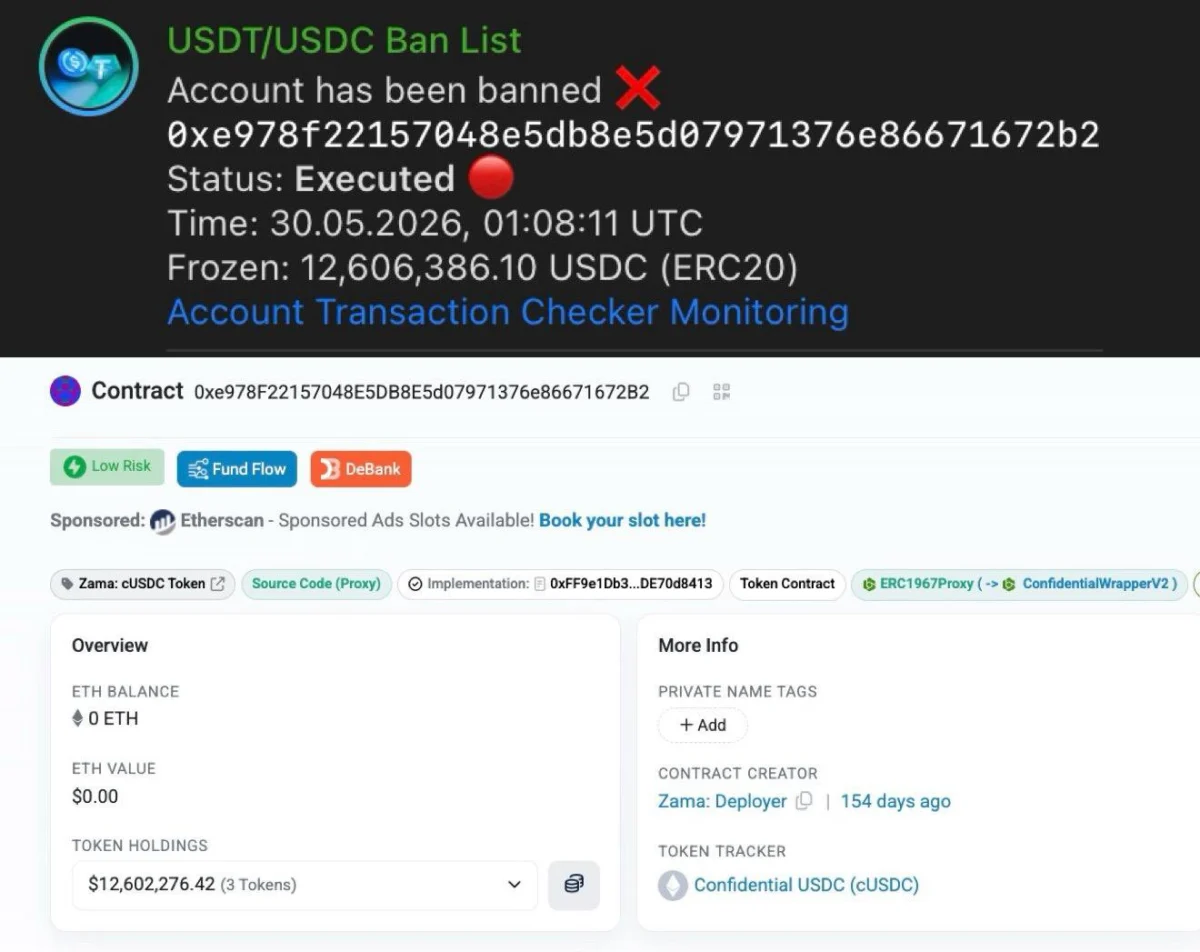
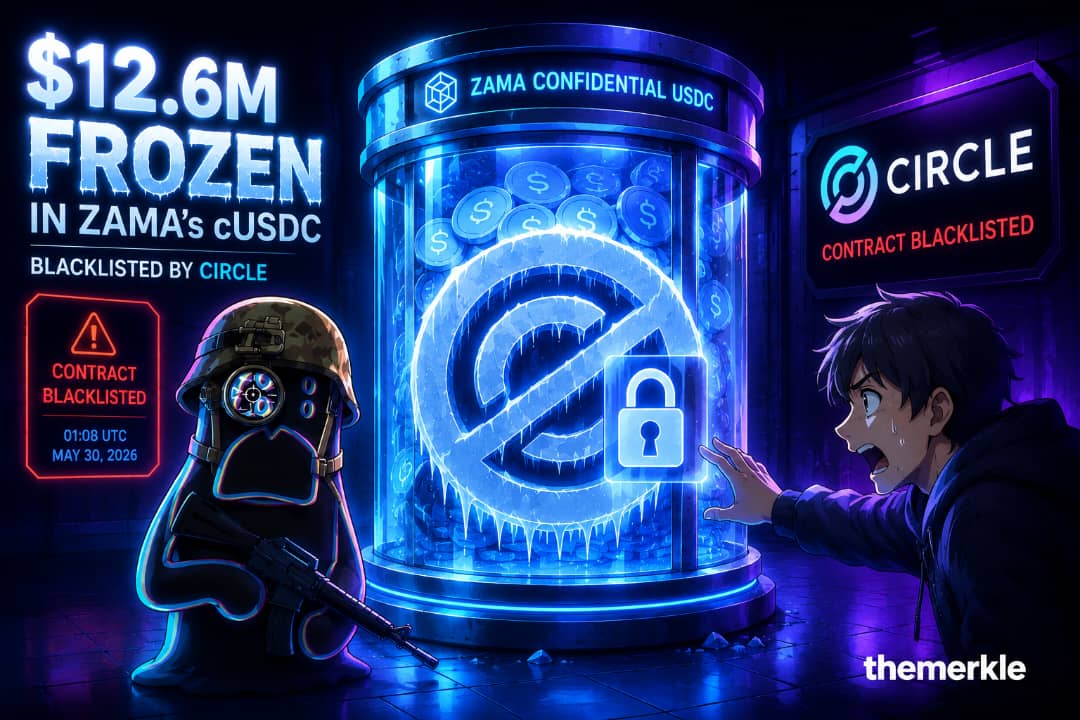
A significant stablecoin freeze, first brought to light by prominent blockchain investigator ZachXBT, has sent considerable shockwaves throughout the decentralized finance (DeFi) community, reigniting critical discussions surrounding centralization risks inherent in the ecosystem. Circle, the issuer of the widely used stablecoin USDC, has reportedly blacklisted the smart contract address associated with privacy protocol Zama’s Confidential USDC (cUSDC) on the Ethereum blockchain. This action has effectively locked approximately $12.6 million in user funds, a substantial sum that may have no direct connection to any alleged wrongdoing that prompted the freeze.
ZachXBT, known for his meticulous on-chain investigations, disseminated his findings across his social channels, noting that the blacklist appeared to have been enacted roughly seven hours prior to his public flagging. By the time the broader cryptocurrency community began to process the implications, the funds within the cUSDC contract were already rendered inaccessible. This swift and unannounced action by Circle has provoked alarm, particularly given the nature of Zama’s protocol, which is built on the principles of financial privacy and user autonomy.
The Unfolding Investigation: ZachXBT’s Crucial Role
The initial discovery and subsequent public notification by ZachXBT underscored the vital role played by independent on-chain analysts in bringing transparency to the often-opaque world of blockchain transactions. Through diligent examination of on-chain data, ZachXBT meticulously connected the dots, identifying the blacklisted address as Zama’s official cUSDC contract and tracing the freezing action directly back to Circle. A particularly alarming aspect of the situation, as highlighted by ZachXBT, was the apparent lack of prior communication to either Zama or its users before the freeze was implemented. This absence of warning is a critical point of contention, especially for a protocol whose entire value proposition rests on providing enhanced financial privacy and control. For users who entrusted their assets to cUSDC, believing in its promise of shielded transactions, waking up to an unannounced and unexplained freeze represents a severe breach of trust and an existential threat to the protocol’s fundamental tenets.
Zama’s Confidential USDC: A Deep Dive into Privacy Technology
To fully grasp the gravity of this incident, it is essential to understand Zama’s core mission and the technical innovation behind its cUSDC product. Zama is not a typical trading platform or a yield farming protocol. Instead, the company is at the forefront of cryptographic infrastructure development, specializing in Fully Homomorphic Encryption (FHE). FHE is a groundbreaking cryptographic primitive that allows computations to be performed directly on encrypted data without ever needing to decrypt it. This means that data can remain private and secure even when processed by untrusted third parties.
Zama’s cUSDC product leverages this advanced FHE technology to bring a new layer of privacy to stablecoins. By enabling users to hold and transact in USDC while keeping the details of those transactions—such as sender, recipient, and amount—private on-chain, cUSDC offers a significant enhancement over standard, transparent USDC transactions. The protocol’s commitment to technically serious, privacy-enhancing solutions makes the blacklisting sting even more acutely. The very premise of cUSDC is to offer users a degree of financial privacy that conventional USDC, with its fully auditable public ledger, cannot. Having Circle, the issuer of the underlying asset, unilaterally freeze the cUSDC contract, without notice and seemingly as collateral damage in a third-party legal dispute, directly undermines everything the product is designed to represent and achieve. It poses a fundamental challenge to the utility and trustworthiness of privacy-preserving technologies in a world where centralized entities retain ultimate control over foundational assets.
The Genesis of the Freeze: Overnight Finance and the Whispers of Controversy
The intricate web of events leading to the cUSDC freeze begins with a separate, albeit connected, controversy surrounding Overnight Finance, a DeFi yield protocol. Tracing the on-chain history of the now-frozen cUSDC address, ZachXBT discovered a deposit of approximately $12.4 million in USDC made on May 11. This deposit originated from a wallet that observers have linked to Overnight Finance. Compounding the situation, the same wallet was subsequently observed participating in an Overnight Finance governance vote related to treasury allocation. This particular move did not sit well with certain factions within the protocol’s community, sparking internal discord.
The controversy escalated further as some Overnight Finance holders began to voice serious accusations, going as far as alleging a "rug pull" by the project team. A rug pull is a malicious maneuver in the crypto industry where developers abandon a project and run away with investors’ funds. While these are grave allegations, and their veracity remains a separate and unconfirmed matter, their public circulation appears to have been loud enough to attract external attention, including potential legal scrutiny. These accusations, combined with the suspicious governance activity, seemingly formed the volatile backdrop against which Circle eventually chose to act, leading to the unprecedented freeze.
A Familiar Player Emerges: Patagon Management and the Civil Lawsuit
The narrative gains further complexity with the revelation of a civil lawsuit filed against Overnight Finance. ZachXBT’s investigation delved into the identity of the plaintiffs behind this legal action, bringing a familiar and unsettling name to the forefront: Patagon Management. Within the on-chain community, Patagon Management is recognized for a track record that is, to put it mildly, not flattering. The firm has gained notoriety for what many characterize as "hostile DAO takeovers" and calculated moves to extract residual value from protocols they target. This reputation immediately raised red flags among astute observers of the crypto space.
ZachXBT raised a particularly pointed concern: the possibility that Patagon Management may have approached the court and misrepresented the actual relationship between the frozen wallet and Zama’s cUSDC contract. If this hypothesis proves correct, it implies that Circle acted based on a legal argument or court order that did not accurately reflect the true nature or function of the Zama contract. In this scenario, the Zama team, inadvertently caught in the crossfire of someone else’s legal dispute, would have received no advance warning before their privacy-focused contract was rendered inoperable. This potential misrepresentation underscores a critical vulnerability for decentralized protocols, highlighting how traditional legal processes, when applied to novel blockchain architectures, can lead to unintended and far-reaching consequences.
Circle’s Blacklisting Power: Compliance vs. Decentralization
Circle’s ability to blacklist USDC addresses is a feature explicitly written into the stablecoin’s smart contract. The company has consistently framed this capability as a necessary compliance tool, primarily invoked when responding to legitimate law enforcement requests or fulfilling regulatory obligations, such as anti-money laundering (AML) and counter-terrorist financing (CTF) directives. For much of its history, discussions surrounding this centralized control mechanism have remained relatively subdued, largely confined to academic debates or niche corners of the crypto community.
However, incidents like the Zama cUSDC freeze forcefully bring this contentious issue back into the mainstream spotlight. The concern is no longer theoretical; it has materialized into a tangible problem with real-world financial implications. A prominent DeFi protocol has seen its core contract frozen, and its users have lost access to their funds. Crucially, the apparent reason for this drastic action does not stem from any direct wrongdoing by Zama itself, but rather from a legal dispute involving a third party whose funds merely passed through a connected address. This type of collateral impact is precisely what critics of centralized stablecoins have warned about for years. It serves as a stark, on-chain example of how the centralized control inherent in assets like USDC can pose significant risks to the ostensibly decentralized nature of the broader DeFi ecosystem, forcing a critical re-evaluation of the delicate balance between compliance and true decentralization.
The Broader Implications for DeFi and Privacy
The freezing of Zama’s cUSDC contract carries profound implications for the entire DeFi landscape and the future of privacy-enhancing technologies within it. Firstly, it starkly highlights the fundamental tension between centralized control and decentralized ideals. While DeFi strives for censorship resistance and permissionless innovation, the reliance on centralized stablecoins like USDC introduces a single point of failure and control. This incident serves as a potent reminder that even if a protocol itself is decentralized, its foundational assets may still be subject to external, centralized authority.
Secondly, the impact on privacy protocols like Zama is particularly severe. The very existence of cUSDC is predicated on providing users with an option for financial privacy. When the underlying contract is frozen without warning due to an external dispute, it fundamentally undermines the trust users place in such solutions. It sends a chilling message that even carefully constructed privacy layers might not shield users from the reach of centralized power, potentially deterring further innovation and adoption in the privacy sector of Web3.
Furthermore, the lack of due process and prior notification for Zama raises serious questions about legal recourse and user protection within the DeFi space. If a protocol can be impacted by a legal dispute it is not directly involved in, without any opportunity to present its case or mitigate the damage, it creates a precarious environment for all participants. This incident could catalyze increased regulatory scrutiny on stablecoin issuers regarding their blacklisting policies, demanding greater transparency, clearer criteria, and robust due process mechanisms. It also emphasizes the need for legal frameworks to evolve alongside technological innovation, ensuring that justice is applied appropriately to novel blockchain structures.
The Path Forward: Unanswered Questions and Potential Repercussions
As of the time of writing, Zama has not released a detailed public response regarding the freeze, presumably as they navigate the complexities of the situation and consult legal counsel. Similarly, Circle has yet to issue a public explanation for its decision, leaving the DeFi community to speculate on the precise legal basis for the blacklisting. The $12.6 million in user funds remains frozen, and the individuals whose assets are locked in the cUSDC contract are left in a state of uncertainty.
If ZachXBT’s assessment of the situation proves accurate—that Patagon Management potentially misrepresented the link between the wallet and Zama’s contract in its court filings—then Zama would likely have strong grounds to challenge the freeze, both legally and publicly. Such a scenario would open avenues for Zama to seek the unfreezing of funds and potentially pursue damages for the disruption and reputational harm caused.
This unfolding saga underscores the persistent challenges at the intersection of traditional legal systems and the burgeoning world of decentralized finance. It serves as a critical case study that will undoubtedly inform future discussions on stablecoin regulation, the inherent risks of centralization within DeFi, and the crucial balance between financial privacy and compliance. The resolution of this incident will be closely watched, as it could set significant precedents for how legal disputes are handled in the blockchain space and redefine the operational boundaries for centralized stablecoin issuers and privacy-focused protocols alike.














