The tokenization of Real World Assets (RWAs) has transitioned from a speculative technological concept into a foundational pillar of modern traditional finance (TradFi). As global banking giants, asset managers, and sovereign wealth funds move beyond experimental pilot programs into live, multi-billion-dollar deployments, the industry faces a critical infrastructure crossroads. The central question for financial institutions is no longer whether to tokenize, but where to build.
The search for a "perfect" general-purpose blockchain has proven elusive. Instead, the current landscape of on-chain finance is defined by a complex decision matrix involving five distinct axes: speed, cost volatility, contagion risk, illicit exposure, and governance. Financial institutions can no longer rely on brand recognition alone; they must align the underlying architecture of a blockchain network with the specific functional requirements and risk profiles of the assets they intend to tokenize.
The Evolution of the On-Chain Financial Ecosystem
The journey toward the current state of RWA tokenization has been marked by a shift in institutional sentiment. In the early 2020s, blockchain initiatives within banks were largely confined to private, permissioned ledgers. However, the liquidity and interoperability of public blockchains have proven too significant to ignore.

The timeline of this evolution reached a turning point in 2024 and early 2025. In March 2024, BlackRock, the world’s largest asset manager, launched its first tokenized fund, BUIDL, on the Ethereum network. By February 2025, Franklin Templeton expanded its OnChain US Government Money Fund (FOBXX) to the Solana blockchain, citing the need for high-throughput architecture. These moves signal a broader trend where the choice of network is dictated by the specific utility of the financial instrument.
Categorizing Blockchain Architectures: The Three Archetypes
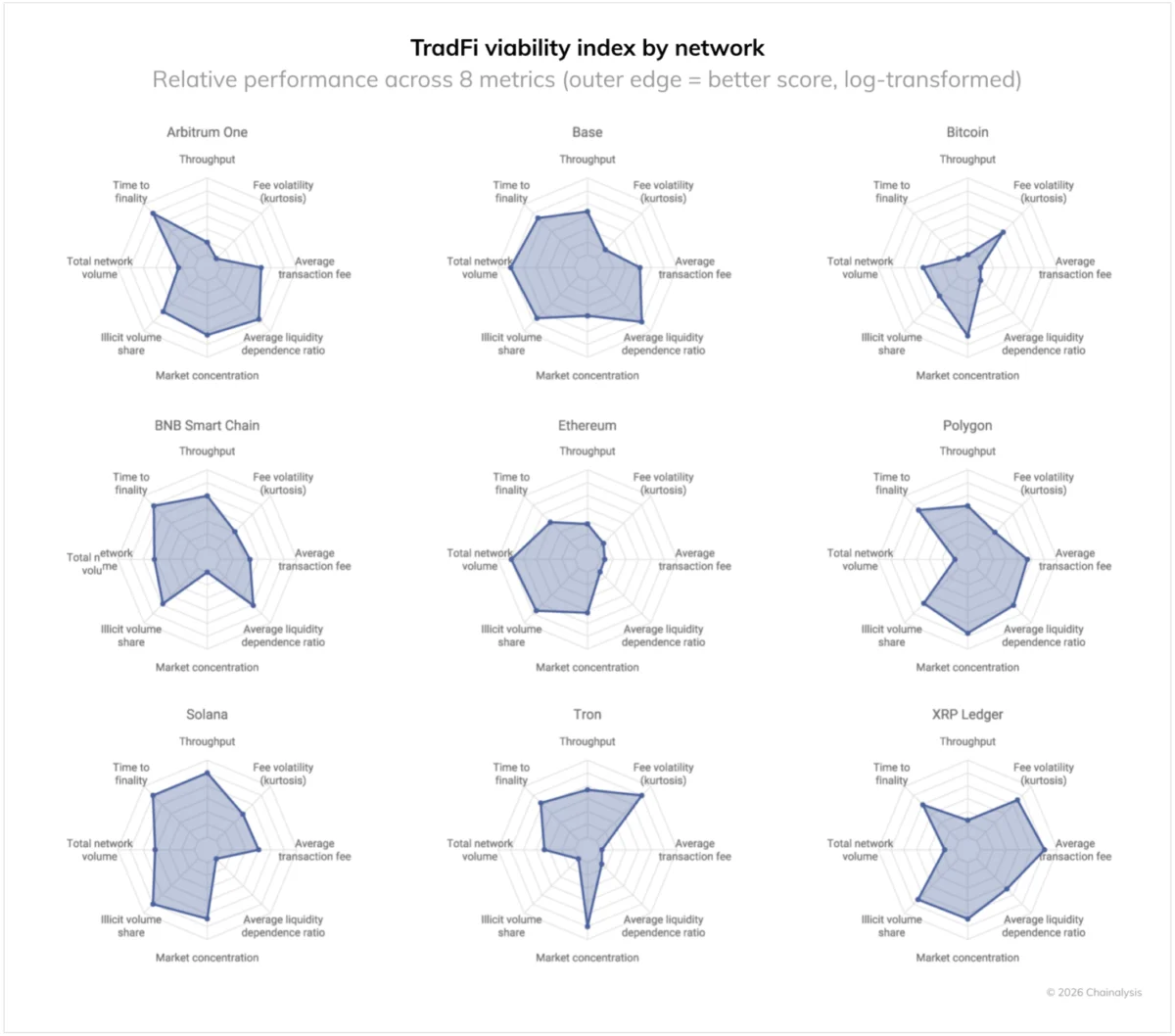
Data-driven mapping of the competitive landscape reveals that major blockchain networks generally fall into one of three architectural archetypes, each serving a different institutional purpose.
1. Institutional Anchors
Networks like Bitcoin and Ethereum serve as the bedrock of the ecosystem. These "Institutional Anchors" prioritize security and macro-settlement over transaction speed or low costs. They are characterized by contracted shapes on performance charts, indicating that while they may lack the agility of newer networks, they offer unparalleled stability and decentralization.
2. The "Goldilocks" Tier
Ethereum Layer-2 (L2) solutions—including Arbitrum, Base, Optimism, and Polygon—occupy a balanced middle ground. These networks are designed to provide the security of Ethereum while offering significantly higher performance and lower costs. For many retail-facing tokenization projects, these L2s represent the "sweet spot" of efficiency and compliance.

3. High-Frequency Engines
Networks such as Solana, TRON, BNB, and XRP Ledger function as specialized high-frequency engines. They dominate the market in terms of raw throughput and negligible transaction fees. However, this performance often comes at the expense of higher market concentration and less predictable fee structures during periods of extreme network congestion.
Operational Costs and the Statistical Reality of "Tail Risk"
For a financial institution, the absolute cost of a transaction is often less important than the predictability of that cost. To assess this, analysts use "kurtosis"—a statistical measure of tail risk. A high kurtosis score indicates that a network is prone to violent, unpredictable pricing shocks.
Since the Dencun upgrade in early 2024, the Ethereum Mainnet has seen a significant stabilization of daily average fees. By offloading data to Layer-2 networks, Ethereum has mitigated the extreme "gas spikes" that characterized previous market cycles. TRON remains the most predictable network in this regard, with a kurtosis score of nearly zero, explaining its continued dominance in the global stablecoin payment sector.
Conversely, Bitcoin presents extreme tail risk. With a kurtosis score exceeding 240, Bitcoin’s fee structure is susceptible to massive spikes driven by non-financial activities such as the "Runes" and "Ordinals" protocols. While baseline fees are manageable, the potential for costs to surge into the hundreds of dollars makes Bitcoin a challenging environment for high-volume, daily operational scaling.

Throughput vs. Finality: The Speed Dilemma
The industry often conflates two different measures of speed: throughput (how many transactions a network can process) and finality (how fast those transactions are settled and irreversible).
Solana is the undisputed leader in raw throughput, processing more than twice the transaction volume of its nearest competitor, TRON. This capacity to absorb massive bursts of activity makes it the preferred home for high-frequency trading applications. However, throughput does not always equate to instant settlement.
In terms of "time to finality," Arbitrum consistently leads the market, followed by BNB and TRON. A critical nuance for TradFi institutions is the distinction between "soft finality" and "hard finality." Soft finality occurs when a transaction is processed by a network node, often on an L2. Hard finality—the point at which a transaction is finalized on the base layer (L1)—can take significantly longer. For high-value transactions in the multi-million-dollar range, the 15-minute to several-hour delay required for L2-to-Ethereum finality represents a "processing risk" that must be accounted for in institutional risk frameworks.
Assessing Contagion and Institutional Dependency
The interconnectedness of the crypto ecosystem introduces systemic risks similar to those found in traditional "just-in-time" logistics. Centralized exchanges (CEXs) frequently provide liquidity to one another. While this facilitates market function, excessive dependency can create fragility.

Analysis of direct CEX-to-CEX transfers over $1 million reveals varying levels of institutional dependency. Solana’s history provides a cautionary tale; the network saw a dramatic rise in interconnectivity before the FTX collapse, which primed the system for a rapid exodus. While Solana has since rebounded to a high level of institutional dependency (over 60%), older networks like Bitcoin and Ethereum maintain much more resilient baselines, typically running below a 50% dependency threshold. This lower ratio suggests a reduced risk of contagion during periods of market stress.
The Compliance Mandate: Liquidity and Illicit Exposure
For regulated entities, the "green zone" of blockchain operations is defined by high liquidity and low illicit exposure. Ethereum, Solana, and Base currently occupy this quadrant, maintaining illicit activity shares of less than 1% while processing trillions of dollars in volume.
BlackRock’s decision to deploy its BUIDL fund on Ethereum reflects this calculus. By choosing a network with deep liquidity and a minimal illicit footprint, the firm ensures its product is accessible to the broadest possible range of institutional investors. Larry Fink, CEO of BlackRock, has stated that tokenization represents "the next major evolution in market infrastructure," aimed at enabling instantaneous settlement and expanding access to investable assets.
In contrast, TRON presents a more complex compliance profile. While it offers massive institutional-scale liquidity—particularly for stablecoin settlements—the proportion of its volume linked to illicit sources has been measured at approximately 4%. This does not necessitate a total avoidance of the network, but it does mandate the use of robust, real-time compliance monitoring tools like Know Your Transaction (KYT) and address screening to mitigate regulatory risk.

Governance and Crisis Management
The final trade-off is qualitative: governance. A network’s structure determines its ability to execute technical upgrades and its protocol for handling catastrophic events.
Institutional users must weigh the absolute immutability of Bitcoin—where no central authority can intervene—against the more flexible governance of Proof of Stake (PoS) ecosystems. Some networks, like Arbitrum, utilize a "Security Council" or Decentralized Autonomous Organization (DAO) structures that can theoretically pause or reverse transactions in the event of a major hack. For many financial institutions, the existence of an "oversight authority" aligns more closely with internal legal and risk management frameworks than the "code is law" philosophy of earlier blockchains.
Implications for the Future of Global Finance
The data indicates that there is no single "best" blockchain. Instead, the right architecture depends entirely on the asset being tokenized.
- Tokenized Bonds: Assets requiring high auditability and finality are naturally suited for Ethereum.
- High-Frequency Trading: Applications optimizing for throughput and near-instant soft finality gravitate toward Solana or Arbitrum.
- Global Payments: Stablecoin rails continue to favor TRON for its cost predictability.
As financial institutions refine their digital asset strategies, the stakes are becoming existential. Projections suggest that the volume of stablecoin-based payments alone could reach $1.5 quadrillion by 2035. This scale of growth reframes the choice of blockchain infrastructure from a technical IT decision to a core strategic imperative. By leveraging on-chain data and aligning network capabilities with specific asset requirements, traditional finance is not just adopting new technology—it is rebuilding the foundations of the global economy.