Major Bitcoin holders appear to have significantly scaled back their acquisition activities, a trend that on-chain analytics firm CryptoQuant has flagged as a potential indicator of weakening structural demand for the leading cryptocurrency. With Bitcoin currently trading just below the $74,000 mark, bulls are actively defending the crucial $70,000 support level, a battleground that analysts are scrutinizing for signs of a sustained market direction.
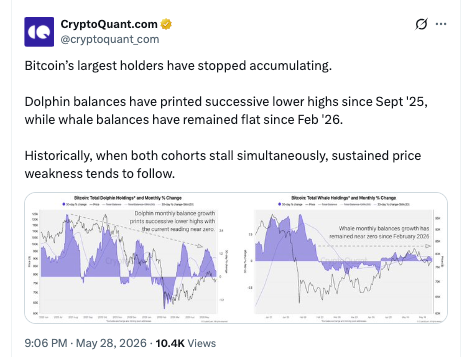
The recent on-chain data, shared via CryptoQuant’s official X (formerly Twitter) account, paints a picture of subdued activity among key investor segments. The report highlights that two significant categories of wallets – "Dolphin" and "Whale" – have exhibited patterns that bear a striking resemblance to conditions observed during previous market downturns, most notably the bear market of 2022. This reticence from large-scale investors, who have historically been instrumental in driving price appreciation, is casting a shadow over the immediate outlook for Bitcoin.
Divergent Trends Among Key Investor Segments
CryptoQuant’s analysis specifically points to the behavior of "Dolphin" wallets, which typically hold between 100 and 1,000 Bitcoin, and "Whale" wallets, generally defined as those holding 1,000 to 10,000 Bitcoin, excluding those belonging to exchanges and mining operations. According to the firm’s findings, Dolphin wallets have registered lower highs in their Bitcoin holdings since September 2025. This suggests a gradual, albeit not aggressive, reduction in their accumulation pace or even a subtle divestment.
More critically, Whale balances have remained largely stagnant since February 2026. This flatlining trend indicates a significant lack of new accumulation sentiment among these substantial holders. In the intricate ecosystem of cryptocurrency markets, the actions of these large entities are often seen as bellwethers for broader market sentiment and future price movements. Their current inaction, therefore, is a cause for considerable attention among market participants and analysts alike.

Echoes of 2022: A Familiar Pattern Emerges
The observed patterns in Dolphin and Whale wallet activity are not unprecedented. CryptoQuant’s report draws a direct parallel to the on-chain data observed during the 2022 bear market. During that period, a similar deceleration in accumulation among large holders preceded a significant price downturn. On-chain metrics, meticulously dissected by professional traders and analysts, often serve as leading indicators, signaling a bearish or bullish bias that can foreshadow major market shifts. The current data suggests that downward forces may be gaining traction.
While the broader market experiences this lull in large-scale accumulation, it’s important to note the exceptions. Firms such as Michael Saylor’s MicroStrategy have continued to demonstrate an aggressive commitment to Bitcoin, making substantial purchases. However, this institutional conviction is not currently being mirrored by widespread retail buying activity. Furthermore, Bitcoin Exchange-Traded Funds (ETFs), which have been a significant source of demand since their inception, have also experienced periods of net outflows, contributing to the overall subdued demand picture. Historically, significant rallies in Bitcoin have been preceded by sustained on-chain demand from a diverse range of investors, a condition that appears to be absent at present.
The Paradox of Long-Term Holders
Adding a layer of complexity to the current market dynamic is the unprecedented surge in Long-Term Holders (LTHs). LTHs are defined as Bitcoin holders who have maintained their positions for at least 155 days. Data indicates that this segment of investors has reached all-time highs, effectively breaking a multi-year downtrend in their holding patterns. This robust holding behavior from LTHs is often a precursor to significant bull markets, as it suggests a strong conviction in Bitcoin’s long-term value proposition and a reluctance to sell even during periods of price volatility.
However, the current scenario presents a paradox. While LTHs are demonstrating remarkable resilience, the lack of concurrent strong demand from other investor segments, particularly large holders, creates an environment where this LTH accumulation might not translate into immediate price appreciation. A prolonged bear market, characterized by low liquidity, can sustain itself for extended periods, and the current situation could be an instance of this phenomenon. Moreover, the longer LTHs are compelled to hold their assets, the greater the potential for eventual capitulation. If a significant number of these long-term holders decide to liquidate their positions during a period of price weakness, it could trigger sharp, short-term price declines.
Navigating the Current Market Landscape
The recent price action of Bitcoin further underscores the prevailing market sentiment. In early May, Bitcoin attempted a recovery above the critical $80,000 resistance level. This surge, however, proved unsustainable, and the cryptocurrency subsequently retreated. Bulls are now finding themselves on the defensive, with the primary objective being to prevent a retest of the $70,000 price floor. This psychological and technical support level is being closely watched by traders and investors as a key indicator of market sentiment.
The broader economic environment also plays a role in investor sentiment towards cryptocurrencies. While other asset classes may be experiencing renewed interest, the crypto sector, as indicated by Bitcoin’s stagnant accumulation trends, appears to be struggling to recapture investor attention. The failures and volatility experienced in the previous year may have instilled a sense of caution among a significant portion of the investing public. A renewed wave of interest and investment in the crypto space is likely to require more time to materialize, potentially contingent on broader economic stability and a clearer path towards sustainable growth for digital assets.
Broader Implications and Future Outlook
The current trend of diminished accumulation among major Bitcoin holders has several significant implications for the cryptocurrency market. Firstly, it suggests that the immediate upside potential for Bitcoin may be capped unless new, substantial demand drivers emerge. The reliance on a few large players for market momentum could make the price susceptible to larger fluctuations if their strategies shift.
Secondly, the extended holding period by LTHs, while a sign of conviction, also creates a latent supply overhang. This "dry powder" held by long-term investors represents a potential selling pressure that could be unleashed under certain market conditions, particularly if confidence erodes. The market’s ability to absorb this potential selling pressure will be a crucial factor in determining future price trends.

Furthermore, the lack of broad-based retail participation, coupled with intermittent outflows from ETFs, indicates that Bitcoin is not currently capturing the imagination of the average investor. This could be attributed to various factors, including ongoing regulatory uncertainties in some jurisdictions, the lingering effects of past market downturns, and the increasing competition for investor capital from traditional and emerging asset classes.
Looking ahead, the trajectory of Bitcoin will likely depend on a confluence of factors. A sustained recovery in the broader macroeconomic environment could provide a tailwind for risk assets, including Bitcoin. Additionally, any positive regulatory developments or significant technological advancements within the blockchain space could reignite investor interest. The behavior of institutional investors, particularly those who have been actively accumulating, will also be closely monitored. Any shift in their accumulation strategies could signal a change in market sentiment.
The current on-chain data from CryptoQuant serves as a vital reminder that market cycles are dynamic and that investor behavior can evolve rapidly. While the long-term prospects of Bitcoin remain a subject of much debate, the present data points towards a period of cautious accumulation and subdued demand, reminiscent of past bear market phases. The ability of bulls to defend key support levels and the eventual re-engagement of major holders will be critical in determining whether Bitcoin can navigate this period of uncertainty and pave the way for its next significant upward trend. The coming months will likely provide further clarity on whether the current pause in accumulation is a temporary recalibration or a precursor to a more prolonged period of price consolidation.