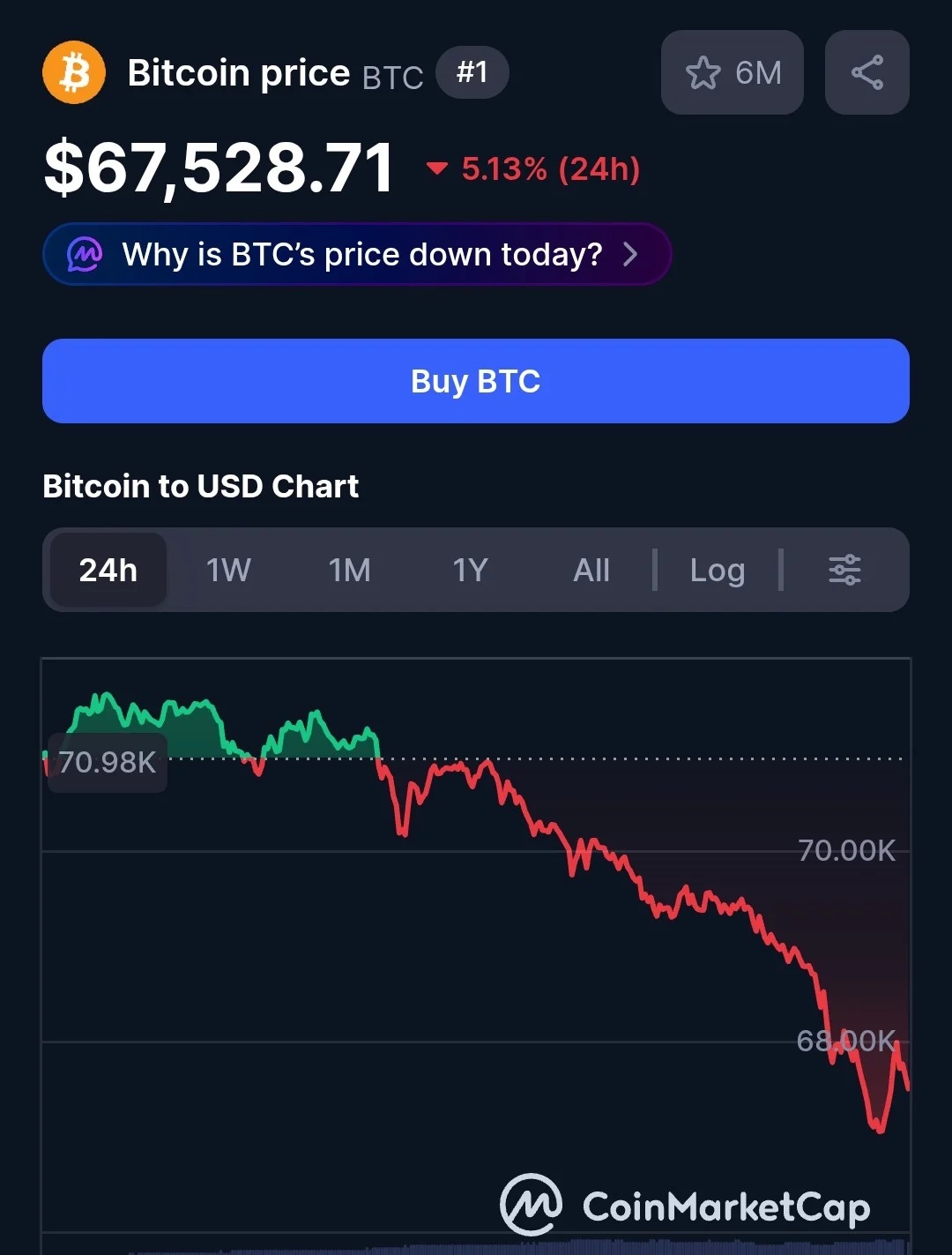
The cryptocurrency market experienced a significant downturn on Tuesday, as Bitcoin, the world’s largest digital asset by market capitalization, plummeted to $66,997. This precipitous drop represents a loss of over $6,750 in a mere 32 hours, sending ripples of panic across global crypto exchanges and triggering a wave of liquidations that wiped out hundreds of millions from leveraged trading positions. The sudden market correction has left many traders reeling, questioning the immediate future trajectory of Bitcoin and the broader digital asset ecosystem, with analysts suggesting that the volatility may not yet be fully abated.
The Precipitous Plunge: A Detailed Account of Bitcoin’s Correction
The recent price action for Bitcoin has been nothing short of brutal for those positioned on the long side of the market. After hovering comfortably above the $73,000 mark as recently as Monday morning, Bitcoin began a rapid descent that culminated in its breach of the critical $67,000 psychological and technical support level. The speed and severity of this decline underscore the inherent volatility of the cryptocurrency market, even for its most established asset. The move below $67,000 on Tuesday was particularly jarring, rattling even seasoned holders who have weathered numerous market cycles. This sharp correction follows a period of significant upward momentum earlier in the year, fueled in part by the approval of spot Bitcoin Exchange-Traded Funds (ETFs) in the United States, which brought new institutional capital into the market. However, the current downturn suggests a shift in immediate sentiment, moving from cautious optimism to widespread apprehension.
The most immediate and tangible impact of this price collapse was observed in the derivatives market. In a span of just two hours alone, over $700 million was liquidated from the broader cryptocurrency market. These liquidations primarily target leveraged positions, where traders borrow capital to amplify their potential returns. When the market moves unfavorably against these positions, exchanges automatically close them out to prevent further losses, a process known as liquidation. The staggering $700 million figure signals not just price weakness but a massive, forced selling event, indicative of over-leveraged traders being flushed out. This cascading effect of liquidations often exacerbates downward price pressure as large sell orders hit the market simultaneously. The magnitude of this event serves as a stark reminder of the risks associated with high leverage in volatile markets.
Underlying Market Dynamics and Macroeconomic Headwinds
While the immediate trigger for such a sharp correction can often be complex and multi-faceted, several underlying market dynamics and macroeconomic factors are believed to be contributing to the current sell-off. One significant factor is the recent cooling of inflows into the U.S. spot Bitcoin ETFs. After an initial surge of institutional interest that propelled Bitcoin to new all-time highs earlier in the year, the pace of these inflows has noticeably slowed, with some days even recording net outflows. This reduction in demand from a previously powerful catalyst may be weighing on investor sentiment.
Furthermore, broader macroeconomic uncertainties are playing a role. The global economic landscape remains characterized by persistent inflation concerns and a cautious stance from central banks, particularly the U.S. Federal Reserve. Expectations surrounding future interest rate cuts have become more ambiguous, with recent hawkish commentary from Fed officials suggesting that high rates might persist for longer than initially anticipated. Higher interest rates typically make riskier assets like cryptocurrencies less attractive compared to traditional, lower-yield investments, as the opportunity cost of holding volatile assets increases. Upcoming economic data releases, such as inflation reports and employment figures, are closely watched by market participants for any clues regarding the Fed’s monetary policy, and any signs of continued economic strength or persistent inflation can dampen enthusiasm for speculative assets.
Beyond these external factors, a natural element of profit-taking might also be at play. After Bitcoin’s impressive run to nearly $74,000 earlier in the year, many investors who bought at lower prices are likely taking profits, especially as the asset approaches significant resistance levels. This profit-taking, particularly from larger holders or "whales," can introduce substantial sell pressure. The confluence of these factors – reduced ETF momentum, macroeconomic jitters, and strategic profit-taking – appears to have created a fertile ground for the current market correction.
The Strategy Sale: A Controversial Precedent
Adding another layer of complexity and controversy to the current market environment is the recent disclosure from Strategy, the company formerly known as MicroStrategy, led by its vocal Bitcoin advocate Michael Saylor. For years, MicroStrategy has been synonymous with an aggressive Bitcoin accumulation strategy, positioning itself as the largest corporate holder of the cryptocurrency. Michael Saylor famously adopted a "never sell" mantra, portraying Bitcoin as a long-term treasury reserve asset for the company.
However, a recent regulatory filing revealed that Strategy sold 32 BTC during the final week of May. While this amount is relatively small compared to the company’s vast holdings (over 214,000 BTC), the timing and nature of the announcement have ignited a fierce debate across the crypto community. The sale itself, though minor, represents a significant deviation from Strategy’s long-standing public stance and Saylor’s personal philosophy. It effectively breaks the "never sell" mantra that had become a cornerstone of their corporate identity and a source of confidence for many Bitcoin maximalists.
The controversy was amplified by its direct intersection with Polymarket, a decentralized prediction platform that has emerged as a key indicator of crypto sentiment and a hub for high-stakes betting on real-world events.
Polymarket’s Predicament: Transparency, Trust, and the $80 Million Bet
Polymarket had hosted a highly popular market asking a very specific question: "Will Strategy sell BTC before May 31?" This market garnered immense attention, with over $80 million wagered on the outcome, reflecting the significant interest in Strategy’s actions and the potential impact on the broader Bitcoin market. The market’s resolution hinges on corporate disclosures, making the timing of such announcements critically important.
The core of the dispute lies in the timing of Strategy’s disclosure. The company announced its sale of 32 BTC after the Polymarket betting window for the "Will Strategy sell BTC before May 31" market officially closed. This delay immediately sparked accusations of fraud and calls for legal action among disgruntled bettors who had wagered that Strategy would not sell. The argument is that Strategy’s late disclosure effectively rendered the market’s outcome retroactively predetermined, undermining the fairness and integrity of the prediction platform.

The situation has exploded across crypto Twitter and Polymarket’s own community forums, quickly becoming one of the most talked-about resolution controversies the platform has ever encountered. It has raised serious questions about the mechanisms of information disclosure in traditional finance intersecting with the often-rapid, decentralized nature of crypto prediction markets. This incident spotlights several critical pressure points now shaping the industry: the growing influence of prediction markets in driving narratives and influencing sentiment, the paramount importance of corporate disclosure timing and its impact on market integrity, rising scrutiny over how market outcomes are adjudicated on decentralized platforms, and the extraordinary level of interest that now surrounds every single move made by prominent corporate Bitcoin holders. The resolution of this specific dispute could set a precedent for future interactions between traditional corporate actions and decentralized betting platforms, potentially leading to calls for stricter rules regarding disclosure windows or more robust arbitration mechanisms within the DeFi space.
Technical Levels Under Scrutiny: $65,000 and the Specter of $60,000
As Bitcoin now trades below $67,000, market participants are intently watching key technical levels that could dictate its short-to-medium term trajectory. The immediate focus is on the $65,000 mark. This level has significant psychological and technical importance, having served as a critical support zone during previous periods of volatility. A clean defense of this zone could provide a much-needed psychological boost for bulls and potentially stabilize sentiment, offering a foothold for a rebound.
The decentralized prediction platform Polymarket further amplifies the significance of the $65,000 level. Its crowd intelligence, which has a track record of accurately anticipating crypto turning points, now gives a 75% probability that Bitcoin will fall to $65,000 in the near term. This isn’t a fringe bet; it represents the collective view of a market priced in real money, signaling strong bearish sentiment for the immediate future.
Should Bitcoin fail to hold the $65,000 support, the conversation would quickly shift to the $60,000 level. This price point has historically acted as a crucial psychological floor and a strong technical reference throughout this market cycle. While analysts are not yet calling for an imminent crash to $60,000, the fact that it is re-entering the conversation tells you how swiftly the mood has soured. A break below $65,000 could open the door to a more pronounced retest of $60,000, potentially triggering another wave of liquidations and further eroding confidence. The ongoing sell-off in Strategy-related assets, fueled by the Polymarket controversy and broader market pressure, is adding fuel to this fire. When one of Bitcoin’s loudest and most consistent corporate advocates becomes a source of uncertainty rather than unwavering confidence, the broader market undoubtedly feels the impact.
Divergent Investor Behavior: HODLers vs. Speculators
In times of significant market corrections, a clear divergence in behavior typically emerges between different classes of Bitcoin holders. For many long-term Bitcoin holders, colloquially known as "HODLers" (a term derived from a misspelled "hold" that has become a mantra in crypto culture), the move below $67,000, while painful, is not entirely surprising. Volatility of this magnitude is a familiar characteristic of the cryptocurrency market, having been a feature of every previous cycle. For this cohort, the instinct to hold, or "HODL," remains incredibly strong, rooted in a belief in Bitcoin’s long-term value proposition and its role as digital gold.
On-chain data, which provides transparent insights into transaction activity on the Bitcoin blockchain, consistently supports this observation. Analysis of metrics like HODL waves and Dormancy flow often indicates that long-term holders are generally not the primary sellers during these sharp downturns. Instead, it is typically the leveraged traders, short-term speculators, and over-extended positions that are getting flushed out. These market participants, often driven by quick gains and employing high leverage, are highly susceptible to sudden price swings. Liquidation events like Tuesday’s are, in essence, designed to "clear out weak hands" and reduce excessive leverage in the system, thereby resetting the market for its next major move, regardless of the direction. This process, while painful for those caught on the wrong side, is often viewed by long-term investors as a necessary cleanse that strengthens the market’s foundation.
Broader Market Contagion and Altcoin Impact
Bitcoin’s dominant position in the cryptocurrency market means that its price movements often dictate the broader trend for altcoins. When Bitcoin experiences a significant correction, it frequently triggers a ripple effect, leading to even more pronounced declines across the altcoin spectrum. This is due to several factors: Bitcoin’s role as the primary trading pair for many altcoins, its influence on overall market sentiment, and the tendency for investors to de-risk by moving out of more speculative assets during times of uncertainty.
During Tuesday’s sell-off, many major altcoins saw even larger percentage losses than Bitcoin, with some shedding double-digit percentages in a matter of hours. This phenomenon, often referred to as "altcoin bleed," is a common characteristic of bear markets or significant corrections. The fear and uncertainty generated by Bitcoin’s plunge can lead to a broad-based flight to safety, where capital either flows into stablecoins or out of the crypto market entirely. This contagion effect underscores the interconnectedness of the digital asset ecosystem and highlights Bitcoin’s role as the bellwether for the entire asset class. The current market environment suggests that if Bitcoin continues to struggle, altcoins are likely to face sustained pressure.
The Road Ahead: Navigating Volatility and Uncertainty
The path forward for Bitcoin and the broader cryptocurrency market hinges critically on several key factors. The most immediate concern is whether Bitcoin can establish and hold strong support within the $65,000-$66,000 range. As indicated by Polymarket odds and technical analysis, a successful defense of this zone could stabilize sentiment, allowing bulls to regroup and potentially initiate a recovery. Conversely, a definitive break below this critical range would open the door to a more serious discussion about the $60,000 level, bringing renewed bearish pressure and potentially triggering further cascading sell-offs.
Market participants will need to closely monitor several indicators in the coming days and weeks. These include: the ongoing liquidation numbers, which signal the extent of leveraged positions being unwound; the evolving odds on prediction markets like Polymarket, which reflect collective sentiment; and any further disclosures or statements from major corporate holders like Strategy, whose actions can significantly sway market perception. Furthermore, the performance of spot Bitcoin ETFs, particularly their daily net flows, will remain a crucial barometer of institutional interest and demand. Macroeconomic data, including inflation reports and central bank policy announcements, will also continue to cast a long shadow over the risk-on appetite for digital assets. In a market moving with such velocity and susceptibility to both technical and fundamental catalysts, the next 48 hours, and indeed the coming weeks, are poised to be definitive in shaping the near-term trajectory of Bitcoin.
Disclosure: This article is for informational purposes only and does not constitute trading or investment advice. Always conduct thorough research before making any investment decisions in cryptocurrency or any other financial service.