


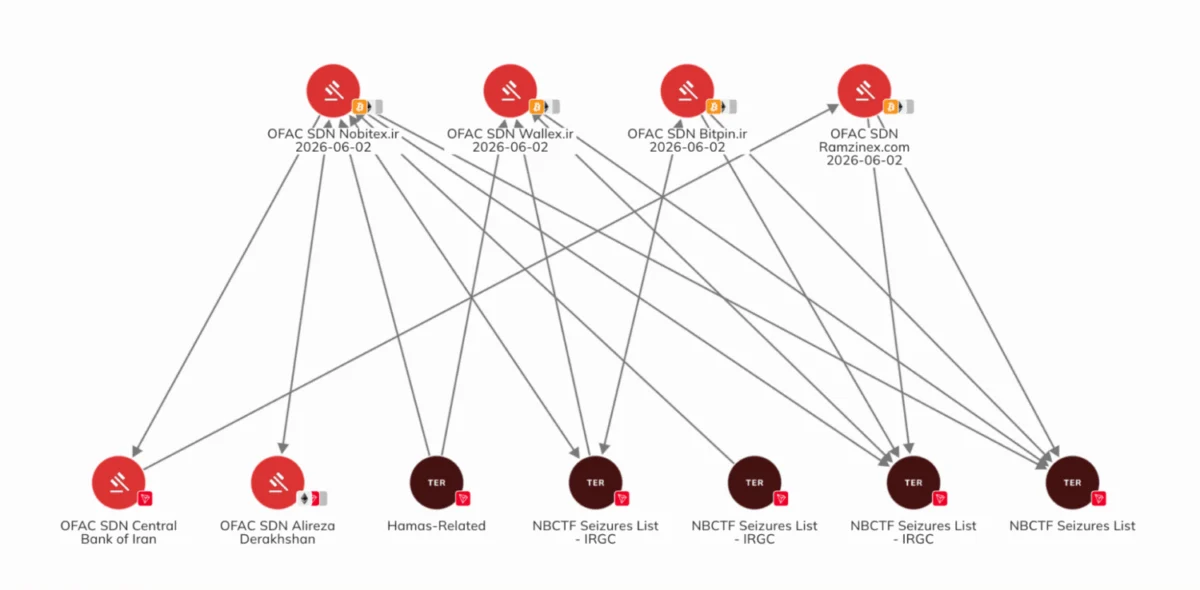
The United States Department of the Treasury’s Office of Foreign Assets Control (OFAC) launched a decisive strike against Iran’s digital economy on June 2, 2026, designating four of the nation’s largest cryptocurrency exchanges for their roles in facilitating sanctions evasion, financing regional terrorism, and stabilizing the Iranian regime’s fragile financial infrastructure. This enforcement action, which targets Nobitex, Wallex, Bitpin, and Ramzinex, represents the most significant escalation to date in the U.S. government’s efforts to dismantle the "digital dollar pipeline" that has allowed Tehran to bypass traditional banking blockades for years.
The move comes at a time of heightened geopolitical tension and internal economic volatility within Iran. By cutting off these high-volume Virtual Asset Service Providers (VASPs) from the global financial system, the Treasury Department aims to sever the primary on-ramps and off-ramps used by the Islamic Revolutionary Guard Corps (IRGC) and other state-linked entities to convert local currency into globally tradable digital assets.
The Magnitude of Iran’s Crypto Economy
The scale of the Iranian cryptocurrency ecosystem has grown at a staggering rate, despite—and in many ways because of—extreme international pressure. According to data provided by blockchain analytics firm Chainalysis, the Iranian crypto market reached a total value of over $7.78 billion in 2025. This growth was fueled by a combination of domestic currency devaluation, which led Iranian citizens to seek refuge in stablecoins, and state-sponsored initiatives to use digital assets for international trade.
The IRGC, a branch of the Iranian Armed Forces designated by the U.S. as a foreign terrorist organization, has become the dominant player in this space. Estimates indicate that addresses associated with the IRGC and its various proxies accounted for more than 50 percent of the total value received by the Iranian crypto ecosystem in the final quarter of 2025 alone. The exchanges targeted in the June 2026 designation were the primary engines of this activity. Nobitex, the largest of the four, processed over 50 percent of all Iranian digital asset inflows last year. Its competitors, Wallex and Bitpin, accounted for 12 percent and 10 percent of the market, respectively, while Ramzinex, a platform established in 2018, has facilitated more than $2.45 billion in lifetime transactions.
A Strategic Pivot to Digital Assets
Since the re-imposition of U.S. sanctions and the subsequent disconnection of Iranian financial institutions from the SWIFT international banking network, the Iranian regime has been forced to innovate to maintain its global financial footprint. The Treasury Department’s investigation revealed that the regime and its proxy networks have increasingly relied on digital assets to move value across borders, settle import bills, and fund clandestine operations.
The strategy employed by Tehran involves a sophisticated "pipeline" where local rials are converted into stablecoins, such as USDT (Tether) or USDC, which are then transmitted to international entities. These transactions are often masked through layers of obfuscation, but the transparent nature of the blockchain has allowed U.S. authorities to trace the flow of funds back to the designated exchanges. OFAC officials noted that these actions have already led to the freezing of nearly half a billion dollars in cryptocurrency linked directly to the Iranian regime, but the June 2026 designations are intended to prevent the flow of funds at the source.
Nobitex and the Digital Dollar Pipeline
At the heart of the Treasury’s enforcement action is Nobitex. Beyond the exchange itself, OFAC has designated four key individuals who have been instrumental in its operations: Amir Hossein Rad (Chairman and former CEO), Seyed Ali Khoee (current CEO), and co-founders Seyed Mohammad Ali Aghamir and Seyed Mohammad Aghamir.
Nobitex served as more than just a retail trading platform; it functioned as a vital component of the Central Bank of Iran’s (CBI) efforts to prop up the national currency. When the rial faced significant downward pressure, the CBI reportedly used Nobitex to process hundreds of millions of dollars in stablecoin transfers to stabilize its foreign exchange reserves. Furthermore, the exchange was found to have processed transactions for IRGC-affiliated ransomware actors, who use the platform to launder extortion payments.
Investigations into Nobitex’s ledger revealed extensive business dealings with other previously sanctioned entities. This includes the Central Bank of Iran and Hamas, the latter of which has increasingly turned to cryptocurrency to fund its operations in the Middle East. During periods of domestic unrest and internet blackouts in Iran, Nobitex reportedly facilitated the movement of wealth for regime insiders, ensuring their assets remained liquid and accessible outside of the country even as the general population was cut off from the global web.
The Broader Network: Wallex, Bitpin, and Ramzinex
While Nobitex remains the primary target due to its sheer volume, the designations of Wallex, Bitpin, and Ramzinex are equally strategic. These platforms provided the redundancy needed for the Iranian state to maintain its financial operations.

- Wallex: With a 12 percent market share, Wallex provided a sophisticated interface for institutional-level trading, often used by state-linked corporations to settle international trade contracts in digital assets.
- Bitpin: Handling 10 percent of inflows, Bitpin focused on a younger demographic and tech-savvy users, but was also utilized by proxy networks to distribute funds for regional influence operations.
- Ramzinex: As one of the oldest exchanges in the country, Ramzinex provided deep liquidity pools that were essential for converting large sums of rials into Bitcoin and Ethereum before they were swapped for stablecoins.
By targeting all four major exchanges simultaneously, the U.S. Treasury is effectively attempting to "darken" the Iranian crypto landscape, making it significantly more difficult and expensive for the regime to move money.
Compliance and the Threat of Secondary Sanctions
The implications of these designations extend far beyond the borders of Iran. For global cryptocurrency exchanges, stablecoin issuers, and traditional financial institutions, the OFAC action creates a high-stakes compliance environment. The sanctions against Nobitex and its peers include "secondary sanctions" provisions.
Under these provisions, any foreign financial institution or VASP that knowingly facilitates significant transactions for the designated Iranian exchanges risks being cut off from the U.S. financial system. This is a potent deterrent, as most global exchanges rely on U.S. dollar liquidity and access to American banking partners to operate.
Blockchain forensics firms, including Chainalysis, have already updated their monitoring tools to flag any addresses associated with the four exchanges. Compliance officers at major global exchanges are now required to conduct retroactive audits of their transaction histories to identify and report any exposure to these Iranian entities. Failure to do so could result in massive fines or the loss of their operating licenses in Western jurisdictions.
Chronology of U.S. Pressure on Iran’s Financial Sector
The June 2, 2026, enforcement action is the latest chapter in a decades-long campaign of financial attrition.
- 2018: The U.S. withdraws from the JCPOA (Iran Nuclear Deal) and begins re-imposing sanctions on the Iranian energy and banking sectors.
- 2019: The IRGC is designated as a Foreign Terrorist Organization, leading to increased scrutiny of its financial networks.
- 2021-2023: Iran experiences a surge in crypto adoption as the rial loses over 50 percent of its value. The regime begins officially using crypto for imports.
- 2024: OFAC begins targeting individual Iranian crypto miners and small-scale over-the-counter (OTC) desks.
- April 2026: The Central Bank of Iran is further designated for its role in using digital assets to fund regional proxies.
- June 2, 2026: OFAC issues its largest-ever crypto-related designation against the "Big Four" Iranian exchanges.
Official Responses and Global Impact
While the Iranian government has yet to issue a formal diplomatic response, state-aligned media in Tehran have characterized the sanctions as "economic terrorism" and an attempt by the United States to stifle Iran’s technological progress. Conversely, U.S. Treasury officials have emphasized that these measures are designed to protect the integrity of the global financial system.
"Iran has systematically exploited the digital asset ecosystem to fund its malign activities and evade the consequences of its actions," a senior Treasury official stated following the announcement. "By designating these exchanges, we are making it clear that the virtual currency industry is not a safe haven for those who seek to undermine international security."
Financial analysts suggest that while these sanctions will undoubtedly disrupt the flow of funds, they may also drive Iranian crypto activity further underground into peer-to-peer (P2P) networks and decentralized finance (DeFi) protocols, which are harder to regulate. However, the loss of high-volume centralized on-ramps like Nobitex will likely create significant friction for the regime’s large-scale financial maneuvers.
Analysis of Future Implications
The 2026 designations mark a turning point in the regulation of the global crypto economy. It signals that the U.S. government views major domestic exchanges in adversarial nations as extensions of the state itself. This "whole-of-platform" targeting strategy is likely to be replicated in future actions against other jurisdictions suspected of using digital assets to circumvent international law.
For the Iranian people, the impact is two-fold. While the sanctions target the regime’s ability to fund its military and proxy groups, they also complicate the efforts of ordinary citizens to protect their savings from inflation. As the "digital dollar pipeline" narrows, the economic divide between the regime’s elite and the general population may widen, potentially leading to further domestic instability.
In the long term, the success of this enforcement action will depend on the cooperation of international partners and the continued advancement of blockchain tracking technology. As the U.S. Treasury tightens its grip on the digital financial borders of Iran, the world will be watching to see if this "crypto-blockade" can achieve what traditional sanctions have struggled to do: force a fundamental change in the regime’s behavior.














