



Bitcoin (BTC) has entered a period of short-term consolidation, trading relatively flat on Wednesday following a significant downturn earlier in the week. The world’s leading cryptocurrency experienced a sharp decline of approximately 13% over the past seven days, creating a volatile stretch that has now given way to a period of range-bound trading. This period of stabilization comes as on-chain data reveals a divergence in behavior between large-scale stakeholders, commonly referred to as "whales," and smaller retail investors.
Whale Distribution Fuels Recent Downturn
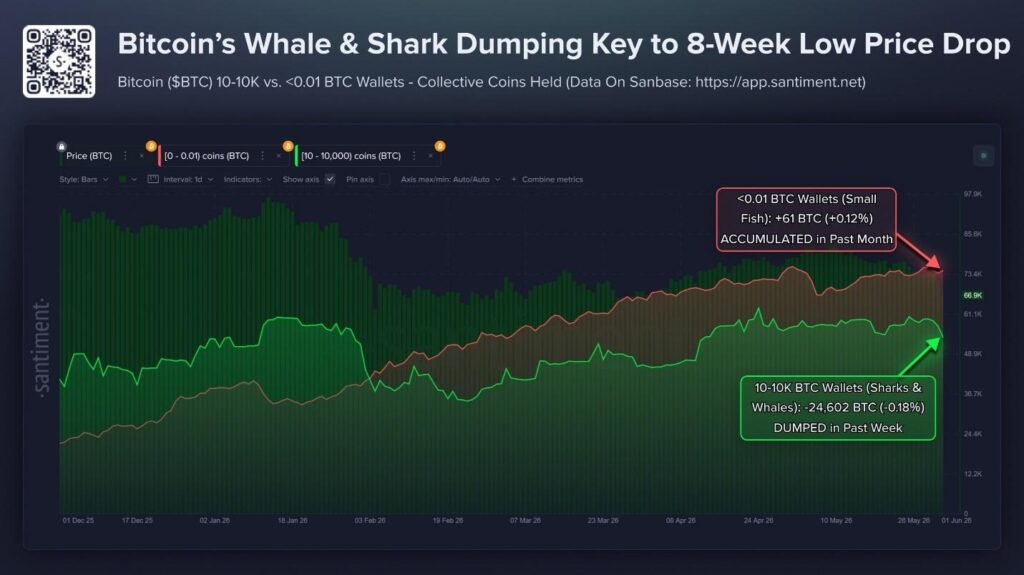
Analysis from the blockchain analytics platform Santiment Intelligence indicates that the recent sharp drop in Bitcoin’s price was primarily driven by coordinated selling activity from significant holders. Over the past week, wallets holding between 10 and 10,000 BTC reportedly reduced their holdings by approximately 24,602 BTC. This represents a substantial decrease of about 18% in the holdings of these large-scale participants, suggesting a deliberate move to offload significant portions of their Bitcoin reserves.
This distribution by whales is a critical factor in understanding the recent price action. Historically, large sell-offs by these entities can exert considerable downward pressure on the market, especially if not met with equivalent buying interest. The sheer volume of BTC moved by these wallets points to a significant shift in sentiment or strategy among some of the market’s most influential players.

Retail Investors Exhibit Cautious Accumulation
In contrast to the selling pressure from whales, smaller retail addresses holding less than 0.01 BTC have shown a slight increase in their holdings. While the individual impact of these smaller transactions is minimal, the collective trend suggests an early-stage accumulation phase by retail investors. These smaller players appear to be taking advantage of the lower prices to gradually increase their positions. However, this accumulation has not yet been robust enough to counteract the substantial selling volume from institutional and whale investors.
This divergence between the behavior of large and small holders is a notable observation for market analysts. Such patterns often signal transitional phases within market cycles. A common interpretation is that confidence among major players is waning, leading them to reduce their exposure, while retail traders, often more risk-tolerant at lower price points or driven by different investment horizons, begin to cautiously re-enter the market. This dynamic can set the stage for future price movements, depending on whether the accumulation by retail investors can eventually absorb the distributed supply.
Market Structure and Analyst Outlooks
The current market environment has attracted significant attention from cryptocurrency analysts, who are observing various technical indicators and patterns to forecast Bitcoin’s next move.
Key Support and Resistance Levels Identified
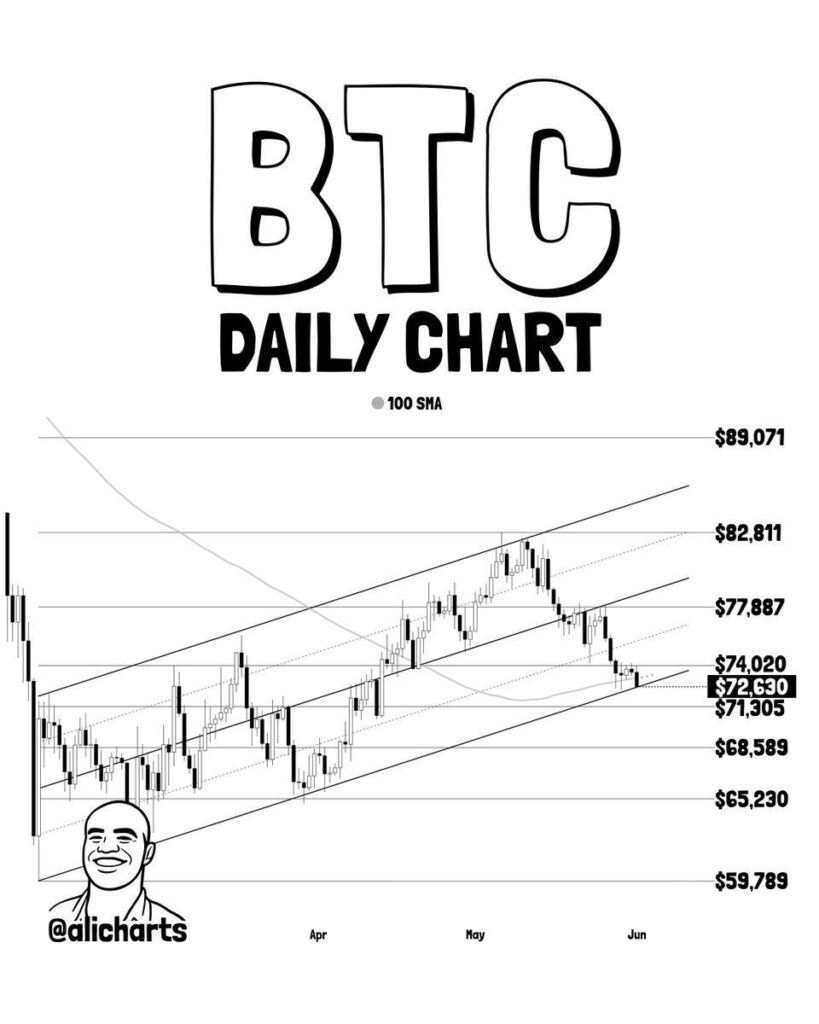
Popular analyst Ali Martinez has pinpointed a major support zone for Bitcoin between $71,300 and $73,000. According to his analysis, a strong rebound from this region could potentially propel Bitcoin back towards the $78,000 mark. This suggests that if buying pressure emerges at these levels, it could initiate a bullish reversal.
However, Martinez also cautioned that a decisive break below this critical support zone could expose Bitcoin to further downside, with potential targets near $65,000. Such a scenario would raise concerns about the possibility of deeper capitulation if the selling pressure intensifies. The $65,000 level has been a significant psychological and technical marker in recent price action, and a sustained move below it could signal a more prolonged bearish phase.
The Expanding Triangle Pattern
Veteran trader Peter Brandt has observed that the market appears to be forming an expanding triangle pattern. This technical formation is characterized by widening price ranges and is often associated with increased volatility, frequently preceding sharp directional moves in the market. Brandt noted that such patterns have historically been observed in Bitcoin’s price history and typically resolve with a decisive breakout.
He further elaborated that a sustained move above the $75,000 level would serve to invalidate his current bearish outlook and would signal a shift in momentum back in favor of the bulls. This suggests that $75,000 is a key psychological and technical threshold that, if breached decisively, could trigger renewed buying interest and upward price momentum.
Potential for Deeper Corrections
Adding another perspective, analyst TedPillows has offered a more cautious interpretation of the recent price action. He argues that the recent downside moves may have already cleared short-term liquidity pools, which could provide some temporary relief. However, he also issued a warning that Bitcoin could still be vulnerable to deeper corrections.

Pillows pointed to a larger liquidity cluster located between $55,000 and $65,000 as a potential long-term price magnet. This suggests that even if Bitcoin experiences a temporary rebound, there remains a significant amount of buy-side liquidity concentrated in this lower range, which could attract price action if broader market sentiment turns decisively negative. While acknowledging the possibility of short-term rebounds, he maintained that a definitive market bottom has not yet been established.
Broader Market Context and Implications
The current price action of Bitcoin unfolds against a backdrop of broader macroeconomic factors and evolving institutional interest in digital assets. The sharp decline earlier in the week, followed by consolidation, reflects the inherent volatility of the cryptocurrency market, which is sensitive to a wide array of influences, from regulatory news and technological developments to shifts in investor sentiment and global economic conditions.
The distribution by whales, while concerning for short-term price prospects, can also be interpreted in various ways. It could signal profit-taking after a period of significant gains, a reallocation of capital into other assets, or a strategic response to perceived market risks. For retail investors, the cautious accumulation suggests a belief in Bitcoin’s long-term potential, even amidst short-term volatility.
The interplay between whale distribution and retail accumulation creates a complex market dynamic. If retail demand continues to grow and absorb the supply being offloaded by larger holders, it could lay the groundwork for a more sustainable upward trend. Conversely, if selling pressure from whales persists or intensifies, and retail accumulation falters, Bitcoin could face further downward pressure.
The identification of key support and resistance levels by analysts like Ali Martinez, coupled with chart patterns like the expanding triangle observed by Peter Brandt, provides valuable insights for traders and investors. These technical indicators, when considered alongside on-chain data, offer a more comprehensive view of the market’s potential trajectory.
Bitcoin’s Price at Press Time
As of the latest reporting, Bitcoin was trading at approximately $65,922, reflecting a 1.90% decrease in the past 24 hours. This figure underscores the current state of consolidation and the slight downward pressure that continues to influence the market. The coming days and weeks will be crucial in determining whether Bitcoin can break out of its current range and establish a clear direction, influenced by the ongoing actions of large stakeholders and the broader sentiment of the cryptocurrency market.
The presence of significant liquidity zones at both higher and lower price points indicates that the market is currently in a state of flux, with potential for sharp movements in either direction. Investors and traders will be closely monitoring key price levels, on-chain metrics, and macroeconomic news for further clues about Bitcoin’s short-to-medium term outlook. The ongoing debate about whether this consolidation is a prelude to further gains or a pause before a deeper correction remains a central theme in market analysis.














