


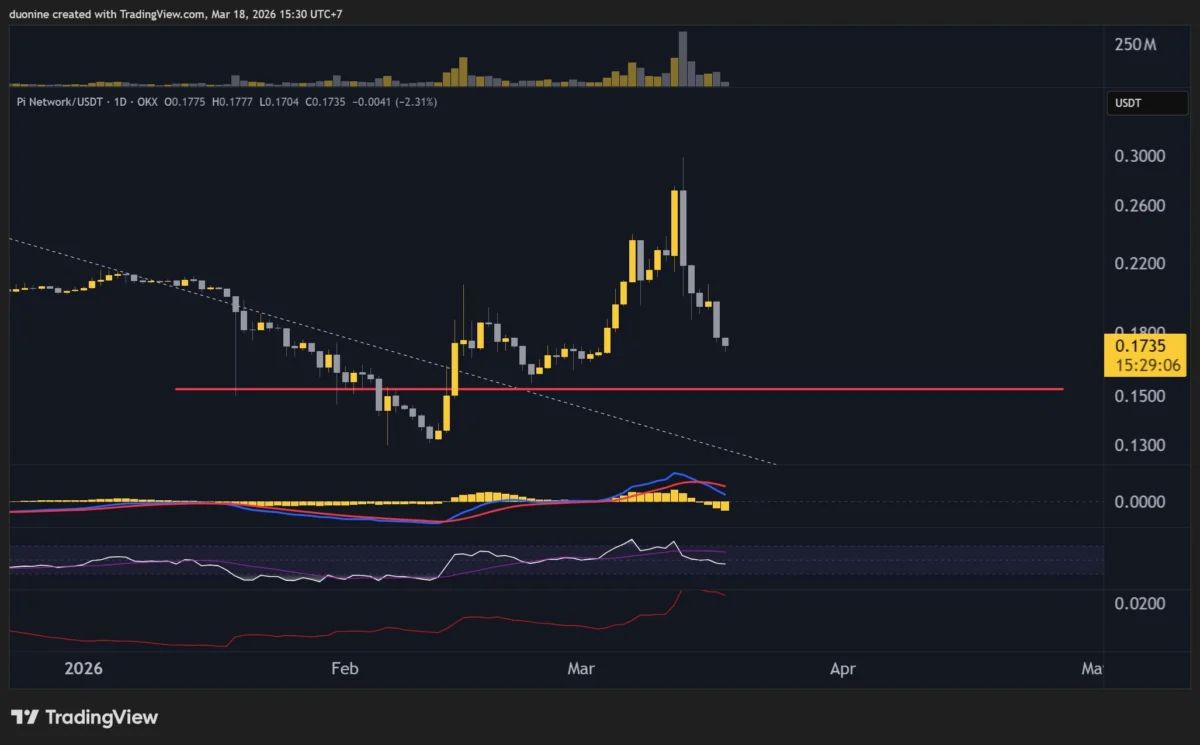
The cryptocurrency market has witnessed a significant shift in sentiment surrounding the PI Network (PI), with sellers aggressively re-emerging and threatening to negate recent price gains. After a period of bullish momentum that saw PI briefly surge above the $0.28 resistance level, the digital asset has experienced a sharp downturn, falling by over 40% from its recent peak around $0.30. This reversal has triggered concerns among investors and analysts about the sustainability of PI’s upward trajectory.
PI Network Turns Bearish as Sellers Dominate
The recent bullish phase for PI Network was characterized by increasing buying pressure, which managed to push the price above a key resistance point at $0.28. However, this breakout proved to be short-lived, as the market failed to sustain the momentum. The inability to hold above this crucial level quickly turned into what analysts term a "bull trap," a scenario where an asset experiences a brief price surge, luring in buyers, only to reverse sharply downwards, trapping those who entered at higher prices. This development signaled underlying weakness in the market and emboldened sellers, who then exerted significant pressure, driving the price below the $0.20 mark.
The aggressive selling has pushed PI into a bearish trend, marked by a series of lower highs and lower lows. This pattern is a classic indicator of a market in decline, suggesting that sellers are in control and buyers are hesitant to enter the market at current levels. The immediate concern for bulls is the key support level at $0.15. This level is critical for the future price action of PI. A failure to defend this support could lead to a further unraveling of recent gains and potentially open the door for the cryptocurrency to test even lower price points, possibly establishing new lows not seen in recent trading history.
The significance of the $0.15 support level cannot be overstated. It represents a potential floor where buying interest might emerge to halt the downtrend. However, the current market dynamics suggest that this level is likely to be tested in the near future. Investors and traders will be closely observing this area to gauge the strength of any potential buying response. A strong bounce from $0.15 could signal a temporary reprieve for PI, while a decisive break below it would likely trigger further selling pressure and reinforce the bearish outlook.
Sell Volume Spiked, Signaling a Trend Reversal
A critical indicator of the shifting market sentiment was the notable spike in sell volume that occurred during PI’s recent rally. This surge in selling activity, particularly as the price approached its recent highs, is often a precursor to a trend reversal. When a significant amount of an asset is being sold off as the price rises, it suggests that there are more participants willing to exit their positions than to enter new ones, even at potentially attractive prices.
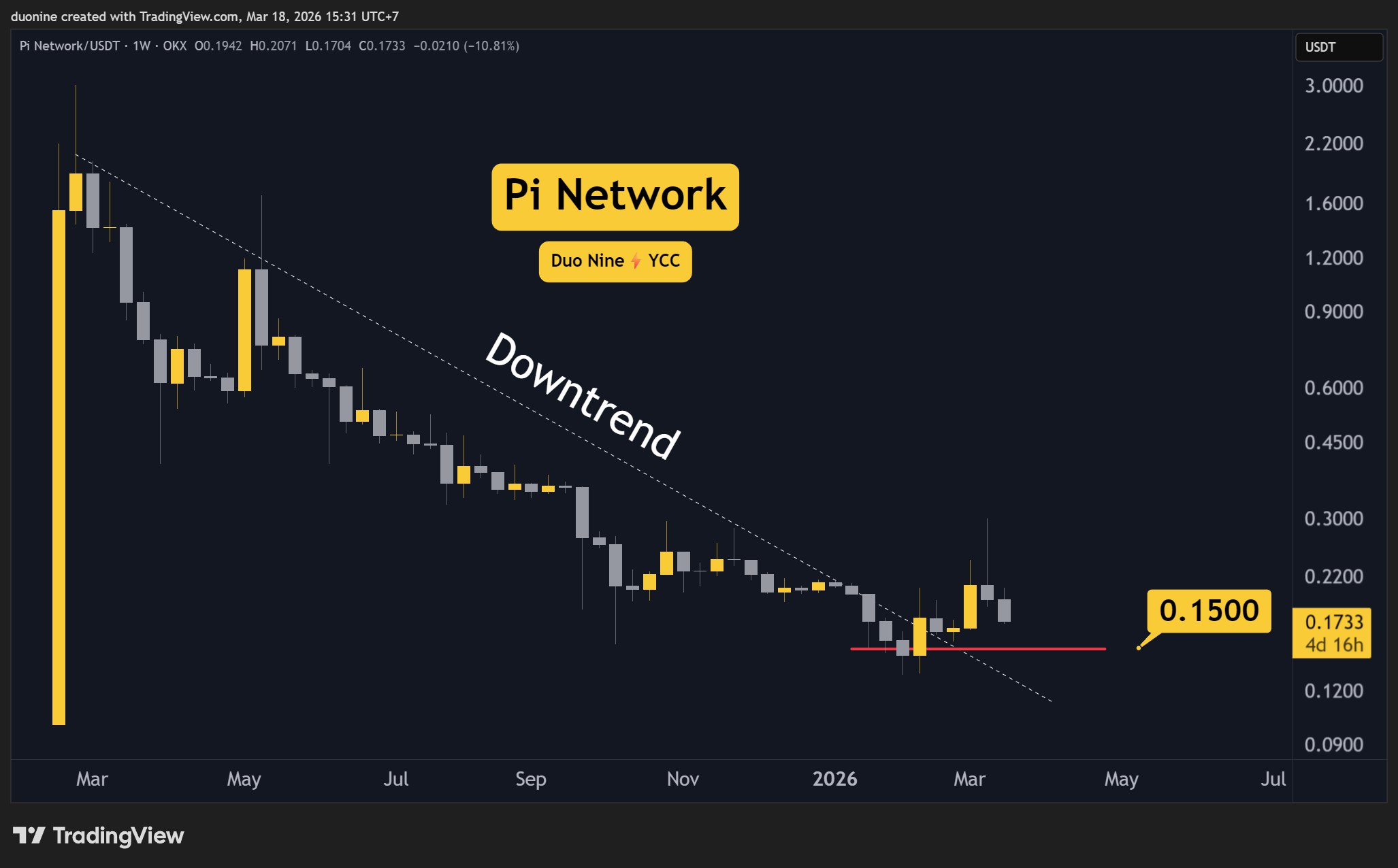
Following this spike in sell volume, the price chart of PI Network has clearly depicted a bearish pattern. The consistent formation of lower highs and lower lows signifies a progressive weakening of buying power and a strengthening of selling conviction. This technical pattern is a strong signal for traders to re-evaluate their long positions and consider the possibility of a sustained downtrend.
The next crucial juncture for PI is the $0.15 support level. Analysts are keenly watching this price point to see if it can absorb the selling pressure. If PI can hold above $0.15, it would suggest that the bearish momentum is losing steam and that a potential consolidation or even a mild recovery might be on the horizon. However, a breach of this support would have significant implications, potentially invalidating the bullish sentiment that existed prior to the current downturn and setting the stage for further price depreciation. The market’s reaction at the $0.15 level will provide vital clues about the immediate future direction of PI Network.
Daily MACD Turns Bearish, Intensifying Downtrend
Further reinforcing the bearish outlook for PI Network, the daily Moving Average Convergence Divergence (MACD) indicator turned negative last Sunday. The MACD is a widely followed technical indicator that measures the momentum of an asset’s price by comparing two moving averages. A negative MACD signal, particularly when the MACD line crosses below the signal line and the histogram turns red, indicates that the short-term momentum has shifted to the downside, aligning with the prevailing bearish trend.
Since the MACD’s bearish crossover, the downtrend in PI’s price has intensified. This synchronized movement between the price action and the MACD indicator suggests that the market is experiencing a strong bearish sentiment, with little immediate indication of a reversal. The continued descent of the MACD histogram, making lower lows, further supports the notion that selling pressure remains dominant.
For investors looking for early signs of a potential bullish reversal, monitoring the daily MACD histogram will be crucial. A cessation of lower lows in the histogram, followed by a move towards positive territory, would be an early indication that selling pressure is exhausting and that buyers might be starting to regain control. This would suggest that the bears are losing their grip, creating an opportunity for a potential price recovery. However, until such signals emerge, the market is likely to remain under pressure, with the $0.15 support level remaining the key area of focus.
PI Network: Context and Background
The PI Network, often referred to as "Pi," is a digital currency project that aims to make cryptocurrency mining accessible to everyday users through mobile applications. Launched in 2019, its core proposition has been to allow individuals to "mine" Pi coins using their smartphones without requiring significant technical expertise or substantial energy consumption, unlike traditional cryptocurrencies like Bitcoin. The project has garnered a large user base, primarily driven by its accessibility and the promise of future utility and value for its mined coins.
However, the PI Network has faced scrutiny and skepticism within the broader cryptocurrency community due to its extended development phase and the lack of a fully functional mainnet and public listing on major exchanges for a significant period. The project has operated in a closed ecosystem, with users accumulating Pi coins through in-app mining. The anticipation surrounding its eventual open mainnet launch and potential listing on exchanges has been a major driver of interest and speculative trading activity whenever price-related information or developments have emerged.
The recent price action, with its sharp rise and subsequent fall, is indicative of this speculative environment. The surge above $0.28 likely stemmed from renewed optimism or rumors regarding project developments, such as progress towards an open mainnet or potential exchange listings. Such events often trigger a wave of buying from individuals who have accumulated Pi coins over time and are looking to capitalize on perceived opportunities. The subsequent sharp decline, however, highlights the inherent volatility and speculative nature of assets that are still in their development phase and lack established market liquidity or widespread adoption.
The aggressive selling observed in the past week can be attributed to several factors. Firstly, the failure to sustain the price above $0.28 created a technical breakdown, triggering stop-loss orders and encouraging short-selling. Secondly, the broader cryptocurrency market has experienced periods of volatility, and PI, being a relatively nascent and less liquid asset, can be more susceptible to sharp price swings. The significant drop from the $0.30 peak to below $0.20, representing over a 40% decline, underscores the market’s sensitivity to both internal project developments and external market conditions.
Key Support and Resistance Levels to Watch
Technical analysis plays a crucial role in understanding potential price movements for cryptocurrencies. For PI Network, the identified key levels provide crucial reference points for traders and investors.
-
Key Support Level: $0.15
This level is the most critical immediate support for PI. It represents a price floor where buying interest is expected to emerge. A sustained hold above this level is vital for PI to avoid further significant price erosion and to potentially initiate a recovery. Failure to hold $0.15 could lead to a cascade of selling as market participants seek to exit positions to limit losses, potentially pushing the price into uncharted territory below its recent trading range. -
Key Resistance Levels: $0.20 and $0.28
These levels act as potential ceilings for any upward price movement. The $0.20 level, which PI has recently fallen below, is now a psychological and technical barrier that needs to be overcome for any short-term bullish sentiment to return. The $0.28 level is a more significant resistance, representing the peak of the recent rally. Breaking and holding above $0.28 would be a strong bullish signal, indicating that PI has overcome its immediate selling pressure and is poised for further gains. However, given the current bearish momentum, these resistance levels are likely to remain challenging to breach in the short term.
Broader Market Implications and Investor Sentiment
The sharp decline in PI Network’s price serves as a stark reminder of the risks associated with investing in cryptocurrencies, particularly those that are still in their nascent stages of development. The market’s reaction highlights the speculative appetite that often surrounds such projects, driven by anticipation of future value rather than established utility.
For existing PI holders, the current downturn necessitates a re-evaluation of their investment strategy. Those who entered at higher prices may be facing significant paper losses, and the crucial $0.15 support level will be a deciding factor in whether to cut losses or hold on in the hope of a future recovery. For new investors, the current bearish trend might present a potential entry point if they believe in the long-term vision of the PI Network and if the price shows signs of stabilizing at the $0.15 support.
The broader implications extend to the perception of the PI Network project itself. While the project aims to democratize cryptocurrency mining, its price volatility and reliance on speculative interest can create a challenging narrative. Sustained periods of price decline, especially after periods of hype, can deter potential users and developers, potentially impacting the project’s long-term adoption and ecosystem growth.
The cryptocurrency market is dynamic and influenced by a multitude of factors, including technological advancements, regulatory developments, macroeconomic trends, and investor sentiment. For PI Network, its future price trajectory will undoubtedly be tied to the successful execution of its development roadmap, particularly the launch of its open mainnet and the establishment of real-world utility for its native currency. Until then, price movements are likely to remain sensitive to market sentiment and speculative trading, making the $0.15 support level a critical juncture to monitor.














