The burgeoning landscape of decentralized finance (DeFi) and blockchain technology is increasingly defined by the need for seamless interaction between disparate networks. In this evolving ecosystem, the Open Intents Framework (OIF), launched in February 2025 by the Ethereum Foundation in collaboration with Hyperlane and Bootnode, is rapidly gaining significant traction. Positioned not as a proprietary product but as a neutral, open-source standard, the OIF is designed to facilitate the building and execution of cross-chain intents, a fundamental component for unlocking true interoperability. The framework’s growing influence is underscored by the backing of over 30 prominent teams, including major Layer 2 scaling solutions and blockchain innovators such as Arbitrum, Optimism, Polygon, ZKsync, and Starknet. This broad coalition signifies a shared vision for a more interconnected and efficient blockchain future.
The Core Mechanics of the Open Intents Framework
At its heart, the Open Intents Framework provides a comprehensive toolkit enabling cross-chain intents to function across a multitude of blockchain networks. This toolkit is not a monolithic entity but rather a modular collection of components that developers can readily integrate into their applications. Key elements include a suite of smart contracts designed to manage the settlement of cross-chain transactions, open-source "solver" software responsible for efficiently executing these intents, aggregator protocols that streamline the process, and a Software Development Kit (SDK) that simplifies integration for developers. The permissionless nature of this SDK is a crucial design tenet, allowing any developer to utilize and extend its capabilities without seeking prior approval from a central authority.
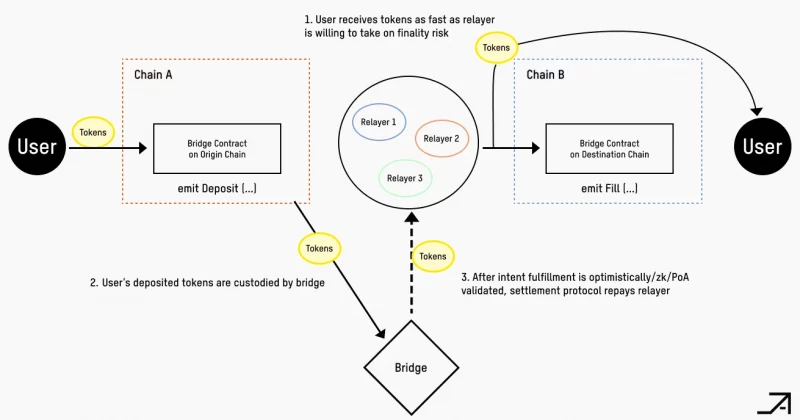
The architectural backbone of the OIF rests on three fundamental contract types: InputSettler, OutputSettler, and Oracle contracts. The InputSettler is responsible for receiving and validating incoming intent requests from a source chain. The OutputSettler then facilitates the execution of the intent on the destination chain, ensuring that the agreed-upon actions are carried out. Oracle contracts, a vital component in any decentralized system interacting with external data, are integrated to provide reliable and secure information necessary for the fulfillment of cross-chain intents, such as asset prices or network states. These core contracts are interconnected and orchestrated by the interoperability SDK, which acts as the glue that binds the different components together, abstracting away much of the underlying complexity for developers.
Furthermore, the OIF is built upon the foundation of the ERC-7683 standard, a community-driven initiative that defines a standardized structure for representing and processing cross-chain intents. This standardization is paramount for ensuring that intents submitted on one chain can be understood and acted upon by solvers operating on other chains. When a user expresses an intent – for instance, initiating a cross-chain token swap from Ethereum to Optimism – this intent is submitted to the OIF. Subsequently, a competitive ecosystem of "solvers" springs into action. These solvers are independent entities that race against each other to fulfill the user’s request in the most efficient and cost-effective manner possible. This competitive dynamic incentivizes solvers to optimize their operations, driving down transaction costs and improving execution speeds for users.
Early Deployments and Performance Metrics
The practical implementation of the OIF is already underway, with initial deployments successfully established on several prominent testnets. Notably, the framework is live on Ethereum Sepolia and Optimism Sepolia, allowing developers and the broader community to test and experiment with its capabilities in a controlled environment. These early deployments are crucial for identifying potential issues, gathering feedback, and refining the framework before a full mainnet rollout.
Under optimal network conditions, the performance observed in these early stages is highly promising. Solver-filled orders, representing completed cross-chain intents, are consistently being fulfilled within a timeframe of 10 to 60 seconds. This rapid execution speed is a significant improvement over many existing cross-chain solutions and is critical for applications requiring near real-time interactions, such as decentralized exchanges and gaming platforms. The efficiency is a direct result of the competitive solver market and the optimized architecture of the OIF.
Coinbase Payments Joins as a Core Contributor
A pivotal moment in the OIF’s trajectory arrived in September 2025 with the announcement that Coinbase Payments, the payments division of the globally recognized cryptocurrency exchange Coinbase, had become a core contributor to the framework. This endorsement from a major industry player provides substantial validation for the OIF’s mission and technical merit. Coinbase Payments’ involvement is specifically focused on leveraging the OIF to help standardize cross-chain asset transfers, a critical area for improving user experience and unlocking new possibilities for digital asset management.
The decision by Coinbase to actively contribute to an open-source, neutral standard highlights a growing trend within the industry towards collaborative development and shared infrastructure. By participating in the OIF, Coinbase Payments signals its commitment to fostering a more interconnected and interoperable blockchain ecosystem, rather than pursuing a proprietary solution. This collaboration is expected to accelerate the adoption of the OIF and introduce its capabilities to a wider audience of users and developers.
A Philosophy of Modularity and Permissionlessness
A cornerstone of the Open Intents Framework’s design philosophy is its inherent modularity and permissionless nature. This means that any development team or individual can deploy, extend, and build upon the OIF’s smart contracts and protocols without requiring explicit approval from a central governing body or consortium. This open approach fosters innovation and prevents the creation of walled gardens that could hinder broader adoption.
The absence of a dedicated governance token is a deliberate and significant design choice. This means there is no associated cryptocurrency asset that dictates control, voting power, or economic incentives within the framework itself. This decision strongly reinforces the OIF’s positioning as neutral, foundational infrastructure. For developers, this translates into a more predictable and stable environment. They are not required to navigate complex tokenomics, understand staking mechanisms, or contend with fee structures that could be subject to the fluctuating outcomes of token holder votes. This allows developers to focus on building innovative applications rather than managing the intricacies of a protocol’s native token.
Moreover, the lack of a token means there is no direct, built-in financial incentive mechanism designed to bootstrap a network of solvers and participants. Instead, the OIF relies on the fundamental economic principles of competition. Solvers are motivated to participate and operate efficiently because they stand to profit from successfully fulfilling user intents. This profit motive, coupled with the competitive pressure to offer the best execution prices and speeds, is the driving force behind the framework’s operational effectiveness. This approach aligns with the broader ethos of building decentralized systems that are self-sustaining and driven by market forces rather than artificial token incentives.
Technical Foundation and Future Development
The OIF’s technical foundation is robust and built for scalability and extensibility. Production-ready contracts have already been successfully deployed across various testnets and are in the process of being audited. Audits are a critical step in ensuring the security and reliability of any blockchain protocol, especially one dealing with the transfer of assets and execution of transactions across multiple chains. These rigorous security assessments are ongoing, with additional solver development and optimizations slated for release later this year.
The framework’s architecture is designed to accommodate a growing number of blockchains and evolving interoperability standards. As new chains emerge and existing ones evolve, the OIF’s modular design will allow for their seamless integration. The focus on open-source development ensures that the community can contribute to its improvement, leading to a more resilient and adaptable framework.
The Significance of the "No Token" Approach
The deliberate decision to launch the Open Intents Framework without a dedicated token is a strategic move that carries significant implications for the broader blockchain ecosystem. In an industry often characterized by token-centric projects and the pursuit of native cryptocurrency assets for fundraising and governance, the OIF’s tokenless approach distinguishes it as a pure infrastructure play. This positioning is crucial for establishing trust and broad adoption, particularly among institutional players and established enterprises that may be wary of the volatility and regulatory complexities associated with tokenized ecosystems.
By foregoing a token, the OIF aims to be perceived as a public good, akin to an open internet protocol. Its value proposition lies in its utility and the problems it solves – namely, enabling secure and efficient cross-chain communication – rather than in its speculative potential as an investment. This can foster a more stable and predictable environment for developers and users alike, reducing the risk of governance disputes or economic manipulation that can sometimes plague token-based protocols.
However, the absence of a token also presents challenges. As noted, it removes the immediate financial incentive for early participants to contribute resources and build out the solver network. The success of the OIF will therefore depend heavily on its ability to attract a vibrant and competitive ecosystem of solvers who are motivated by the economic opportunities presented by fulfilling intents. This requires a strong value proposition for solvers themselves, ensuring that the fees they earn are sufficient to cover their operational costs and provide a reasonable profit margin.
Broader Implications for Blockchain Interoperability
The emergence of the Open Intents Framework has profound implications for the future of blockchain interoperability. By providing a standardized, neutral, and open-source solution, the OIF has the potential to break down the current fragmentation of the blockchain landscape. This could lead to a more unified and user-friendly experience for individuals and businesses operating in the decentralized space.
Enhanced User Experience: Users will no longer be constrained by the limitations of single blockchain networks. They will be able to seamlessly move assets, interact with dApps, and execute complex transactions across multiple chains with greater ease and security. This could significantly lower the barrier to entry for mainstream adoption of blockchain technology.
Innovation Acceleration: Developers will have a robust and reliable infrastructure to build upon, freeing them from the need to reinvent cross-chain communication solutions for every new project. This will allow them to focus their efforts on developing novel applications and services that leverage the power of interconnected blockchains.
Increased Network Effects: As more chains and applications adopt the OIF, the network effects will grow exponentially. This will further incentivize participation and drive the development of a more robust and liquid cross-chain economy.
Reduced Risk of Centralization: The permissionless and tokenless nature of the OIF actively works against the centralization of power. By providing a neutral standard, it prevents any single entity from controlling or monopolizing cross-chain communication, fostering a more equitable and decentralized future for blockchain technology.
Institutional Adoption: The framework’s emphasis on neutrality, security, and standardization, coupled with the endorsement from entities like Coinbase, makes it an attractive proposition for institutional investors and enterprises looking to engage with the blockchain space. This could pave the way for wider adoption of blockchain technology in traditional finance and other industries.
The Open Intents Framework represents a significant step forward in the quest for true blockchain interoperability. Its collaborative, open-source, and tokenless approach positions it as a foundational piece of infrastructure that could shape the future of decentralized applications and the broader digital economy. As development continues and adoption grows, the OIF is poised to play a critical role in realizing the full potential of a connected and interconnected blockchain ecosystem.