



Foundry, the industry-leading operator of the world’s largest Bitcoin mining pool, has officially announced its strategic expansion into the privacy-focused cryptocurrency sector with the upcoming launch of a Zcash (ZEC) mining pool. Slated for an April 2026 debut, this new venture is specifically engineered to meet the rigorous demands of institutional investors, publicly traded mining firms, and large-scale enterprise entities. By leveraging the infrastructure expertise that propelled Foundry USA to the top of the Bitcoin mining hierarchy, the company aims to bridge a critical gap in the Zcash ecosystem: the lack of enterprise-grade, North American-based mining facilities that adhere to high standards of transparency and operational security.
The Strategic Pivot Toward Zcash Infrastructure
Foundry’s decision to enter the Zcash market represents a significant maturation of the privacy coin landscape. Historically, privacy-centric assets have occupied a niche corner of the cryptocurrency market, often underserved by the massive infrastructure providers that dominate Bitcoin and Ethereum. However, as institutional interest in diversified digital asset portfolios grows, the need for robust, compliant, and high-performance mining pools has become paramount.
Mike Colyer, CEO of Foundry, emphasized that while Zcash has evolved into a sophisticated asset class suitable for institutional balance sheets, the underlying mining infrastructure has remained fragmented. The forthcoming pool is designed to provide the same level of reliability and professional reporting that has made Foundry USA the preferred choice for North American Bitcoin miners. This move is expected to decentralize the Zcash hashrate further, which has traditionally been concentrated in pools outside of North America.
Understanding Zcash: Privacy, Compliance, and Technical Foundation
Launched in 2016, Zcash was developed by the Electric Coin Company (ECC) and is based on the original Bitcoin codebase. While it shares Bitcoin’s fixed supply of 21 million tokens and its four-year "halving" issuance schedule, it introduces a revolutionary cryptographic tool known as zk-SNARKs (Zero-Knowledge Succinct Non-Interactive Arguments of Knowledge).

Unlike Bitcoin, where every transaction, sender address, and receiver address is visible on a public ledger, Zcash offers "shielded" transactions. These transactions allow users to prove they have the funds and the authority to send them without revealing the sensitive details of the transaction to the public. This functionality is particularly attractive to institutions that require financial privacy for competitive reasons or to comply with data protection regulations, such as GDPR.
The Foundry press release noted that Zcash represents a unique intersection of cutting-edge privacy and compliant digital infrastructure. By offering "viewing keys," Zcash allows users to share transaction details with selected third parties—such as auditors or regulators—ensuring that privacy does not come at the expense of legal accountability.
Analyzing the Recent Surge in Zcash Hashrate
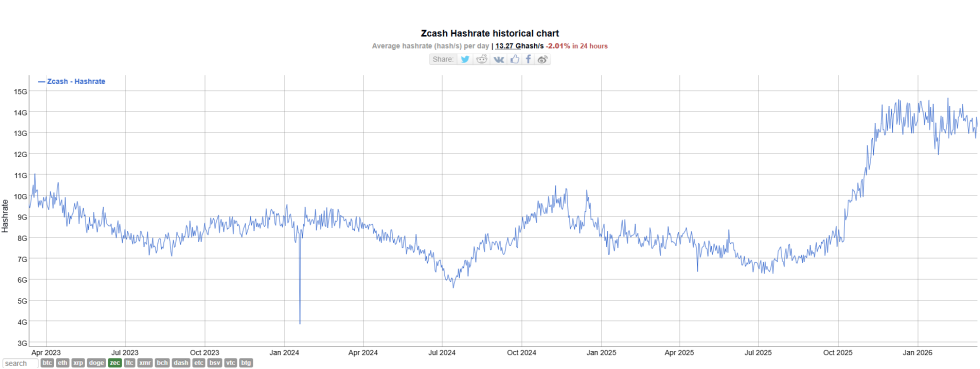
Foundry’s expansion comes at a time of unprecedented growth for the Zcash network. Data from various on-chain analytics platforms, including BitInfoCharts, indicates a substantial "boom" in computing power dedicated to the network. In October 2025, the Zcash hashrate was measured at approximately 8 Gigahashes per second (Ghash/s). By early 2026, that figure surged to over 13 Ghash/s, representing a nearly 63% increase in network security and miner participation in just a few months.
Several factors contribute to this hashrate acceleration:
- Hardware Efficiency: The release of more efficient ASIC (Application-Specific Integrated Circuit) miners tailored for the Equihash algorithm has allowed existing miners to scale their operations.
- Market Realignment: As other Proof-of-Work (PoW) coins face regulatory or technical shifts, miners are seeking established, high-liquidity assets like ZEC.
- Institutional Anticipation: The announcement of Foundry’s entry may be acting as a catalyst, encouraging large-scale operations to begin positioning themselves ahead of the April 2026 pool launch.
A higher hashrate generally signifies a more secure network, as the cost to execute a 51% attack increases linearly with the amount of computing power protecting the chain. For institutional miners, a stable and rising hashrate is a prerequisite for committing significant capital to hardware and electricity contracts.

Chronology of Development and Key Milestones
The path toward the April 2026 launch is marked by several historical and projected milestones that underscore the growth of the Zcash ecosystem:
- October 2016: Zcash officially launches, introducing zk-SNARKs to the blockchain world.
- November 2020: The first Zcash Halving occurs, reducing the block reward and shifting the "Founders’ Reward" toward a new "Development Fund" to support ongoing research.
- August 2025: Strategic internal discussions at Foundry begin regarding the expansion into Equihash-based mining following the continued dominance of Foundry USA in the Bitcoin sector.
- October 2025: Zcash hashrate begins a steady climb from 8 Ghash/s, signaling renewed interest in the protocol.
- March 2026: Foundry officially announces the Zcash mining pool, confirming its commitment to North American institutional-grade operations.
- April 2026: Scheduled launch of the Foundry Zcash pool, coinciding with expected upgrades to the Zcash network protocol.
Official Responses from Industry Leaders
The announcement has been met with enthusiasm from the Zcash community and its supporting organizations. Zooko Wilcox, the founder of Zcash and current Chief Product Officer at Shielded Labs, hailed the move as a landmark moment for the coin’s maturity. Shielded Labs, an independent organization based in Switzerland, serves as a pillar of support for the ZEC ecosystem.
"We at Shielded Labs are delighted that Foundry—the largest Bitcoin mining pool, and one based in North America—is launching an enterprise-grade Zcash mining pool," Wilcox stated. He noted that the presence of a US-based, institutional-focused pool operator would likely attract a new tier of miners who were previously hesitant due to the lack of "white-glove" service providers in the privacy coin space.
The collaboration highlights a growing trend of North American infrastructure providers seeking to dominate the global mining landscape across multiple protocols, not just Bitcoin. By providing a compliant bridge for US-based miners, Foundry is positioning itself as a central hub for the next generation of institutional proof-of-work mining.
Market Performance and Economic Implications
Despite the positive infrastructure news, the price of Zcash has experienced recent volatility. At the time of the announcement, ZEC was trading at approximately $209, reflecting an 11% decline over a seven-day period. This retracement follows a period of recovery, suggesting that the market is currently in a consolidation phase.
For miners, the economics of Zcash are governed by the relationship between the ZEC price, network difficulty (which rises with the hashrate), and electricity costs. The introduction of the Foundry pool could potentially stabilize these economics by providing more consistent payouts and lower fee structures for high-volume miners. Furthermore, the 21 million supply cap ensures that Zcash remains a disinflationary asset, a characteristic highly valued by institutional "macro" investors who view PoW coins as a hedge against fiat currency debasement.
Broader Impact on the Privacy Coin Sector
Foundry’s entry into Zcash mining is more than just a business expansion; it is a signal to the broader financial industry regarding the legitimacy of privacy-preserving technology. In recent years, privacy coins have faced delisting from several centralized exchanges due to regulatory pressures in jurisdictions like Japan and parts of Europe. However, by framing Zcash as an "institutional-grade asset" supported by a major US infrastructure player, Foundry is effectively challenging the narrative that privacy and compliance are mutually exclusive.
The implications for the industry are profound:
- Regulatory Clarity: Foundry’s involvement may prompt more explicit guidelines from US regulators regarding the mining of privacy coins by public companies.
- Technological Standardization: As more institutional miners enter the fray, there will be increased pressure for standardized reporting and auditing tools that can navigate "shielded" blockchain data without compromising user privacy.
- Competitive Landscape: Other major pools may feel compelled to follow Foundry’s lead, potentially leading to a "hashrate war" in the Zcash space that could further secure the network.
As the April 2026 launch approaches, the cryptocurrency industry will be watching closely to see if Foundry can replicate its Bitcoin success within the privacy sector. If successful, the move could redefine the role of North American miners in the global digital asset economy, proving that even the most private blockchains can find a home within a transparent, institutional framework.














