Institutional adoption of Ethereum is entering a new phase of market offense, looking past short-term price volatility and internal debates within the foundation. This strategic shift signifies a maturing ecosystem where foundational development is increasingly complemented by robust go-to-market initiatives from independent stewards, all while the core network continues to demonstrate remarkable resilience and growth.
Ethereum’s Ascendance in Global Finance
Joseph Chalom, CEO of Sharplink (Nasdaq: SBET) and former head of digital asset strategy at BlackRock, articulated a compelling vision for Ethereum’s current market position. He asserted that Ethereum is not merely a cryptocurrency but a foundational layer for critical global financial infrastructure. According to Chalom, the network unequivocally dominates global stablecoin settlement, the burgeoning field of tokenized real-world assets, and high-value decentralized finance (DeFi) transactions. This dominance is not accidental but a result of continuous development and strategic foresight.
Chalom drew a powerful parallel between Ethereum’s evolutionary trajectory and that of early Amazon. He pointed to a consistent track record of significant base-layer upgrades, including the highly impactful EIP-1559 (which introduced fee burning and improved fee predictability), the recent Dencun upgrade (focused on scaling and reducing transaction costs for Layer 2 solutions), the upcoming Pectra upgrade (aiming to further enhance interoperability and efficiency), and the planned Fusaka upgrade. These advancements, he argued, are systematically expanding Ethereum’s "true addressable market" to encompass the entirety of the global financial ecosystem. This perspective suggests that the network is not just improving itself but actively laying the groundwork for a new financial paradigm.
The CEO further elaborated on the investment philosophy driving this expansion, noting that "smart money" – referring to experienced and well-informed investors – operates counter-cyclically. This approach mirrors historical capital allocation strategies employed by legendary investors like Warren Buffett, who famously advocated for buying assets when they are out of favor. It also aligns with the strategic infrastructure investments made by major financial institutions like BlackRock in the wake of significant market events, such as the FTX collapse. This indicates a long-term, conviction-based approach to investing in Ethereum and its associated ecosystem.
Decentralization of Leadership and Operational Focus
As the Ethereum Foundation strategically narrows its operational focus towards core "CROPS" properties – Censorship Resistance, Openness, Privacy, and Security – a parallel trend of independent ecosystem stewards assuming go-to-market leadership has become evident. This division of labor allows the Foundation to concentrate on the deep technical underpinnings of the network, while external entities drive adoption, application development, and market penetration.
This new wave of leadership is spearheaded by a consortium of influential entities. Sharplink, under Chalom’s direction, is at the forefront, with upcoming Research & Development initiatives aimed at further solidifying Ethereum’s position. The company is also actively participating in the broader financial landscape, highlighted by its involvement in a $125 million DeFi yield fund managed in partnership with Galaxy Digital, a prominent digital asset investment firm. Other key players actively expanding their advocacy and development efforts include Consensys, a leading Ethereum software company; BitMine, an investment firm focused on digital assets; Nethermind, a prominent Ethereum client developer; and prominent DeFi protocols like Aave and Morpho. These entities are collectively building out the practical applications and market infrastructure that leverage Ethereum’s core capabilities, translating technological innovation into tangible financial services.
Affirmations from Key Figures and Visionary Roadmaps
The structural decentralization of leadership and the increasing focus on real-world applications have garnered support from key figures within the Ethereum community. Joseph Lubin, a co-founder of Ethereum, affirmed this trend, noting that traditional financial hubs are increasingly choosing the network as their preferred infrastructure. Lubin stated that these institutions are strategically covering their bases and preparing to launch live products, signaling a significant influx of institutional capital and activity. He confidently predicted that "the surge is coming," indicating an imminent period of accelerated growth and adoption.
This shift in operational strategy and leadership aligns perfectly with the long-term vision articulated by Ethereum co-founder Vitalik Buterin. Buterin has consistently advocated for the Ethereum Foundation to operate as a "limited node" rather than a centralized authority. This model ensures that the Foundation’s influence is primarily focused on core research and development, preventing it from becoming a bottleneck or an overly dominant force. The day-to-day execution of the Foundation’s mandate is primarily managed by the CSA operator @aerugoettinea, with a steadfast prioritization of technical longevity and robustness over the breadth of its direct involvement. This focused approach is reflected in the Foundation’s current holdings, which represent approximately 0.16% of the total ETH supply, a testament to its commitment to decentralized governance and asset management.
Buterin himself, a prominent figure whose personal financial interests are deeply intertwined with the success of Ethereum, continues to contribute to the network’s future. He notably holds nearly 90% of his net worth in ETH, demonstrating his profound conviction in the asset. However, he has also acknowledged that his personal influence over the network’s direction is gradually decreasing, a natural consequence of its increasing decentralization and the growing maturity of its governance. His core roadmap for Ethereum’s future development emphasizes several critical areas: the integration of AI-assisted formal verification to ensure bug-free smart contract code, the development of robust consensus mechanisms resilient against sophisticated attacks (such as 49% attacks), and the strict minimization of intermediaries through initiatives like EIP-8141. Furthermore, he is actively supporting Raul’s work on erasure-coded P2P scaling, a vital component for enhancing the network’s capacity and efficiency.
Robust Network Fundamentals and Shifting Market Dynamics
Beyond the strategic and developmental advancements, the underlying network fundamentals of Ethereum remain exceptionally strong, painting a picture of sustained health and increasing utility. Usage metrics have recently hit all-time highs, indicating a growing number of users and applications actively engaging with the network. This surge in activity is occurring concurrently with record-low transaction fees, a direct benefit of recent upgrades and ongoing scaling solutions. The increasing demand for block space, coupled with the economic incentives of staking, has also led to a growing staking queue, with significant entities like Fundstrat reportedly staking 80% of their holdings. This indicates a high level of institutional confidence in the long-term value proposition of ETH.
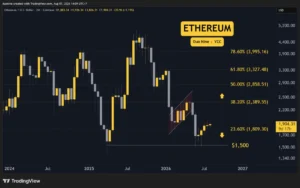
This robust network activity and the strategic shift in holdings have been analyzed by market observers. Former BlackRock Vice President John Gillen described the current phase as a significant transfer of supply from short-term speculators to high-conviction hands. This indicates that investors who are more focused on the long-term potential of Ethereum are accumulating the asset, potentially absorbing selling pressure from more transient market participants. This fundamental strength is currently playing out against a backdrop of fluctuating spot prices. Santiment data recently revealed that Ethereum had slipped below the $2,000 mark for the first time since late March 2024.
Interestingly, despite the price dip, retail sentiment has exhibited a counterintuitive reaction. Instead of widespread fear, there has been an eruption of optimistic "buy the dip" calls across social media and online forums. While this sentiment might appear positive on the surface, historical analysis of market cycles suggests that such extreme crowd optimism at price bottoms can sometimes indicate that the local floor has further to fall, as it often reflects a herd mentality rather than a deeply informed conviction. However, the underlying strength of the network and the accumulation by long-term holders suggest that this price fluctuation may be a temporary market adjustment rather than a sign of fundamental weakness.
The ongoing developments within the Ethereum ecosystem, from foundational upgrades to the emergence of new leadership in market adoption, coupled with strong network fundamentals, suggest a network poised for continued growth and integration into the global financial system. The strategic decentralization of responsibilities within the Ethereum community, with the Foundation focusing on core infrastructure and independent entities driving market engagement, represents a maturation of the ecosystem that bodes well for its long-term success. The interplay between technological advancement, strategic investment, and evolving market dynamics will continue to shape Ethereum’s trajectory in the coming years.