



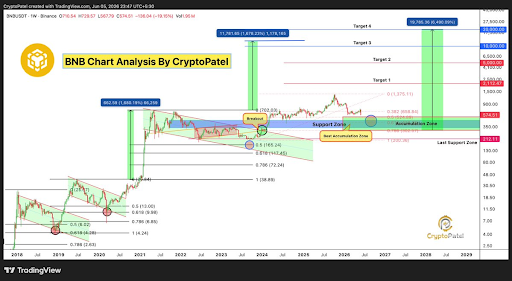
The digital asset market has witnessed a significant shift in its hierarchy as BNB, the native utility token of the BNB Chain ecosystem, successfully reclaimed its position in the upper echelons of the cryptocurrency rankings. By surpassing XRP in market capitalization during the second quarter of the year, BNB has signaled a robust recovery following a period of intense regulatory scrutiny and market volatility. However, as the asset consolidates its gains, the focus of the investment community has shifted from its rivalry with XRP to a much more ambitious question: the feasibility of a five-figure price valuation. A comprehensive analysis of the token’s trajectory suggests that while a return to previous record highs and a push toward $2,000 remains within the realm of technical possibility, the more hyperbolic targets of $10,000 to $20,000 per token would necessitate a fundamental expansion of the global cryptocurrency market cap that far exceeds current valuations.
The Mathematical Framework of a $10,000 BNB
The primary hurdle for BNB reaching the $10,000 threshold is not merely a matter of investor sentiment or technical indicators, but one of basic market mathematics. Crypto Patel, a prominent market analyst, recently provided a breakdown of these valuations, highlighting the disconnect between speculative targets and economic reality. As of the current market cycle, BNB maintains a market capitalization of approximately $80.6 billion, securing its spot as the fourth-largest cryptocurrency by market cap, trailing only Bitcoin (BTC), Ethereum (ETH), and the stablecoin USDT.
To understand the scale of growth required for a $10,000 price point, one must look at the circulating supply and the asset’s burn mechanism. The BNB ecosystem utilizes a programmatic "Auto-Burn" system designed to reduce the total supply of the token to 100 million. At this target supply level, a price of $10,000 per token would result in a total market capitalization of $1 trillion. To put this into perspective, a $1 trillion valuation is roughly equivalent to the entire market capitalization of Bitcoin at various points during its 2024 recovery. Essentially, for BNB to reach $10,000, it would need to achieve a level of dominance and capital inflow comparable to that of the world’s first and largest cryptocurrency.

The projections become even more strained when examining the $20,000 target. At a $20,000 price point, BNB would command a $2 trillion valuation. This figure is particularly striking because it matches or exceeds the total combined market capitalization of the entire cryptocurrency sector during many of its historical phases. As Patel noted in his analysis, any entity or analyst promoting a $20,000 price target in the near term is likely engaging in marketing rather than objective financial analysis. For such a valuation to manifest, the total crypto market cap would likely need to expand into the tens of trillions of dollars, representing a massive shift in global liquidity toward digital assets.
The Battle for Second Place: Can BNB Overtake Ethereum?
While the $10,000 target remains a long-term aspiration, a more immediate milestone involves the competition between BNB and Ethereum. Having already distanced itself from XRP, the next logical target for BNB in the rankings is the #2 spot currently held by Ethereum. The "flippening" of Ethereum by BNB is a frequent topic of debate among Binance ecosystem proponents, but the structural gap remains substantial.
Based on current supply metrics, for BNB to match Ethereum’s valuation—which is approximately $203 billion in the current snapshot—it would need to trade at a price of roughly $1,500. This target is significant because it aligns closely with the projected all-time high zones identified in various technical models. However, this comparison assumes a static market where Ethereum’s price remains unchanged while BNB surges. In a realistic market recovery scenario, Ethereum would likely benefit from the same "rising tide" of capital, moving its own market cap target further away.
For BNB to truly overtake Ethereum, it would need to demonstrate superior growth in utility, on-chain activity, and institutional adoption. Currently, Ethereum remains the primary hub for Decentralized Finance (DeFi) and Non-Fungible Tokens (NFTs), though BNB Chain has made significant strides in stablecoin transaction volume and the integration of Real-World Assets (RWAs). The total value of RWAs on the BNB Chain recently hit a milestone of $3 billion, suggesting that the ecosystem is successfully diversifying its use cases beyond simple exchange utility.

Chronology of BNB’s Market Evolution
The journey of BNB from a simple exchange-based discount token to a top-tier layer-1 blockchain asset is marked by several pivotal moments:
- July 2017: BNB is launched via an Initial Coin Offering (ICO) as an ERC-20 token on the Ethereum network, primarily used for fee discounts on the Binance exchange.
- April 2019: The launch of Binance Chain marks the migration of BNB to its own native blockchain, evolving the token into a utility asset for a decentralized exchange (DEX).
- September 2020: The introduction of Binance Smart Chain (BSC) brings smart contract functionality and EVM compatibility, allowing BNB to compete directly with Ethereum in the DeFi space.
- 2021-2022: BNB reaches an all-time high of approximately $690, driven by the explosive growth of PancakeSwap and other BSC-based protocols.
- 2023: The ecosystem faces its most significant challenge as Binance enters into a multi-billion dollar settlement with the U.S. Department of Justice (DOJ) and the Commodity Futures Trading Commission (CFTC), leading to a change in leadership from founder Changpeng Zhao to Richard Teng.
- May 2024: BNB successfully overtakes XRP in market cap rankings, signaling a return of investor confidence in the post-settlement era.
The Binance Concentration Risk and Structural Obstacles
A critical factor that analysts like Crypto Patel emphasize is the "Binance concentration risk." Unlike Ethereum, which is highly decentralized with various independent development teams and a wide array of institutional backers, the value proposition of BNB remains inextricably linked to the success and regulatory standing of the Binance exchange.
The primary drivers for BNB’s value—including the burn mechanism, trading fee discounts, Launchpad participation, and institutional custody—all flow through or are adjacent to Binance. This creates a centralized point of failure. Any significant regulatory action or negative sentiment directed at the exchange tends to have a direct and proportional impact on the price of BNB. While the 2023 settlements provided some level of "regulatory clarity," the exchange continues to navigate complex legal landscapes in multiple jurisdictions, including ongoing pressure from the U.S. Securities and Exchange Commission (SEC).
Furthermore, the path to $3,000 and beyond requires more than just exchange utility. It requires the BNB Chain to function as a truly independent and decentralized infrastructure. The growth of opBNB (a Layer-2 scaling solution) and BNB Greenfield (a decentralized storage provider) are attempts to broaden the technical appeal of the network, but the market still largely views BNB as a "proxy" for Binance’s corporate success.
Institutional Sentiment and the Role of ETFs
The potential for BNB to reach higher price targets is also tied to the evolving landscape of institutional investment. Recently, amendments by major asset managers like Grayscale and VanEck regarding altcoin-related products have sparked rumors of a potential BNB Exchange-Traded Fund (ETF). While a Bitcoin ETF has already been approved and an Ethereum ETF is in the process of entering the market, a BNB ETF would represent a massive bridge to traditional finance capital.
Institutional adoption would provide the liquidity necessary to push BNB toward the $2,000 and $3,000 levels. Without the "stamp of approval" from institutional custodians and the ease of access provided by ETF structures, reaching a $1 trillion market cap remains a mathematical improbability in the current environment.
Broader Impact and Future Outlook
The analysis provided by Crypto Patel offers a grounded perspective in an industry often dominated by "moon" predictions. The most believable "bull case" for BNB involves reclaiming its previous highs and establishing a new floor above $1,000, eventually pushing toward $3,000 during the next major market expansion. The trajectory toward $20,000, while appearing on some long-term charts, is projected for 2029 or later, assuming a decade of uninterrupted growth and a massive increase in the global adoption of blockchain technology.
For investors, the takeaway is one of cautious optimism tempered by structural reality. BNB has proven its resilience by surviving the regulatory onslaught of 2023 and reclaiming its status as a top-four asset. Its burn mechanism provides a deflationary tailwind, and its ecosystem remains one of the most active in terms of retail users. However, the path to a $10,000 valuation requires BNB to not only grow as an asset but for the entire cryptocurrency industry to mature into a multi-trillion-dollar pillar of the global financial system. Until the "Binance concentration risk" is fully mitigated through further decentralization and the market cap of the entire sector expands significantly, the five-figure targets remain a distant, albeit mathematically defined, horizon.














